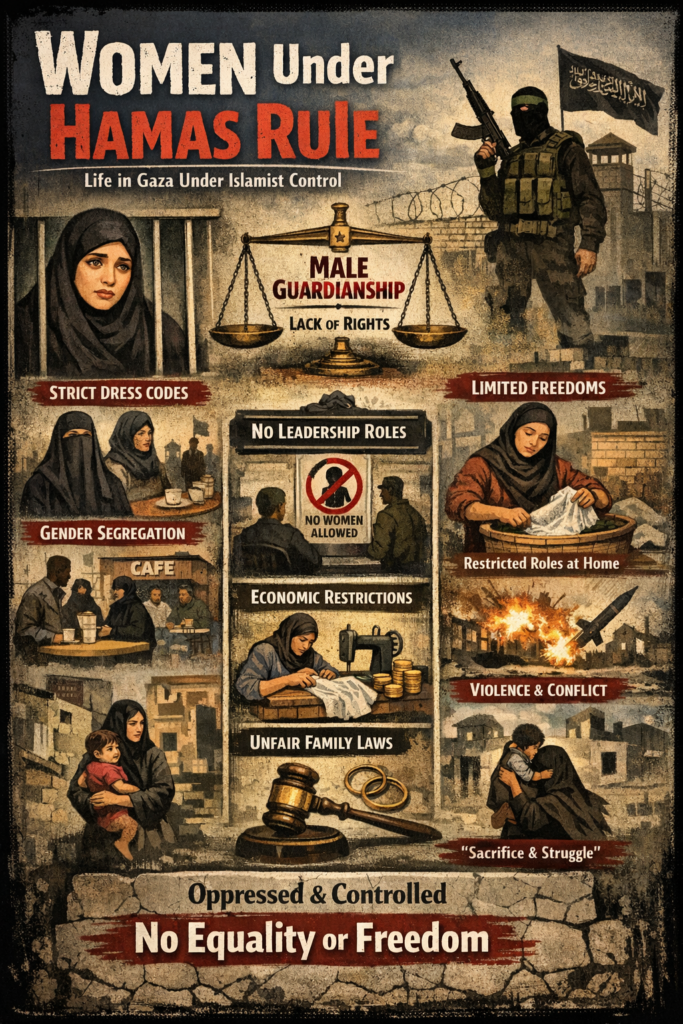
In debates about the Israel–Gaza conflict, attention often focuses on geopolitics, military operations and humanitarian suffering. Less frequently examined is the condition of women under the rule of Hamas, the Islamist movement that has governed Gaza since 2007. What is true is that the treatment of women is a revealing measure of any political order. On this test, Hamas represent an ideological framework and governing practice that place women in a subordinate and tightly controlled social role.
Hamas’s worldview is rooted in a conservative Islamist interpretation of social order that emphasises male guardianship, traditional gender roles, and strict codes of so-called public conduct. In Gaza this has translated into social policies and informal enforcement practices that limit women’s autonomy in everyday life. Dress codes, gender segregation in public spaces, and pressure on women to conform to conservative norms have been widely reported. While some of these practices reflect broader cultural dynamics within Palestinian society, this shows the society is not dynamic in being able to adjust to principles of social equality, and also shows that the governing authority of Hamas has reinforced and institutionalised rigid norms through both formal rules and informal coercion.
The consequences extend right into the economy and enabling women to have economic / financial independence. Women’s participation in the labour market remains low, and their access to leadership positions in politics, business and public life is limited. Legal and social frameworks governing marriage, divorce and custody also tend to favour men. In such an environment, women’s roles are frequently framed in terms of family, motherhood and national struggle (producing fighters for the future) rather than as independent citizens with equal rights and opportunities.
The militarisation of Gaza further deepens these dynamics. In a territory shaped by blockade, repeated conflict and economic hardship, civilian life is affected by the presence of armed groups and the infrastructure of war. Women often bear the disproportionate burdens of displacement, care-giving, and social instability during periods of violence. This is even more so when men can simply terminate marriage relationships. The framing of sacrifice and endurance of women as part of national resistance simply obscures the gendered negative impact of the reality if a Hamas order.
A full understanding of life in Gaza must acknowledge the internal social structures that shape daily existence, including the constraints placed on women. There is a principle here that is worth considering. It is that political movements and governing authorities should be evaluated on how they treat the people under their rule. Women’s rights, in particular, are often a clear indicator of the broader character of a political system.
Any durable vision of progress in Gaza must also address the status of women within that society. A political order that limits women’s autonomy, participation, and voice cannot plausibly claim to represent genuine liberation or justice. Instead, it leaves scope for misogyny to flourish.
https://substack.com/profile/152321377-perspective-undercurrents-pu/note/c-223669626