Have you ever wondered about diplomat’s memoirs? Diplomats when they leave their embassies, surrender their credentials but in their minds they do not leave behind what they know. Their memories remain filled with private assurances, strategic doubts and moments of candour that were never meant for public view. This is why diplomatic memoirs are unlike ordinary autobiographies. They are not simply stories of a life lived, but records of extended trust not only between diplomat and state, but between states themselves.
Governments understand this intuitively, and they regulate diplomatic memoirs accordingly. Across the world, Ministries of Foreign Affairs or the like require both serving and retired diplomats to seek permission before publishing accounts drawn from their official experience. This is not bureaucratic pettiness. It reflects a truth about diplomacy that confidentiality is not a temporary condition of employment, but a permanent obligation of stewardship. When a diplomat speaks, even years later, their words can still shape the perceptions, calculations and trust of other nations.
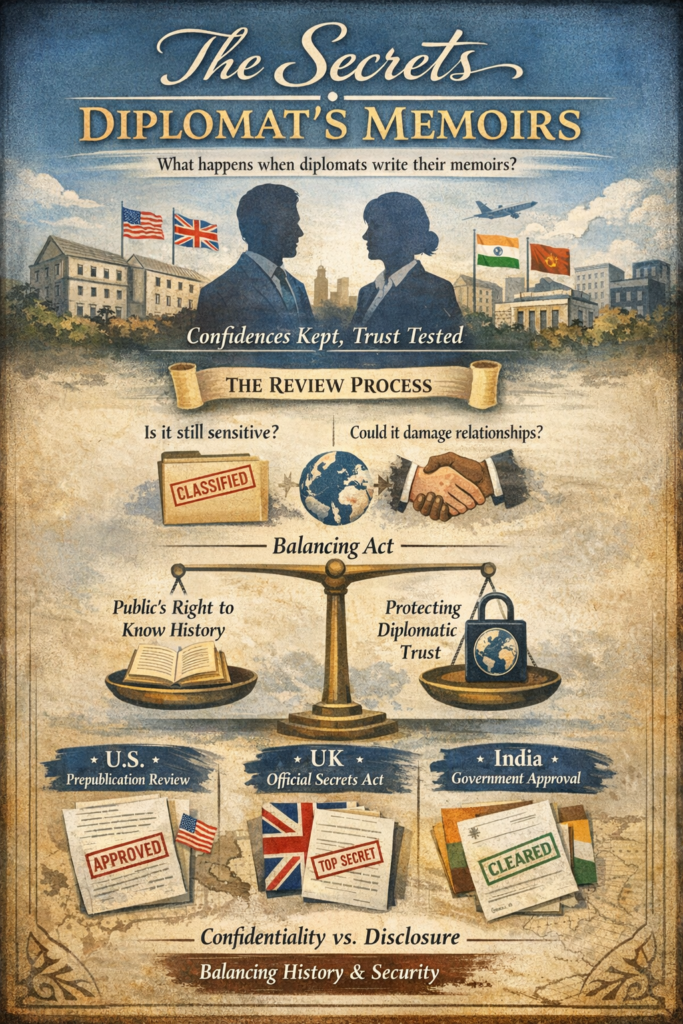
However, diplomats do like to write about their experiences. So, this is where an initial review process comes into play. The review process is guided by two fundamental questions.
- First, does the memoir reveal information that remains confidential, either legally classified or diplomatically sensitive? Diplomacy depends on candour, which is based on the assumption that difficult truths can be spoken privately without fear of future exposure. If that expectation collapses, diplomacy itself becomes cautious and ultimately less effective.
- Second, governments ask whether publication could harm relationships that remain strategically or politically important. A memoir that embarrasses a foreign government, reveals negotiating tactics, or exposes private disagreements may satisfy historical curiosity, but it can also quietly damage the fragile architecture of international trust.
Different countries enforce these principles with varying degrees of rigour, but the underlying logic is remarkably consistent.
- In the United States, former diplomats must submit memoirs for prepublication review to ensure sensitive information is not disclosed.
- In the United Kingdom, the Official Secrets Act 1989 imposes lifelong obligations of confidentiality, reinforcing the idea that certain knowledge cannot simply be reclaimed as private property.
- India similarly requires prior government approval for memoirs based on diplomatic service.
These systems do not exist to prevent diplomats from speaking, but to ensure that when they do, they do not inadvertently weaken the very relationships they once worked to build.
There is, of course, a tension here, which is between:
- the public’s legitimate interest in understanding how diplomatic decisions were historically made in its name, and
- the state’s need to safeguard its current and future diplomatic relationships and strategic interests.
Diplomatic memoirs can illuminate how decisions were made, expose failures, and humanize the opaque machinery of foreign policy. They can serve as acts of historical clarification, even moral reckoning. But they can also reopen old wounds, embarrass allies, and complicate negotiations that continue long after the memoirist has left the diplomatic mission.
This tension is an inevitable consequence of diplomacy itself, which operates in the space between secrecy and accountability. Democracies depend on transparency, but diplomacy depends on discretion. The regulation of diplomatic memoirs represents an attempt to balance these competing imperatives, that is to allow history to be told without undermining the trust upon which future diplomacy depends.
In the end, the restrictions placed on diplomatic memoirs are less about controlling speech than about preserving credibility. Diplomacy functions because states believe that private exchanges, through diplomats, will remain private. If private assurances can later be publicly disclosed, diplomats will no longer speak with full candour to each other. Negotiations will become guarded, relationships will become brittle, and the quiet work of preventing conflict becomes harder.
A diplomat’s career may end, but their obligations do not. Importantly, what they know was entrusted to them not as individuals, but as representatives of a state that sometimes has to navigate its way through some parts of a dangerous and uncertain world. A diplomat’s memoir, for all its value, simply has to yield to a deeper responsibility to the state. Of course, In diplomacy, confidentiality is not merely professional etiquette, it is the foundation of the profession itself.
See:
USA – https://fam.state.gov/fam/03fam/03fam4170.html
UK – https://civilservicecommission.independent.gov.uk/wp-content/uploads/2019/03/03a_diplomatic.pdf
International problem solving does still rely on diplomacy, even if not always successful.
https://substack.com/profile/152321377-perspective-undercurrents-pu/note/c-217941929