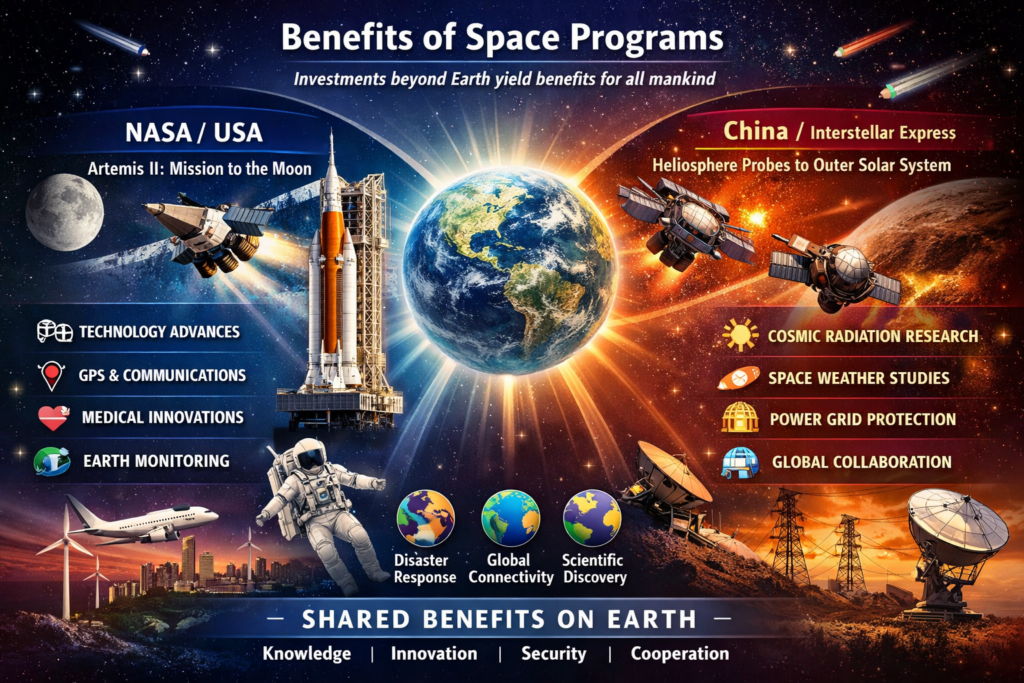
Space exploration has regularly shown that investments for infrastructures beyond Earth, including for travel beyond Earth, yield enduring benefits on Earth. These benefits cover scientific, technological, social, economic, and even culture. The benefits derived often reach well beyond the countries that launch the missions themselves.
NASA/USA
In one of the final milestones before launch, NASA has rolled out the Space Launch System and Orion spacecraft for Artemis II at Kennedy Space Center (USA). This comes after Artemis I, which was an uncrewed test mission, that successfully flew in late 2022. The Artemis II mission will carry four astronauts around the Moon and back (with no landing), marking humanity’s first venture beyond low-Earth orbit since 1972.
This return to lunar exploration is not merely symbolic. Past lunar programs drove advances in materials science, propulsion, computing, telecommunications and systems engineering that reshaped modern life. The Apollo missions accelerated the development of integrated circuits, precision navigation, lightweight composites (strong reinforcing material embedded in a lighter binding matrix) and life-support technologies. Some of these advances later underpinned improvements in commercial aviation and medical devices, among other things, for use on Earth. Lunar exploration also refined large-scale project management, international scientific collaboration, and high-reliability engineering practices that became benchmarks for complex civilian infrastructure.
Today’s renewed focus on the Moon builds on this legacy, while adding the importance of sustainability of space exploration into the future. Artemis II will test this in regard to developing power systems, robotics and radiation protection, and in seeking better resource utilisation. All this is directly relevant to future deep-space missions and to resilience technologies on Earth. In this sense, returning to the Moon represents a deliberate investment in knowledge and capability with enduring scientific, technological and societal returns. Society now expects space missions to also lead to affordable and widely shared technologies on Earth, including in developing countries. This is simply the demand for rational distribution of success that has come about through public funding and exploration of the commons of outer space (including the Moon, Mars and other celestial bodies).
Satellite communications, weather forecasting, GPS-enabled services and Earth-observation tools are all products of space programs. They have transformed disaster response, agriculture, education and connectivity across both the Global North and the Global South. These benefits have not remained confined to the original spacefaring nations; they diffused globally through commercialisation, international cooperation, and open scientific data. Artemis II will continue this tradition by pushing the boundaries of human spaceflight while generating new knowledge and technologies that can spill over into civilian use.
China
At the same time as the NASA rollout, China has released detailed plans for twin missions to the outer Solar System, aimed at studying the heliosphere. This is the vast plasma shield created by the Sun that protects Earth from interstellar radiation. This mission concept is commonly known as China’s Interstellar Express, formally described in scientific literature as the Interstellar Heliosphere Probe (IHP) program. In current plans it consists of two spacecraft, often referred to as IHP-1 and IHP-2, which would launch in the early 2030s (around 2032–2033). They would travel in opposite directions out of the Solar System, and study the heliosphere, including how the Sun’s plasma bubble interacts with interstellar space and shields the Solar System from cosmic radiation.
While the mission has not yet received final government approval, indications are that it has serious backing of China’s government. If launched, these probes would deepen understanding of cosmic radiation and solar activity, knowledge essential not only for future exploration but also for safeguarding satellites, power grids and communications on Earth. Such insights would contribute to global space-weather forecasting capabilities, offering benefits that extend well beyond any single nation and reinforcing the shared scientific value of deep-space exploration.
Conclusion
Together, these two efforts illustrate that space exploration is not a zero-sum prestige contest (though that is present). It is a cumulative human enterprise over time that has already improved lives worldwide and is likely to continue doing so, as new discoveries and technologies spin out to benefit all of humanity. This is the case even though the USA and China are geopolitical rivals.
Still, the scientific knowledge their national space programs generate and the capabilities they develop do contribute to a shared planetary future. It is hoped that the advances made in parallel (as there is no full collaboration between these countries) can reinforce collective resilience, increase understanding, and ensure long-term human security. At the least, space programs of different nations should help to maintain constructive geopolitical relations, foster mutual respect through demonstrated capability, and sustain shared scientific norms, so reducing mistrust and strategic rivalry.
https://substack.com/profile/152321377-perspective-undercurrents-pu/note/c-208215166