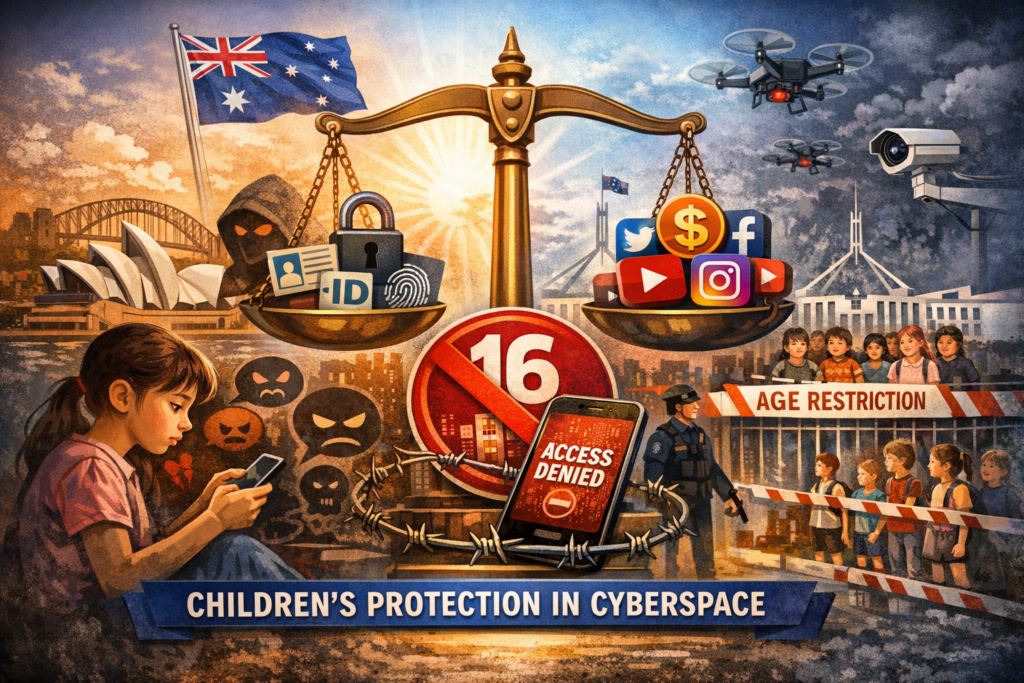
In the digital age, information is a strategic asset, not just content. It can empower and educate, but it can also mislead and harm those who lack the capacity to filter it wisely. Children sit squarely in this vulnerable category. Today, the question is not whether children need protection in cyberspace, but how that protection should be legally structured in a world where technology evolves faster than the law.
Governments have long struggled with this lag. The underlying dilemma is how to reconcile children’s access to digital opportunity with safeguards against exposure to harm. Online environments do expose children to cyberbullying, harmful content and exploitation. Ethical and social norms rightly place primary responsibility on parents to act in the best interests of their children. Yet parental supervision is increasingly strained by the scale, speed and opacity of online platforms.
Australia’s approach reflects a growing recognition that voluntary measures and parental goodwill alone are insufficient in a complex, global information ecosystem. Amendments to the Online Safety Act 2021 (a federal law) in late 2024 introduced a social media minimum age framework, effectively preventing children under 16 from holding most social media accounts. This move reflects a view that systemic risks, such as data harvesting, algorithmic amplification, echo chambers, and peer-to-peer harm, cannot be adequately mitigated by parental oversight alone.
However, the objective is not simply to block access, but to rebalance responsibility. The legislation aims to ensure that children’s online safety is strengthened without creating a system that compels the widespread collection of sensitive personal or government-issued identification, and that online platforms — not parents or children — bear clear legal responsibility for compliance. To this end, platforms must take “reasonable steps” to prevent under-16 users from holding accounts.
Children’s online safety is actually strengthened because many of the most serious digital harms are structurally embedded in those online platforms’ design and business models, rather than arising from isolated user behaviour. The legislation aligns with the yogic moral principle of ahimsa (non-harm). In this regard, ahimsa is not limited to avoiding direct, intentional harm; it also surely requires preventing foreseeable harm that arises from exposure to systems, in this case online platforms.
This matters because currently online platforms design, control and profit from the digital environments in which harms occur. Assigning responsibility for the age restriction measures to platforms aligns legal accountability with actual power and technical capability, rather than outsourcing enforcement to families who lack equivalent tools or leverage. Accordingly, the legislation is intended to have an impact on platforms in Australia by basically saying they need a redesign. Australia’s position now is that children’s online safety is not an optional add-on to innovation, but a core public interest requiring both technological intelligence and legal force.
https://substack.com/@macropsychic/note/c-208739773