E-governance is more than just functions and powers of government and its e-government tools
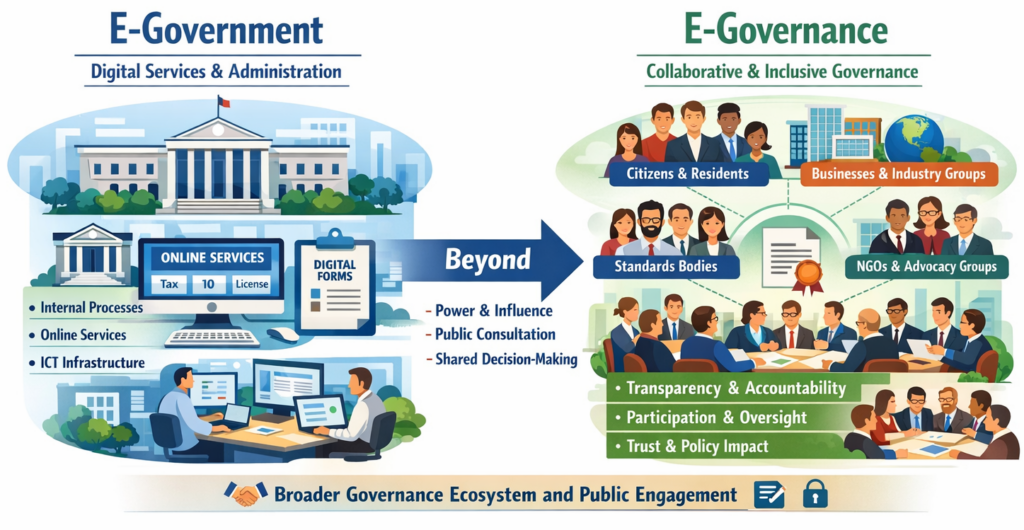
Governance is broader than government; accordingly, e-governance is broader than e-government. Governance extends beyond formal state institutions to include the multiple stakeholders, range of processes (e.g. consultation), and interconnected relationships (e.g. advisory bodies and working groups comprising both government and non-government personnel) that are involved before government decisions are ultimately made. These may also continue to be relevant when decisions are implemented.
How e-governance goes beyond e-government
Likewise, e-governance goes beyond the official digitalisation of government administrative processes and services, encompassing wider interactions of government agencies with citizens and residents, civil society organisations, businesses and their peak bodies, relevant public authorities, and other diverse actors who seek to participate in shaping public outcomes from digitalisation. Consequently, governance and e-governance must address and consider more than the internal functions and powers of government and use of e-government systems. Indeed, e-governance should be concerned with how digital systems could redistribute power in society (both positively and negatively, or simply neutrally), and how they could influence decision-making and shape public trust well beyond the formal boundaries of their use in government agencies.
Importantly, governance frameworks have to recognise diverse actors outside of government. Some of those actors can play a significant role in the governance of certain aspects of society – which could be directly or indirectly. This includes bodies such as standards-setting organisations, professional associations, industry associations, advocacy and lobby groups, domain name and other internet governance bodies, and multi-stakeholder working groups (which also include government personnel). These actors interact extensively with government agencies, and the evidence they provide, tools they use, and instruments they produce can be adopted or embedded within public policy, regulations of all kinds, and administration of government.
Today, interaction online with and between government agencies is huge. E-government is seen in the digitalisation of government processes, operations and services, and the use of information and communication technologies (ICTs) by government agencies to facilitate their operations and deliver services to clients. ICTs have also changed how communications take place internally in government agencies, as well as externally with other governments (e.g. in a federal system) or for the purposes of diplomacy with foreign governments or international (intergovernmental) organisations.
However, e-governance is more than that. It cannot be reduced simply to use of digital technologies within or by the public sector (which actually falls into e-government). Instead, it encompasses and considers the broader ecosystem of digital interactions, their inputs and outputs, feedback loops, accessibility to online services, human use of interfaces for online services (e.g. when applying for social welfare benefits) and how this affects users, as well as transparency and accountability for operation of online services and any errors and mistakes, and much more. Effective e-governance must also ensure that digital systems used in government are auditable, which means examining for regulatory compliance, verifying accuracy, assessing controls, evaluating processes, identifying risks and weaknesses, and providing assurance that digital systems are functioning as intended (or highlighting where they are not).
Furthermore, the design of online services has to be inclusive and responsive to user needs, as poor design can unintentionally exclude or disadvantage users. Some of these matters may well have standards or guidelines set by civil society organisations or these may at least influence governments. So, when it comes to e-governance it is critical to consider how digitalisation of government operations and services, and application of ICTs by government agencies, can enhance the relationship between a government agency and the users of a public online service. This is consistent with participatory democracy.
For this, user friendly or user-centric design is needed for those interacting online with government agencies so as to provide the best user experience. User experience is a matter for e-governance. Also important is enhancing the ways users can interact with government, participate in decision-making processes, and provide feedback on government policies. These are examples of how e-governance focuses on empowering citizens (and residents) through digital means and online interaction.
Distinguishing e-government and e-governance
In terms of operational efficiency, a goal of both e-government and e-governance should be to improve the speed and quality of public online services for the benefit of end-users. The actual technical means of doing so is part of e-government as it is managed internally by the government agency, but the external implications regarding impact on end-users and benefits for them is more a matter of e-governance. So, e-government can focus on making government processes more streamlined, but e-governance is concerned with user friendliness, accountability and transparency.
Regarding online service delivery, e-government initiatives include online tax filing, electronic voting systems, digital licensing systems, and online application forms that have to be completed to access or receive a range of government services or benefits. But, as mentioned, e-governance goes further and requires accountability of such systems, providing confidence to the public in how they work, and transparently explaining the policy reasons for them and expected policy outcomes. Such public openness (the degree depending on security concerns) is important for fostering trust.
A part of e-government is use of digital technologies for making automated decisions regarding individuals or organisations operating in society by using algorithms and artificial intelligence (e.g. they may apply for a licence), along with digital record-keeping. But e-governance goes further with the focus shifting from internal administrative efficiency to the legitimacy and legality regarding automated decision-making, human rights, and where does human oversight come into play, as well as privacy issues and access to and correction of personal information. Again, transparency and accountability are important. E-governance should require automated decision systems to be embedded within transparent, accountable frameworks that allow affected individuals and organisations to understand decisions, challenge outcomes, and even participate in shaping the rules and standards that govern their use, or at least be consulted on them.
Lastly, e-government is about building the necessary digital infrastructure to support online services and internal government functions. Whereas e-governance would call for greater understanding and explanation of infrastructure needs, with some public consultation accordingly. This is important in relation to public-private partnerships that often help build this infrastructure, as well as transparency in procurement processes, and reporting on a regular basis on how money was spent and if within or outside budgeted amounts. These measures foster trust in government.
Conclusion
We can say that e-governance is about the overarching impact of digital technologies on the public, and public involvement and concerns, and that e-government is merely a component of e-governance. E-government being focused on providing online government services and use of ICTs in internal administration, while e-governance strives to create an inclusive environment where various public stakeholders, indeed often in multi-stakeholder scenarios, can contribute to greater governance issues that are relevant to government. Crucially, this broader conception of e-governance emphasises matters such as transparency, accountability, human oversight, and open participatory processes (where relevant), ensuring that digital transformation of government services strengthens democratic legitimacy and public trust.
https://macropsychic.substack.com/p/e-governance-and-e-government

Identity is an indispensable concept for human beings and has to be considered for e-governance purposes, given the increased use of digital IDs. A sufficient description of an individual’s identity distinguishes it from any other individual. When citizens cannot prove their identity to the state, they are not able to verify their eligibility for some public services and benefits. Today, it is common to use online systems to apply for eligibility for certain public services and benefits. So, proving identity online is crucial.
Furthermore, for the state to provide people with public services and benefits, at least for those that require an application and approval process, the public sector must have the means, methods and workflows to manage the state’s population’s identity. This necessarily entails robust governance arrangements to ensure that identity systems are accurate, secure, interoperable and used proportionately, while safeguarding privacy, preventing exclusion or misuse, and maintaining public trust. Again, creating and having a digital identity becomes both an e-government and e-governance matter.
In a digital state, and in relation to public services and benefits, those identities must be handled by the public sector through combining the highest security standards, identity concepts, and user-centric approaches. This is a matter of e-government. From an e-governance perspective, however, digital identity also raises broader issues of legitimacy, trust, consent, interoperability across public and private systems, proportionality of use, and accountability for misuse or exclusion.