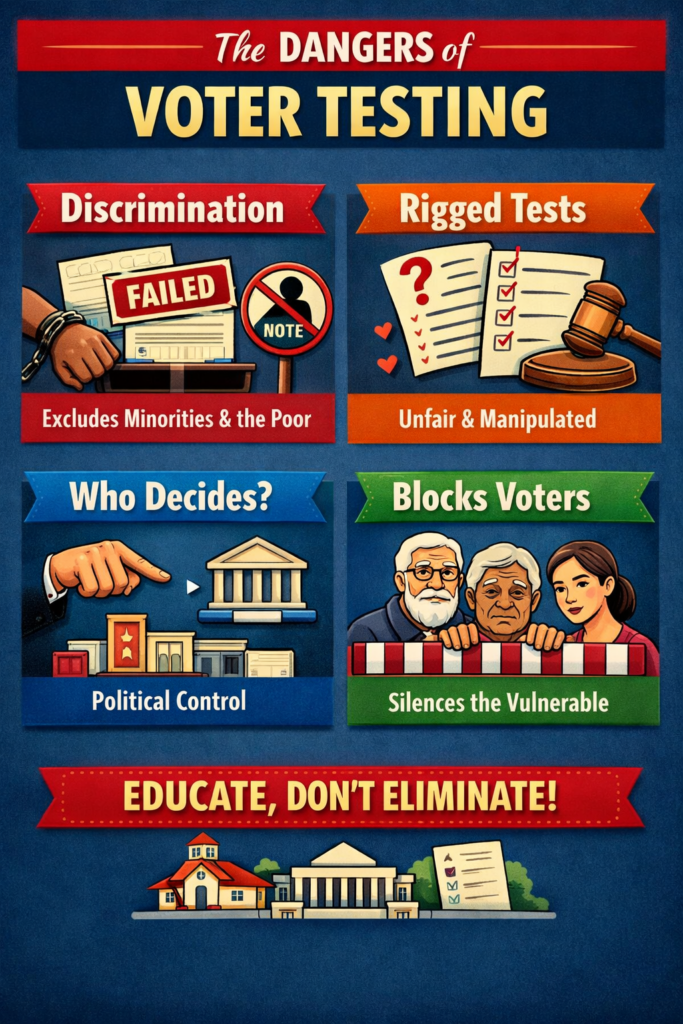
Impractical, litigious and unwise!
Occasionally someone dusts off an old bad idea and presents it as bold reform: What if voters had to pass a test before casting a ballot? Perhaps a literacy exam. Perhaps a civics quiz. Perhaps some supposedly neutral ‘competency’ standard to ensure only the informed participate in democracy. It is often framed as common sense, i.e. why should people vote on matters they do not fully understand?
This raises other questions, such as how much understanding is really required? Isn’t sufficient understanding or basis understanding enough? Isn’t understanding issues in one’s electorate enough when voting for a candidate to represent that electorate, instead of understanding every issue before a national legislature? Isn’t understanding the role of an elected president enough, instead of every issue the president may conceivably deal with?
Questions such as these begin to show that there is a fantasy in expecting voters to be profoundly knowledgeable, and what benefit would it serve when for issues before a legislature usually a whole process is undertaken from policy to final enactment to deal with the issues and debate them. Plus, the issues become known in the process, not necessarily beforehand. What emerges is that behind the voter testing idea is elitism at its core. Somehow it assumes that political wisdom sits neatly with credentialed experts, university graduates, or those who can perform well on a written test. It imagines citizen participation in deciding government would improve if only the ‘right people’ voted, and that some core body is ‘right’ in determining who those ‘right persons’ are. But history shows that once societies begin deciding who is sufficiently qualified to vote, qualification quickly becomes a weapon of exclusion. Indeed, even thinking that the illiterate should not vote is blaming the victim. It produces immediate exclusion.
The United States learned its own lessons about voter exclusion, when certain practices were outlawed after the Civil War (1861–1865). At that time, Southern states introduced poll taxes (a fee to vote), literacy tests (to prove a person can read and understand laws) and grandfather clauses (voting allowed only if a person’s grandfather had voting rights before a certain date.). These were not to elevate civic standards, but to suppress Black citizens and poor whites. Together, these measures were designed to get around protections like the Fifteenth Amendment to the United States Constitution (which said race could not block voting), dramatically reduce Black voter turnout, and maintain white political control in the South by those not poor.
The tests were often absurd, arbitrary and deliberately impossible. Some registrars asked questions like “draw a line around the number or letter of this sentence”. There was also the strategy of selectively passing favoured voters and failing disfavoured ones. The entire machinery was designed not for enlightenment but disenfranchisement. The federal Voting Rights Act of 1965 swept much of that away because such tests were plainly incompatible with the principle of social equality when voting. The core reason for abolishing voting tests was civil rights and equality. It should also be noted that if voter tests had continued there would have been massive litigation against them, wasting public and private funds, and social unrest.
Yet the temptation remains because voter testing flatters a kind of political vanity, for those arguing that there can be better voter tests (not like the flawed ones in the southern United States after the Civil War). But this still means and requires people to think or imagine that some would pass, while those regarded as gullible or uninformed would fail. It is less about raising standards than about quietly shrinking the electorate to resemble what fits the politically vain. A standard voter test would be an absolute disaster. It would be saying think like this and you will pass. It rejects autonomous thought and the variety of thought that is actually needed in politics.
Nor does citizen participation in deciding government depend on every citizen possessing encyclopedic policy knowledge. Most voters are not economists, constitutional scholars, or foreign policy experts. Nor should they need to be. A citizen may know little about central banking but know that the current interest rate is causing financial stress. They may not understand complex crime statistics but know whether their community feels less safe. They may not be able to explain fiscal multipliers (how much the economy changes when the government changes its spending or taxes) yet understand whether government services are improving or deteriorating. In any case, a voter votes in an electorate and their immediate concern is for their electorate. Once a representative is elected for each electorate, it is then up those elected representatives of all the electorates to combine their special skills and take the broader national or state view.
Accordingly, knowledge at election time, for electorate representation in a legislature, does not require a voter to have so much specialist insight on every national issue. Such elections are plain and simple instruments for gaining consent to represent an electorate and for the representative to then be held accountable. As well, ordinary people can judge whether life is getting better or worse, whether leaders are trustworthy, whether promises were kept. They use heuristics, i.e. practical shortcuts, that involve candidate reputation, character judgements, personal experience, the effects of economic conditions, and other relevant factors to make decisions. It may sound imperfect, but across time, broad suffrage has generally produced more stable, prosperous and legitimate political systems than restricted franchises run by self-declared ‘better classes’ or the ‘enlightened’.
There are also a range of matters that are operationally challenging and so destroy the voter-test proposal. Who writes the test? On what basis? How is the testing body appointed? On what basis? Who grades the test? Is there review by a court or tribunal if a person considers that they are adversely affected? Ultimately, who determines what counts as civic competence? Every question becomes contested ideological terrain. Every test gives rise to potential for massive litigation, be it under administrative law or constitutional law or human rights law, particularly given that voting has essentially already reached the human rights standard.
Questions could be legally challenged on grounds of bias, bad faith, irrelevance, uncertainty, improper purpose, unreasonableness, denial of natural justice and other grounds, regardless of one’s politics. A liberal administration might emphasize structural inequality, colonial history, and climate science. A conservative administration might stress constitutional originalism, social or cultural heritage, or market economics. Each test can easily become contested political territory. Failures can become suspect and subject to challenge. Then elections are shadowed by accusations of manipulation. The result would not be a wiser electorate. It would be endless litigation, distrust and suppression. Plus, a huge expensive bureaucracy to manage all the issues and problems. Indeed, taking away voting rights seems most common in steps toward fascism.
Worse still, the effects of voter testing would fall hardest on those already underrepresented, such as shift workers with little spare time, migrants still mastering English, poorer communities historically excluded from power, elderly citizens uncomfortable with formal testing, and younger voters disengaged from civics education. In each case, voter-testing does not better their position, but makes it worse. They would all effectively be blamed as victims. The very people democracy most needs to hear from would face new barriers. They would have no voice. No voice to even ask for social remedy of their position.
If civic ignorance is the concern, and there is reason for concern, the answer is not gatekeeping ballots. It is stronger civic education, better public institutions, more trustworthy media, and political systems that reward honesty and competence rather than spectacle and division. It is primarily up to the education system to raise the awareness of all, and that is where the central task lies in raising social-economic-political consciousness. In short, society has a duty to inform voters, contestants have an obligation to persuade voters.
It is also totally impractical that a government can simply disqualify a mass of people from voting if they do not pass a voting test. That would mean a law to that effect, which would be constitutionally challenged, and also challenged on human rights grounds. And if implemented, there would be enormous administrative law litigation. Voter tests would effectively mean dismantling constitutional protections, reversing human rights law, and making administrative and judicial review impractical. To attempt all this is plainly absurd. Anyone who thinks they can accomplish it, is out of their mind, and has no sense of reality. Their’s is a hypocrite’s psychology — they have an idea they know is flawed and they know they cannot practically implement it. Plus, the whole bureaucracy of voting tests would be a huge public expense. It would really be a cause for social chaos and rebellion, rather than cohesion.
When elites start talking about ‘qualified voting’ it usually signals the end of the principle of social equality, and the start of discrimination. People advocating voter tests clearly do not understand basic practical matters. They are exerting their pent-up frustration in not being able to solve social problems, as if people who are disadvantaged (those who fail the test or are likely to fail the test) are in their way. Such people cannot earn the confidence of society. Their strategy is to narrow participation instead for the sake of their power and dominance. Their impulse is dangerous.
No doubt, voting campaigns can be messy, emotional, often ill-informed, and exasperating. But the cure for flaws in the general franchise is more citizenship involvement, not less. And more education. Restricting the vote to the supposedly deserving is not wisdom. It would result in keeping power, and in this case using the concept of ‘intelligence’ to keep power. Supposedly, this is all done by ‘enlightened’ human beings, who are uncontested in their knowledge and policies. But this is simply another fantasy. It is not reality. It in itself represents a limited concept of intelligence, indeed.
https://substack.com/@macropsychic/note/p-196531263