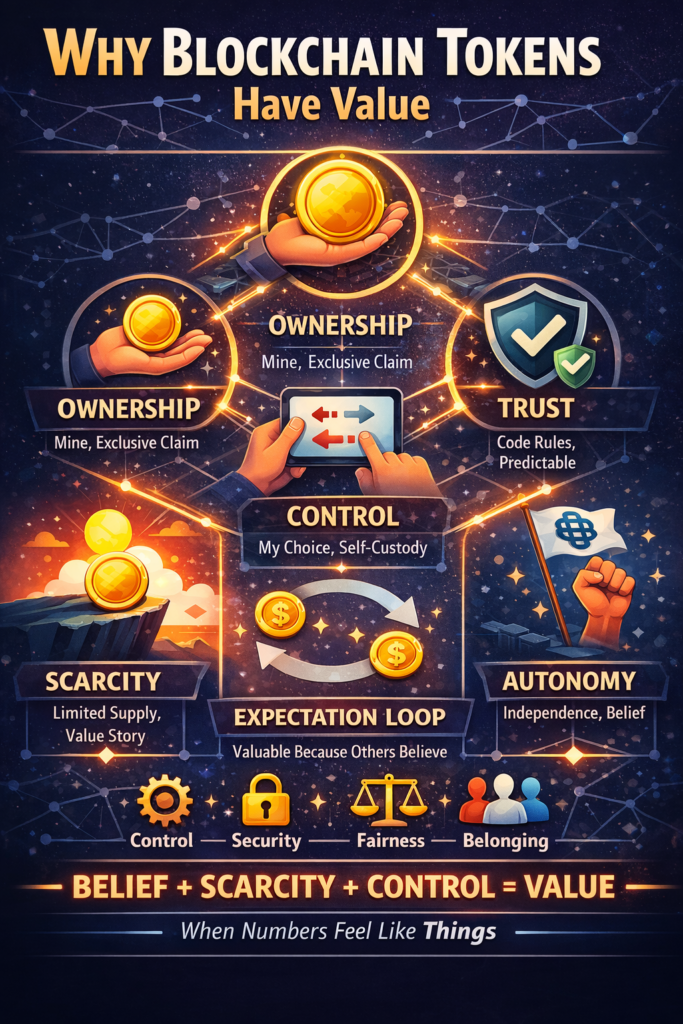
When belief, scarcity and control converge in code, even numbers begin to behave like ‘things’
Tokens are units of value or rights recorded on a blockchain. They can include cryptocurrencies (e.g. native coins), utility tokens, governance tokens, non-fungible tokens (NFTs). Though there is a subtle distinction in that ‘coins’ are native to a blockchain (e.g. ETH on Ethereum), while ‘tokens’ are created on top of a blockchain via smart contracts. In everyday use, people often say blockchain tokens to cover both.
What makes tokens in blockchains systems valuable psychologically is not just the code, but it is how that code maps onto deep, pre-existing human notions or intuitions about ownership, control and trust. Ownership refers to the socially recognised ability to claim something as one’s own and to exclude others from it. It is collective psychology. Control is the practical capacity to use, transfer or withhold that thing at will. Trust is the confidence that these claims and capacities will be respected and upheld by others or by the system itself. In regard to ‘trustless’ systems, arguably they still rely on trust, but just not in people; instead in the reliability of the code (protocol rules, client software, smart contracts), cryptography and consensus rules that are expected to operate predictably and without arbitrary interference.
1. Why property?
Quality of property rights embedded in design
Tokens on decentralised networks derive their value not from their physical form (since they are merely entries on a ledger) but from the quality of the property rights embedded in their design. A token can be altered only through a valid transaction signed with a corresponding private key, which creates a system of control that is both exclusive and verifiable . This feature transforms tokens from simple data into economically meaningful assets.
Economics and property theory
From the perspective of economics and property theory, value depends heavily on the strength of property rights. Classic theorists such as Ronald Coase and Douglass North emphasised that for assets to be valuable, ownership must be clearly defined, exclusive and enforceable. Tokens meet these criteria in an unusually strong form. Ownership is defined by control of a private key; exclusivity is absolute, because no one else can validly transfer the token; and enforcement is automatic, as the network itself rejects invalid transactions. Unlike traditional property, which relies on courts or intermediaries, tokens embed enforcement directly into the system’s architecture.
Reduced transaction costs
This leads to a significant reduction in transaction costs, a central concern in law and economics. Because ownership can be verified instantly and transfers can occur without trusted intermediaries, tokens enable low-friction exchange. There is no need for banks, registries or legal enforcement to validate each transaction. As a result, tokens behave like near-perfect ‘property rule’ assets: they cannot easily be taken or altered without consent, and disputes are minimised. This reliability increases liquidity and encourages participation, both of which enhance value.
Secure, scarce, transferable claims
From an institutional perspective, decentralised networks function as a new form of economic infrastructure. The take the place of traditional institutions, such as banks, but also legal systems, with cryptographic rules and distributed consensus. In this sense, tokens are valuable because they represent secure, scarce and transferable claims within a system that credibly guarantees those attributes. Without the requirement of a valid, key-signed transaction, tokens would be easily duplicated or manipulated, undermining trust and destroying their economic significance.
2. Why psychologically?
The instinct for ownership and control
Humans have a strong, almost universal bias toward possessing and controlling scarce things (the “endowment effect”). When a private key gives exclusive control over a token, the brain treats that control as real ownership, even if the asset is intangible. The sense that “only I can move this” triggers the same psychology as holding land, gold or cash. Loss of a private key feels like loss of property, not loss of data. The cryptographic boundary substitutes for physical boundaries.
Trust in systems that remove human discretion
People are often wary of institutions that can change rules (banks, governments). Tokens appeal because they are governed by predictable, impersonal rules. That “no one can change this without my private key” reduces fear of arbitrary interference. Maths also feels more neutral than human authority. Psychologically, this creates a sense of security without needing to trust people.
Perceived fairness and legitimacy
Humans care about fairness. So, a system where rules/protocols are transparent, enforcement is consistent (due to code), and outcomes are verifiable, feels legitimate, even if it produces harsh results. “The protocol gave it to me” can feel morally persuasive because the rules were followed.
Social consensus and shared belief
Value ultimately depends on collective recognition. If enough people agree that tokens represent something scarce, can be exchanged, and are worth holding, then they become valuable — just like money. This is the same intersubjective process that gives value to fiat currency, shares in a corporation or other entity, and even legal rights generally.
Scarcity and narrative gives desirability
Humans are highly responsive to scarcity (“limited supply”) and stories (“this network will reshape finance”). Tokens combine both enforced scarcity (code limits supply) and compelling narratives about innovation, decentralisation and sovereignty. This amplifies perceived value beyond pure utility. Importantly, when scarcity is both technically enforced and widely believed, it becomes self-reinforcing. So, the more people accept the story, the more real becomes the scarcity, and thus the value.
Liquidity and expectation of future exchange
People value tokens because they believe others will accept them later, and that they can be traded for goods, services or money. This is a classic expectation loop: “It’s valuable because others think it’s valuable.” Crucially, this loop stabilises when enough participants act on that belief simultaneously, turning expectation into actual market liquidity and reinforcing the cycle of value.
Identity, autonomy and ideology
For some users, tokens represent independence from institutions, and this technological progress means participation in a new economic system. Therefore, the value seen in tokens is partly symbolic and ideological, not just economic. In this way, holding tokens can function as an expression of identity or belief, where the act of ownership itself reinforces commitment to the system and its perceived value.
Conclusion
In short, tokens have value because they embody a form of self-enforcing digital property. The requirement that they can only be altered through a valid, cryptographically signed transaction ensures exclusivity, reduces transaction costs, and creates a reliable system of ownership. It is this combination, rather than the data itself, that makes tokens economically meaningful.
Humans attach value to tokens because they satisfy psychological needs of control, security, fairness, social recognition, and belief in shared systems. Tokens are valuable not because they are data, but because they convincingly simulate, and in some ways improve upon, the psychological experience of owning something real. This is likely to remain the case because these underlying human propensities and needs have endured over time and will continue to do so. The technologies that express them will continue to evolve.
https://open.substack.com/pub/macropsychic/p/value-of-blockchain-tokens-why