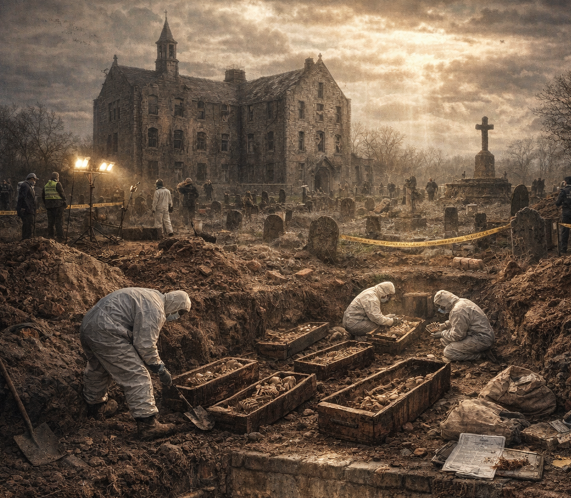
In the Irish town of Tuam, a name that in the Irish language itself means ‘burial mound’, forensic teams are still currently excavating the grounds of the former Bon Secours Mother and Baby Home. Between 1925 and 1961, nearly 800 infants and young children died there. Their bodies were not buried with dignity or even properly recorded. Many were discarded in what had once been a septic tank.
The excavation, begun in 2025, is still ongoing, bringing to light a disturbing chapter in modern Irish history. As of February 2026, forensic investigators reported that 33 sets of infant remains have been recovered during the excavation. Some of these remains were found in coffins and date to the period when the Mother and Baby Home was operating.
The deaths and the mass grave were confirmed by Ireland’s official Commission of Investigation into Mother and Baby Homes. The tragedy of Tuam emerged from a system that sought to enforce rigid sexual morality through stigma, institutional control, and social shame. Unmarried mothers were hidden away, their children institutionalized, and both were treated less as human beings than as moral problems to be managed.
Tuam offers a historical lesson. It is that moral ideals proclaimed in the abstract can produce profoundly inhumane outcomes when they are imposed through coercive institutions. The system that condemned ‘immoral motherhood’ in the name of protecting life ultimately presided over the preventable deaths of hundreds of already-born children. The Bon Secours Mother and Baby Home was a church-run institution where unmarried pregnant women were sent to give birth and live for a period after childbirth.
The tragedy of Tuam illustrates that morality cannot be achieved through shame and prohibition. In this case, when social systems focus solely on enforcing sexual norms, they often neglect the material and emotional support that mothers and children actually need. Institutions designed to preserve moral purity can instead produce secrecy, neglect and suffering.
A humane society approaches moral questions differently. Rather than attempting to legislate virtue through coercion, it works to elevate collective wellbeing through education, women’s empowerment, economic security, and compassionate social policy. When people are supported, respected and free from stigma, the conditions that lead to desperate choices are far less likely to arise.
The excavation in Tuam is therefore more than an archaeological project; it is a moral reckoning. The small bones being recovered from that ground are a reminder that lofty moral rhetoric can coexist with devastating indifference. If the goal is truly to protect life, then history demands humility of the so-called moralist, and a recognition that compassion, not coercion, is the foundation of any ethical society.
Even within spiritual traditions that emphasize non-violence — ahimsa, for example — ethical discipline has to be understood primarily as a path of personal development. In this regard, ahimsa, falls in the framework of Yama and Niyama, so these principles guide individual conduct on the spiritual journey. They are not meant to be ends in themselves. Even if moral principles help in the formulation of human law, the actual principles are not meant to become criminal statutes so as to punish every moral failing. If every lapse in truthfulness, restraint, or compassion were treated as a crime, the legal system would quickly discover that human imperfection is universal.
Articles
- https://eutoday.net/irelands-shame-children-of-tuam/
- https://www.news.com.au/lifestyle/real-life/news-life/new-baby-graveyard-found-at-home-where-796-infants-were-buried-in-septic-tank/news-story/03e6349cbe953ecfffc8a10967023bae
- https://www.irishexaminer.com/news/arid-41788922.html
- https://www.rte.ie/news/ireland/2026/0206/1557100-tuam-excavation/