People will have to progressively utilize every idea. Society will have to bravely confront different types of obstacles that are likely to arise due to progressive ideas and developed technology.
Introduction
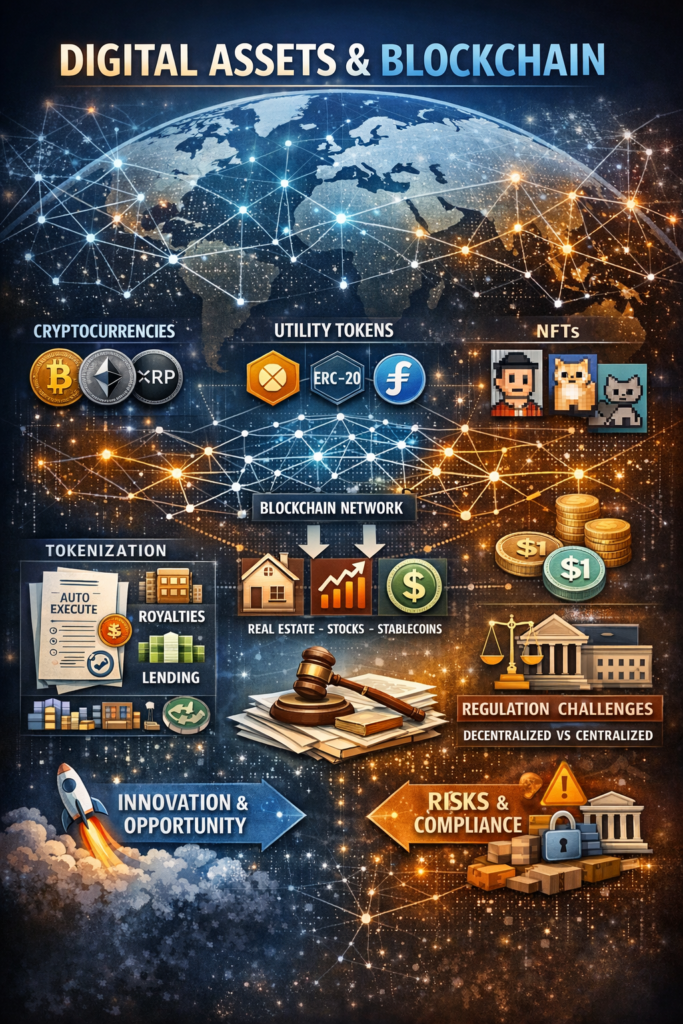
Digital assets represent one of the most significant technological developments in modern financial and digital infrastructure. Broadly speaking, a digital asset can be defined as a representation of economic, proprietary or access rights stored in the canonical shared state of a decentralised public network that is self-contained, uniquely identifiable, and possesses value or use. Within this broader category sits the subset of crypto assets, which are digital representations of value that can be stored, transferred or traded electronically using cryptography and distributed ledger technology. These assets today serve several primary purposes: they can operate as investments, as a means of exchange, and as mechanisms for accessing goods and services. Cryptocurrencies such as Bitcoin, Ripple and Litecoin, utility tokens such as Filecoin or Basic Attention Token, and non-fungible tokens (NFTs) all fall within this evolving ecosystem.
A cryptocurrency is a digital asset that uses cryptography and distributed ledger technology, such as blockchain, to enable secure, decentralised transfers of value without relying on a central authority. Utility tokens provide access to a product, service or functionality within a blockchain-based platform or ecosystem rather than representing ownership in a company or a traditional financial investment. A non-fungible token (NFT) is a unique blockchain-based digital token that represents ownership or proof of authenticity of a specific digital or physical asset, making it distinguishable from other tokens.
The rise of digital assets in relation to blockchain presents challenges for legal systems because the architecture of blockchain networks differs fundamentally from the institutional assumptions upon which most regulatory frameworks are currently built. Traditional law generally assumes a centralised system with identifiable intermediaries that can be regulated. By contrast, decentralised blockchain networks operate through peer-to-peer systems that often lack a central authority capable of holding licences or complying with conventional regulatory obligations. Consequently, policymakers face the difficult task of designing regulatory frameworks (assuming there is a need for regulation) that accommodate decentralised technologies while maintaining adequate consumer protection and financial integrity.
Blockchain as a New Social Scaling Institution
At the heart of digital assets lies blockchain technology. A blockchain is a distributed network of computers/nodes configured to run the same code and maintain a shared canonical database while remaining resilient to system failures or malicious behaviour by individual nodes. Through a combination of cryptography, distributed consensus mechanisms, and game-theoretic incentives, blockchain systems allow strangers to cooperate across time and space without relying on traditional institutional intermediaries.
In this sense, blockchain technology can be viewed as a new social scaling institution. Historically, many economic activities required trusted intermediaries such as central banks, property registries, courts and financial institutions to coordinate transactions and enforce rules. Blockchain systems seek to replace these intermediaries with cryptographic protocols and automated consensus systems. As a result, it becomes theoretically possible to have money without a central bank, property registries without registrars, dispute resolution without courts, and regulatory compliance embedded directly in software.
This decentralised architecture fundamentally challenges existing regulatory approaches. Most laws are designed around a hub-and-spoke model of regulation in which governments regulate identifiable entities that act as central intermediaries. These hubs provide a “throat to choke” — an organisation that can be licensed, monitored, or held responsible for misconduct. However, decentralised blockchain networks often lack such a central entity. Instead, they operate through distributed networks where no single participant controls the system or can realistically apply for regulatory licences on behalf of the network.
Digital Assets as Property
Digital assets arise naturally from blockchain systems because they are essentially entries in a distributed database. What distinguishes blockchain-based digital assets from ordinary database records is that decentralised networks provide sufficient certainty and independence to allow those entries to function as property-like assets.
In a traditional database controlled by a single organisation, data entries depend entirely on the actions of the database owner. By contrast, blockchain systems create records that are verifiable, permanent, transferable and resistant to unilateral alteration. Because the network is permissionless and collectively validated by participants, no single actor controls the asset. Still, this independence allows digital records to function as alienable and transferable property, even though they exist purely as data.
Digital assets therefore blur the line between information/data and property. The blockchain infrastructure transforms what would otherwise be mere data into economic assets that can be owned, transferred and traded. This process also enables tokenisation, whereby a wide range of economic rights and assets can be represented digitally and traded on blockchain networks, contributing to the rapid expansion of digital asset markets.
Tokenisation and the Expansion of Digital Asset Markets
One of the most transformative aspects of digital assets is tokenisation. Tokenisation allows almost any economic right or asset to be represented digitally on a blockchain network. Financial instruments, commodities, real estate interests, intellectual property rights, and even digital identities can be converted into tradeable tokens.
However, tokenisation also introduces regulatory challenges. Once assets are digitised and traded on blockchain networks, they become highly liquid and easily transferable across borders. Markets that were traditionally treated as commodity markets may suddenly begin to resemble securities markets. One reason for this is because tokenisation allows assets to be fractionalised, widely traded, and held for speculative or investment purposes, characteristics that are typically (though not always) associated with securities markets. As a result, regulators face pressure to treat digital assets as investment instruments subject to securities regulation.
This dynamic is further complicated by the fact that tokenised assets can function simultaneously as money, property and speculative investments. These categories are typically regulated in different and sometimes incompatible ways. Financial law distinguishes between the following three aspects: payment systems, securities markets, and property rights. Yet digital assets can fall into all three categories at once.
Smart Contracts and Programmable Assets
The utility of digital assets is significantly enhanced through the use of smart contracts. Smart contracts are small software applications that operate on blockchain networks and automatically execute transactions when predetermined conditions are met. They allow digital assets to become programmable, enabling new forms of economic coordination and automated governance.
Through smart contracts, complex financial relationships can be implemented directly in code rather than relying on human intermediaries. For example, lending agreements, royalty distributions, insurance payments and supply chain transactions can all be automated through blockchain protocols. For example, in the context of copyright, smart contracts could automatically distribute royalties to creators each time a digital work is used or resold, ensuring transparent and timely payments.
This programmability creates new possibilities for economic organisation but also introduces regulatory challenges. If contractual relationships are embedded in code rather than traditional legal agreements, questions arise regarding legal enforceability, liability and dispute resolution. For instance, where smart contracts automatically distribute copyright royalties to creators when a digital work is used, legal questions may arise about responsibility if the code distributes payments incorrectly or fails to execute as intended. This scenario is plausible, but whether it is likely depends on how widely smart-contract royalty systems are adopted and how well they are designed. Problems could arise if metadata identifying copyright holders is wrong, ownership percentages change but the contract is not updated, streaming or usage data is inaccurate, or a platform integrates the contract incorrectly.
Diversity of Blockchain Systems
Another important regulatory consideration is that blockchain systems are not uniform. Different networks employ different consensus mechanisms and governance structures. This technological diversity means that a single regulatory approach may be inappropriate, as rules designed for one type of blockchain architecture may not function effectively for others.
Obvious examples are Proof-of-Work and Proof-of-Stake. Proof-of-Work (PoW) systems rely on miners competing to solve cryptographic puzzles in order to validate transactions and secure the network. Miners are participants who contribute computing power to process transactions and add new blocks to the blockchain in exchange for rewards. By contrast, Proof-of-Stake (PoS) systems allow validators to stake digital assets to gain the right to produce blocks and earn rewards. Validators are network participants who lock up (stake) their digital assets as collateral to verify transactions and maintain the blockchain’s integrity.
Other systems use alternative consensus models, such as the XRP Ledger’s consensus protocol, where validators collectively order transactions based on trusted node lists. XRP is simply the digital asset (token) used on the ledger (the decentralised blockchain network). Ripple Labs is the company that has built payment technologies using XRP.
Digital assets themselves also vary significantly. Some assets, such as Bitcoin and Ether, are native tokens that exist only within their respective blockchain networks and have no counterparty. Others are smart-contract-controlled tokens, such as ERC-20 tokens on Ethereum, which operate through programmable contracts rather than centralised issuers. ERC-20 tokens are digital tokens created using a standardised smart contract framework on the Ethereum blockchain that allows different tokens to interact consistently with wallets, exchanges and applications. Still others, such as stablecoins, depend on third parties to maintain their value or redeemability. Stablecoins typically rely on issuers who hold reserves or manage mechanisms designed to keep the token’s value stable relative to assets such as the US dollar.
This diversity creates a continuum of blockchain projects ranging from fully decentralised systems to projects that merely imitate decentralisation while relying on centralised infrastructure. For example, the Bitcoin network is often cited as a highly decentralised system because its operation depends on a distributed network of independent participants rather than a single controlling authority. By contrast, some blockchain projects maintain central control over token supply, validation nodes or governance, creating what is sometimes described as “decentralisation theatre” where the system operates more like a traditional centralised platform despite using blockchain technology.
Regulatory Implications
Countries or regions then have to consider how to become a competitive jurisdiction for digital asset innovation, given the diversity, and their regulatory frameworks should account for this diversity. A one-size-fits-all regulatory model risks undermining the very features that make blockchain systems valuable. If regulatory frameworks are overly rigid, innovators may simply relocate to jurisdictions with more adaptable legal environments, potentially leading to a loss of technological development and investment.
In particular, regulation must accommodate purely decentralised projects that have no identifiable entity capable of holding licences or complying with traditional regulatory requirements. Attempting to regulate such systems as if they were conventional financial institutions could eliminate their potential benefits. This raises a fundamental regulatory challenge: how to ensure accountability in systems where control is distributed across a network rather than concentrated in a single organisation.
At the same time, regulators must ensure that digital asset markets do not become vehicles for fraud, market manipulation or consumer harm. Achieving this balance requires regulatory frameworks that are technologically neutral, flexible and capable of addressing misconduct without suppressing innovation. Effective regulation must therefore focus on harmful activities and outcomes rather than attempting to control the underlying technology itself.
Summary of Critical Points
Digital assets represent a transformative development in economic infrastructure. By combining distributed ledgers, cryptography and programmable smart contracts, blockchain networks create new forms of digital property (or at least claims) that operate independently of traditional institutional intermediaries. These systems enable tokenisation of economic rights, automated contractual relationships, and new forms of decentralised economic organisation.
However, the hybrid nature of digital assets, in that they can simultaneously function as money, property and speculative investments, poses significant regulatory challenges. Traditional legal frameworks are built around centralised institutions and clearly defined asset categories, e.g. land titles, copyrights, shares in a company, etc, each of which is a permission from society to hold them expressed in law. Whereas blockchain technologies blur classification distinctions and distribute authority across networks. Consequently, regulators may need to develop new frameworks that recognise the unique yet mixed characteristics of decentralised digital assets.
For each jurisdiction, the key challenge lies in designing regulatory frameworks that protect consumers and maintain market integrity while preserving the innovative potential of decentralised technologies. Ideally, regulation must remain technologically neutral, adaptable to rapidly evolving blockchain architectures, and sufficiently flexible to accommodate projects that operate without central intermediaries. Addressing all the matters effectively, can lead to digital assets becoming a cornerstone of the next generation of global financial and digital infrastructure. Possibly.
Conclusion
Ultimately, the regulation and utilisation of digital assets must recognise that technologies, economic systems and social needs evolve over time. The appropriate use and governance of digital assets cannot remain fixed in regulatory frameworks designed for earlier financial and institutional structures. Rather, the method of utilisation must adapt according to changes in time, place and social context, ensuring that technological innovation is harnessed progressively for broader social benefit.
In the context of blockchain and digital assets, this means embracing scientific and technological developments while designing regulatory approaches capable of extracting greater economic and social value from these systems without suppressing their innovative potential. At the same time, society must remain prepared to confront the challenges and risks that accompany new technologies, responding through thoughtful adaptation and institutional reform. In doing so, regulation should not cling rigidly to outdated models but instead evolve dynamically so that emerging technologies such as blockchain and digital assets can contribute constructively to economic development, cooperation and the progressive advancement of society.
https://open.substack.com/pub/macropsychic/p/digital-assets-blockchain-and-challenges