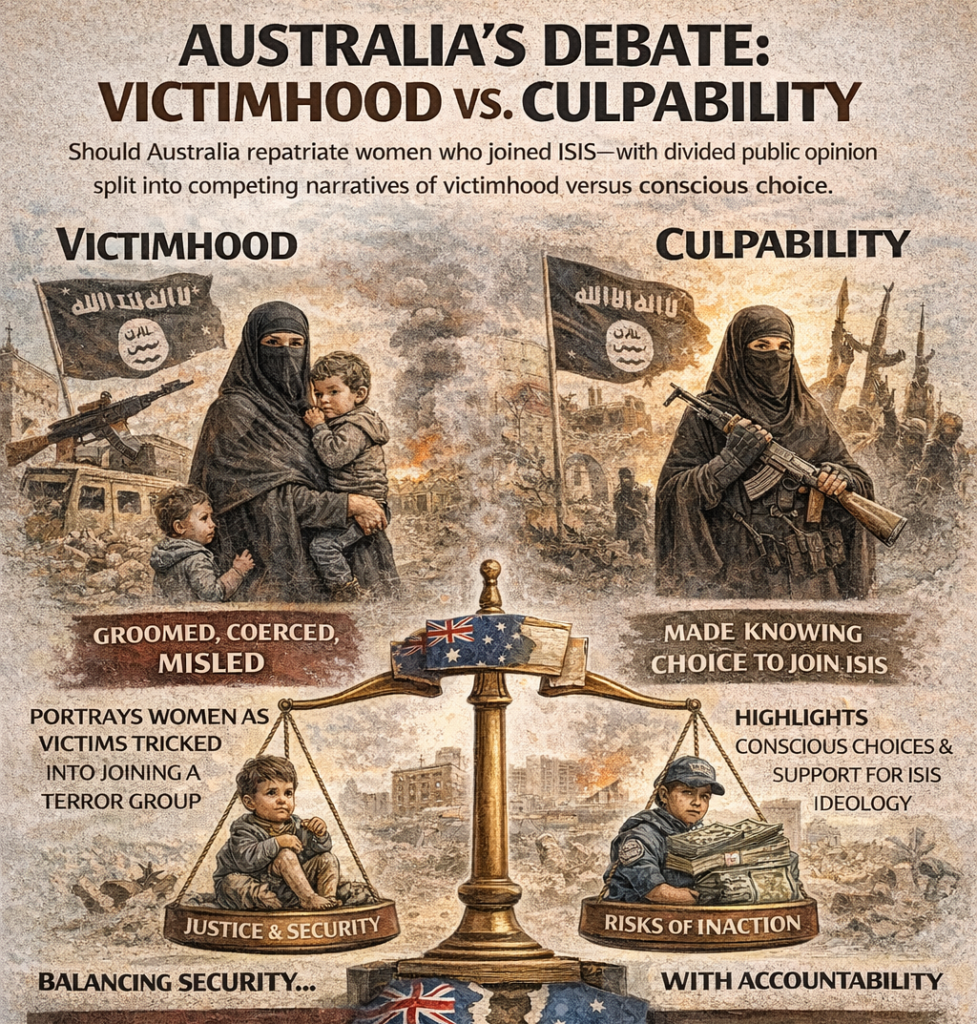
Australia’s debate over whether to repatriate women who travelled overseas to foreign countries to join the Islamic State, and their children, has been framed around victimhood versus conscious decisions made. Many views emphasize grooming, coercion or patriarchal manipulation. These factors would have existed in some cases and should not be dismissed. Yet the public discussion risks becoming incomplete when it minimizes the documented reality that many of these women made conscious, voluntary decisions to leave Australia and affiliate with a designated terrorist organisation whose ideology and practices were widely known.
The case of Kirsty Rosse-Emile illustrates the complexity. Reports indicate she was exposed to extremist ideology before travelling to Syria, including online expressions of admiration for jihadist figures. Her father has publicly stated that she left willingly and disputes later claims that she was misled. While each individual case must be assessed on its own evidence, such accounts challenge simplified narratives that portray all individuals involved as passive victims. Islamic State’s recruitment strategy did not conceal its core objectives. It openly called for supporters, both men and women, to help build and sustain its envisaged caliphate. It assigned women roles as spouses and mothers and also as contributors to the Islamic State social and ideological infrastructure.
This does not diminish the moral urgency of protecting their children. Many were born into the conflict or taken there without meaningful choice. They are victims of circumstances imposed upon them and deserve protection, rehabilitation, and the opportunity for a normal life. Their welfare should remain central to policy decisions.
However, acknowledging the children’s innocence does not eliminate the need to address adult responsibility. Australian law does provide certain mechanisms for reaching a balanced position. Individuals who return can be investigated, prosecuted where evidence supports charges, and monitored through structured reintegration and deradicalisation programs. This approach reflects a core principle of democratic justice: accountability based on evidence, not collective assumptions of guilt or innocence. However, public concern remains about how much this will cost the Australian taxpayer.
The policy challenge, therefore, is not whether to ignore security concerns or humanitarian obligations, but how to reconcile both. Refusing repatriation entirely basically leaves these individuals beyond the scope of Australian law and oversight. Conversely, repatriation without proper legal and security processes risks undermining public trust and national security. A lawful, case-by-case approach, combining repatriation with investigation, prosecution where appropriate, and rehabilitation, ensures both accountability and protection. Here the major concern is whether rehabilitation is possible. There is widespread doubt in the Australian community about this, which leaves people nervous about another terrorist incident based on jihadist Islamic extremism
Ultimately, the debate should resist reducing human decisions (often complex) to a single narrative of either pure victimhood or pure culpability. Adults possess agency, even within systems of influence, and democratic societies must address that agency and its criminal implications through due process. Upholding justice means neither excusing wrongdoing nor letting responsibility for decisions be abandoned. It means ensuring that accountability, security, and the rule of law prevail together.
The current situation though is that the ISIS brides and their children are not coming back to Australia any time soon. This is a political decision of the current government because the backlash of allowing their return is seen to be very significant, whether against the current Labor party in power or even if a Liberal-National party coalition were in government. Public opinion continually raises concerns focused on national security, what is appropriate justice for ISIS supporters, and the perceived risks of reintegration. Governments are acutely aware that any misstep, particularly if a repatriated individual were later involved in extremist activity, would carry severe political and reputational consequences. As a result, policymakers have adopted a cautious, risk-averse stance, prioritizing political stability and public confidence.
See:
- https://www.abc.net.au/news/2026-02-21/how-a-window-opened-for-is-linked-australians-to-leave-syria/106368348
- https://www.abc.net.au/listen/programs/politics-now/why-is-albanese-taking-a-hard-line-on-isis-brides-/106306984
- https://www.abc.net.au/news/2026-02-19/australian-citizens-banned-returning-overseas-exclusion-orders/106361634
- https://www.abc.net.au/news/2026-02-19/naus_nrcoyne_1902/106362332
- https://www.abc.net.au/news/2026-02-18/australia-issues-teo-against-isis-linked-citizen-in-syria-camp/106360092
- https://www.abc.net.au/news/2019-09-30/women-of-isis-reveal-australian-network/11549490
- https://theconversation.com/view-from-the-hill-chris-minns-makes-sense-on-isis-brides-children-while-opposition-adds-to-scaremongering-275913
Currently the widespread view in Australia is that the Prime Minister has got the balance right? He appears to have conceded that they have legal rights as Australian citizens, which means they could reenter Australia. Though this is certainly not made easy. The Australian government has used passport cancellation, citizenship removal, and temporary exclusion orders in relation to Australian women linked to ISIS in Syria, but the situation is legally complex and varies case-by-case. The Prime Minister has also pointed out they got themselves there and the government is not obliged to go and rescue them from the foreseeable consequences of their choices.
And the story will go on …
https://substack.com/@macropsychic/note/c-217622312