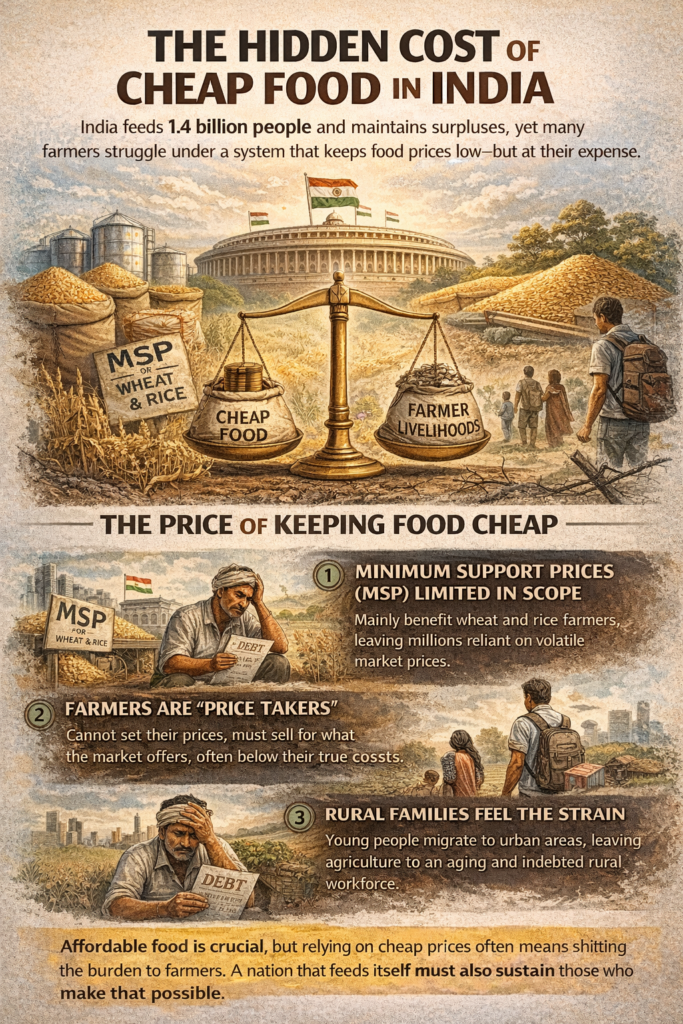
India celebrates its agricultural success with understandable pride. The country feeds 1.4 billion people and maintains grain surpluses large enough to buffer global shocks. Yet beneath this achievement lies a quieter reality: many of the farmers who sustain this system struggle to sustain themselves. Agricultural self-sufficiency has not translated into agricultural prosperity.
At the heart of the problem is not productivity alone, but pricing power. Farmers operate in a system where they rarely control the price of what they produce. The government announces Minimum Support Prices (MSP) for key crops, and since 2018 has pledged to set these at roughly 1.5 times certain production costs. In principle, this is meant to ensure farmers earn a margin. In practice, however, only a minority benefit. In practice it is also meant to ensure that the poor can afford food.
MSP is really more suited to government procurement of agricultural commodities, which is concentrated heavily in wheat and rice, and geographically in a handful of states. Millions of farmers growing pulses, oilseeds, fruits or vegetables must sell into open markets where prices fluctuate and often fall below MSP benchmarks. For them, MSP exists more as a signal than a guarantee.
This situation shapes rural life. In most industries, producers can adjust output, negotiate prices, or pass rising costs to consumers. Farmers, by contrast, are price-takers at the mercy of weather, intermediaries and market volatility. Meanwhile, input costs, mainly seeds, fertilizers, irrigation, diesel, have steadily risen. The result is a narrowing margin between effort and reward. Farming continues, but increasingly as a livelihood of necessity rather than opportunity.
The consequences are visible across India’s countryside. Rural families diversify into wage labour, construction, or services to stabilize income. Younger generations migrate to cities, leaving agriculture to an aging population. This is not simply a demographic shift but a signal of declining economic confidence in farming itself. To bolster that confidence, mechanisation is needed, but that requires investment.
Agricultural labourers face great precarity. Most work in informal arrangements without contracts, health insurance or income security. Their employment can be seasonal, fluctuating with planting and harvest cycles. Unlike the formal industrial workforce, they remain largely outside social protection systems. Agriculture, despite its centrality, operates with fewer institutional safeguards than other sectors of comparable importance.
India’s policy dilemma is understandable. Affordable food is essential for national stability, especially in a country where many households remain economically vulnerable. But keeping food prices low has an unintended effect: it shifts the burden of affordability onto farmers themselves. Consumers benefit from stable prices, while producers absorb the risk.
None of this reflects a failure of farmers. It reflects a structural imbalance in how the agricultural economy distributes value. India has succeeded in producing enough food. It has not yet succeeded in ensuring that those who produce it share fully in the benefits.
The challenge now is not one of production, but of sustainability. Expanding market access to benefit farmers, improving infrastructure and mechanisation, strengthening farmer bargaining power, and ensuring more reliable income mechanisms would help rebalance the system. A critical goal would, therefore, be fairer distribution of risk and reward across the supply chain. At the same time ensuring food prices do not rise significantly. This is a hard call.
India’s agricultural success story is real in terms of feeding the country. But until farming becomes a viable and secure livelihood for those who practice it, that success will remain incomplete. Industrialisation of agriculture has to be a priority. Careful thought needs to be given as to how cooperative enterprises can assist in advancing the agricultural sector and those people who rely on it for their livelihoods. A nation that feeds itself must also sustain those who make that possible.
https://substack.com/profile/152321377-perspective-undercurrents-pu/note/c-217594704