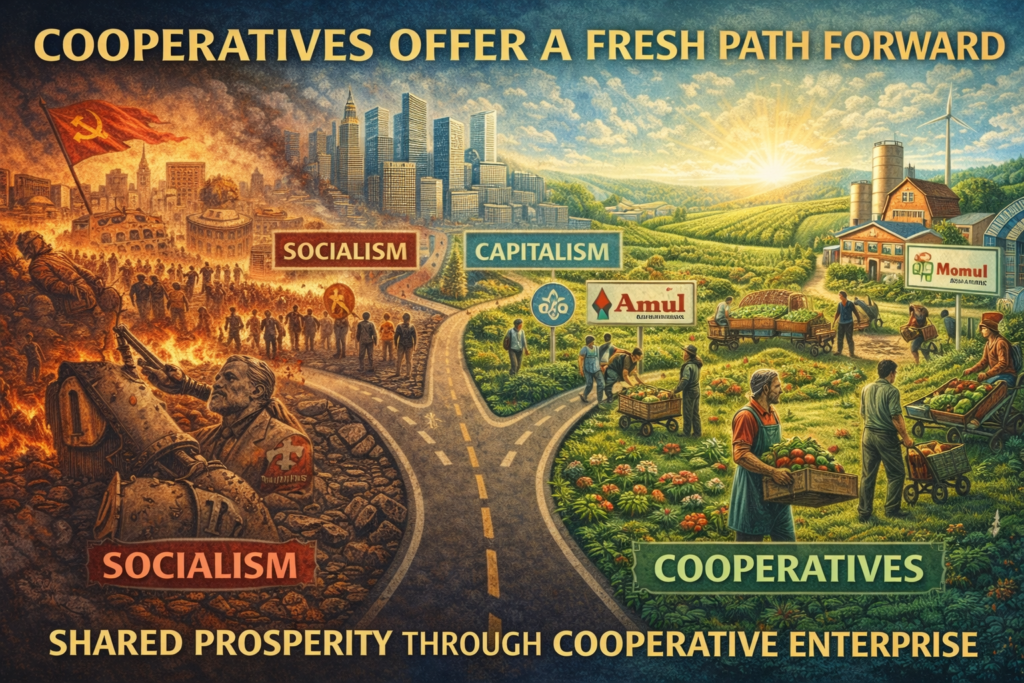
Economic inequality will fuel social unrest and there will be disillusionment with orthodox economic ideologies. However, the tired debate between socialism and capitalism will feel increasingly obsolete. The entire socialism/capitalism dichotomy is out of date. What our societies desperately need is not another ideological tug-of-war, but systems that deliver shared prosperity without the baggage of failed dogmas.
History’s verdict on state-centralised socialism is clear. Over the past century, attempts to build command economies — from the Soviet Union to Maoist China and modern Venezuela — collapsed under bureaucratic sclerosis and economic stagnation. As soon as these experiments faltered, apologists retreated into conceptual purity: they declared that “real socialism has never been tried”. But this misses the deeper flaw: those models substituted any semblance of cooperative ownership with rigid top-down control, thus eroding the very human motivation that makes economic endeavour fruitful.
Cooperatives that really go by the cooperative spirit offer an entirely different logic. They are not rooted in ideological rigidity but in get to the basics of participation, democratic control and shared benefits. Cooperatives are not state monopolies nor atomised enterprises chasing narrow profit interests. They are member enterprises of all sorts, and with a variety of participatory interests, that balance economic incentives with democratic governance and mutual accountability. This is not theory; it is practice.
Consider the success of the Mondragon Corporation in Spain’s Basque region, one of the world’s largest cooperative networks, spanning manufacturing, finance and retail. It is a federated system of cooperatives, layered in a way that blends local ownership with coordinated strategy. It is polycentric, not hierarchical in the corporate sense. Mondragon shows that cooperatives can scale without becoming state-controlled, or shareholder-dominated, or losing democratic participation. It operates with income equality embedded into executive/manager pay policies.
Consider also the Indian dairy giant Amul, which is owned by millions of farmers. It ranks among the world’s largest cooperatives. Amul is a three-tier cooperative system from village level (where dairy farmers are members of local milk societies) to district unions (for milk processing and packaging) to state federation (for marketing under the Amul brand). Amul was fundamental to India’s ‘White Revolution’: the country’s dairy development program that transformed the country from a milk-deficient nation into the world’s largest milk producer.
Agricultural and consumer co-ops also dominate global food sectors in nations like New Zealand and Canada, harnessing local knowledge and collective bargaining to stabilise markets and elevate rural livelihoods. Globally, cooperatives contribute trillions in turnover and employ roughly one in ten workers, bringing economic resilience and community stability that traditional corporate models often fail to achieve. Their success is not accidental; it arises from the cooperative principle of shared risk and shared reward, where members/participants have voice and stake. They are not distant shareholders and extractive investors.
This is the direction envisioned by the Progressive Utilization Theory (Prout). By emphasising wide participation (matching demographics of an area) yet decentralised ownership, democratic management and utilisation of latent human potential, cooperatives embody a system that transcends the polarities of state control and unfettered markets. Cooperatives can scale, small producers can compete fairly, decentralised ownership can coexist with national coordination. You don’t need state-run collectivisation to mobilise production. Nor do you need corporate consolidation to achieve efficiency.
The path forward is not merely about tweaking capitalism or resurrecting socialist planning. It is about embracing cooperative enterprise as a third way. A way that builds economic justice into the very structure of production and exchange. Doing so doesn’t just mitigate inequality; it unlocks human dignity, collective resilience, and shared prosperity. In a world facing complex economic and social challenges, cooperatives offer not just an alternative, but a practical evolution of economic life.
https://substack.com/@macropsychic/note/c-213915311