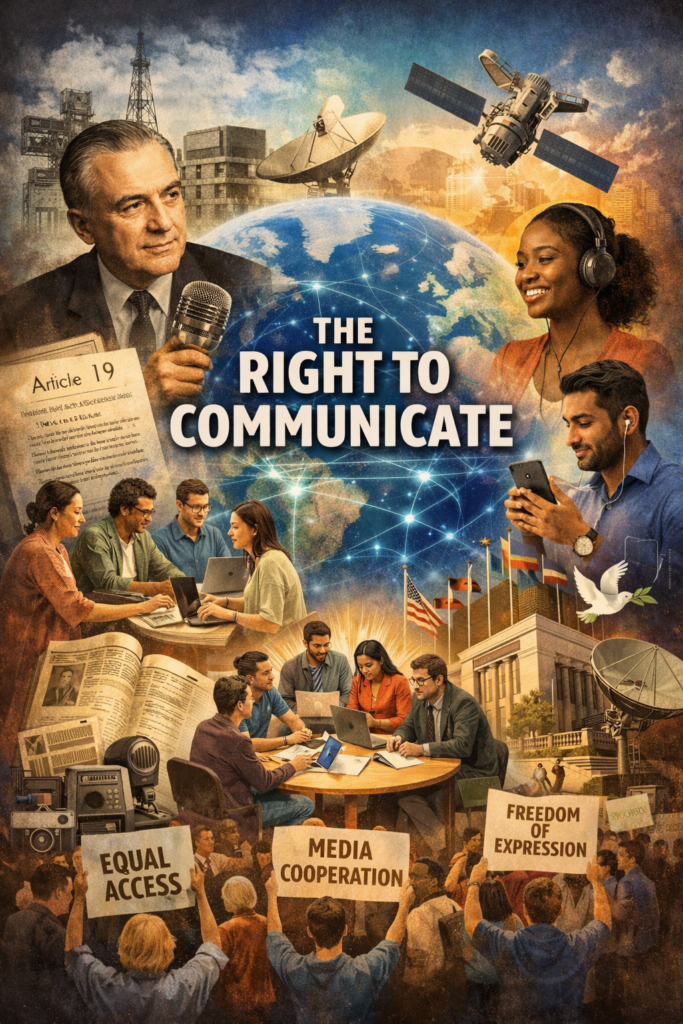
Jean d’Arcy envisaged a greater right than current rights about freedom of expression and opinion
Jean d’Arcy, was a pioneer of French television. D’Arcy became director of programming for the new government run French television network in 1952. At the time there were just a few tens of thousands of television sets in France. D’Arcy helped build up the network and shaped its programming. He was also the founder of Eurovision in 1954, an organization that exchanged television programs across national boundaries. In 1959 he became director of international relations for the French national radio and television network, and in 1961 he was named director of the radio and television service of the United Nations in New York, where he served for 10 years.
The right to communicate
In 1969, d’Arcy recognised that ‘communication rights’ relating to freedom of expression and related norms, had to be re‑examined in an evolving environment of global, interactive communications, so that not only are there communication rights but also a general ‘RIGHT TO COMMUNICATE’. This emergent right reflected a recognition that traditional free‑expression frameworks were no longer adequate to address the societal, technological and participatory shifts taking place in global communication networks. Thus, d’Arcy proclaimed, in his opening sentence in a 1969 EBU Review article titled ‘Direct Broadcast Satellites and the Right to Communicate’:
“The time will come when the Universal Declaration of Human Rights (UDHR) will have to encompass a more extensive right than man’s right to information, first laid down 21 years ago in Article 19. This is the right of man to communicate.”
UDHR Article 19 summarizes the struggle of humankind for freedom of opinion and expression, without interference, and to seek, receive and impart information and ideas through any media and regardless of frontiers. It affirms that access to information is essential for individual autonomy and meaningful participation in public life. It also recognises that participation in modern societies depends on the free exchange of ideas across all forms of media.
That said, it would be better if the fundamental right to communicate was there in the first instance! So, behind d’Arcy’s idea of the right to communicate is the assertion that traditional communication rights, such as freedom of expression and the right to information, would no longer be sufficient in a globalised world. What is needed is a broader human right to actively participate in communication processes themselves. This better reflects the changing social, economic, technological and cultural shifts he foresaw that would be introduced by emerging media systems that could span the globe.
Communications today
Today the social consciousness is such that the right to communicate can be considered fundamental to society (i.e. equivalent to a human right), so that every person can access communications systems appropriate to their needs and have the basic necessities for communications, such as connection to networks, devices, ability to send and receive, and capability to spread content. The internet has brought on such needs. Sometimes it is said that there should be a right to the internet or to telephone services generally (or certainly for emergency calls). However, this is mostly focusing on the technology. The real focus needs to be broader, around what it means to be human itself and to communicate in human society. One substantial aspect of being human is the ability to communicate. So, the right to communicate has to be a high-level right, which not only encompasses what people need or want to do, but also the technology to do so. It can be regarded as a fundamental right.
Taken further, the concept of the right to communicate provides psychological impetus for cooperation and this should lead to cooperative distribution and use of communications resources, because everyone is entitled to such a right. Logically then, there has to be a proper sharing of communications resources on a fair and rational basis, which is to be accomplished mainly through cooperative means and principles under the banner of ‘the cooperative spirit’. As well, such cooperation reinforces the democratic character of communications, assuming the purpose is to further social good while also developing individual contribution. Ensuring that access, participation and representation should, therefore, not be determined by power or privilege, but by the shared moral claim of all humans to communicate, which indeed is automatically inherited over generations.
D’Arcy also appears to have argued new technologies would have the potential for more horizontal forms of communication. Today, we see this in peer-to-peer communications and interactive messaging on social media platforms, though ownership of digital platforms is actually vertically structured due to the accumulation of infrastructure wealth in the hands of a few. Such excessive accumulation has meant the monetisation of personal information and data of users by the accumulators. Nevertheless, the ability to communicate with potentially anyone around the world (or most of it) means that horizontal and cooperative structures for communications infrastructure ownership and use would be more sensible. If a general right to communicate existed as an enforceable norm, perhaps cooperative structures would be more readily resorted to. The right would also seem to better enable various social objectives regarding communications to be advanced on a cooperative basis.
So, the issue becomes what is the potential for cooperative structures in communications industries, including for media enterprises, and how can this be achieved. Going down that pathway would take d’Arcy’s vision and legacy further: cooperative structures as the norm in communications and media! For this, a more cooperative media/communications ecosystem, including for new information technologies and platforms, would have to be advocated by ideological activists of today. Such a push could also stimulate more in-depth thinking about possibilities for even more diverse uses of media/communications, while breaking away from dominant, mass mainstream media models.
In this regard, the right to communicate seems a good way, and has potential, to transform individualist views (or wealth in the hands of a few) regarding the free press and information rights. So, communications rights should not be subordinated to market trends, but instead involve a redistribution and democratisation in communication access and interaction, and production and circulation of information and content. The motivating force for this approach is simply the observation that communication is more than a one-way processes of transfer of messages which is seen in classical broadcast models.
Today, we have greater scope for citizens’ communications, citizen’s news, citizens’ data and information, citizens’ content and multi-way communications. Yet provisions in human rights law do not adequately deal with communications as an interactive process. The essential omission in human rights law, and in the information society itself, has been lack of provisions for the conversational mode of communication, which is two-way or multi-way. Communication rights should reflect communication as an interactive process.
Conclusion
Implicit in d’Arcy’s theme is that the means of communication have determined political and social structures, and that persons or groups (classes) controlling communications effectively control society. A way to avoid such elitism is for more cooperative enterprises and cooperative management of various communications industries. This mirrors the right to communicate being a fundamental and inclusive human right; it is both a natural right of the human person and a prerequisite for the exercise of other human rights. This fundamental right enriches the common heritage of humankind.
The right to communicate then leads to the holistic conclusion that means of communication should not be limited or controlled by a few. For greater communication possibilities, greater social inputs, greater access and scope for communications, cooperative communication structures and channels are needed. Such structures honour the shared human entitlement to communicate by aligning communicative power with a more collective stewardship rather than concentrated control in the hands of a few powerful media moguls.
References
Acosta, A.M. (2010). ‘La comunicación un derecho necesario para el buen vivir’, in Cordero Heredia, D. (ed.) Nuevas instituciones del derecho constitucional ecuatoriano, 2, pp. 139–160, Fundación Regional de Asesoría en Derechos Humanos.
D’Arcy, J. (1969). ‘Communication Satellites and the Right of Man to Communicate’, EBU Review.
Hamelink, C.J. (2002). ‘The Civil Society Challenge to Global Media Policy’ in Raboy, M (ed.) Global Media Policy in the New Millennium, pp.251-260. Luton University Press.
Hamelink, C.J. (2004). ‘The 2003 Graham Spry Memorial Lecture: Toward a Human Right to Communicate’, Canadian Journal of Communication, 29, 205-212. https://cjc.utppublishing.com/doi/epdf/10.22230/cjc.2004v29n2a1436
Harms, L.S. (2001). The Right to Communicate: Towards Explicit Recognition (quoting d’Arcy’s original opening sentence), Centre for Communication Rights.
https://archive.ccrvoices.org/articles/the-right-to-communicate-towards-explicit-recognition.html
Harms, L.S. & Richstad, J (eds.) (1977-78). Evolving perspectives on the right to communicate. East-West Communication Institute. https://scholarspace.manoa.hawaii.edu/items/dbd7632b-8826-47b2-be94-f1506c5afe7e
McIver, W.J. & Birdsall, W.F. (2002). Technological Evolution and the Right to Communicate: The Implications for Electronic Democracy. Presented at Euricom Colloquium: Electronic Networks & Democracy 9-12 October 2002, Nijmegen, The Netherlands. https://www.researchgate.net/publication/253707571_Technological_Evolution_and_the_Right_to_Communicate
UNESCO (1982) The Right to Communicate: A Status Report. https://unesdoc.unesco.org/ark:/48223/pf0000050335
https://substack.com/@macropsychic/note/p-187452324