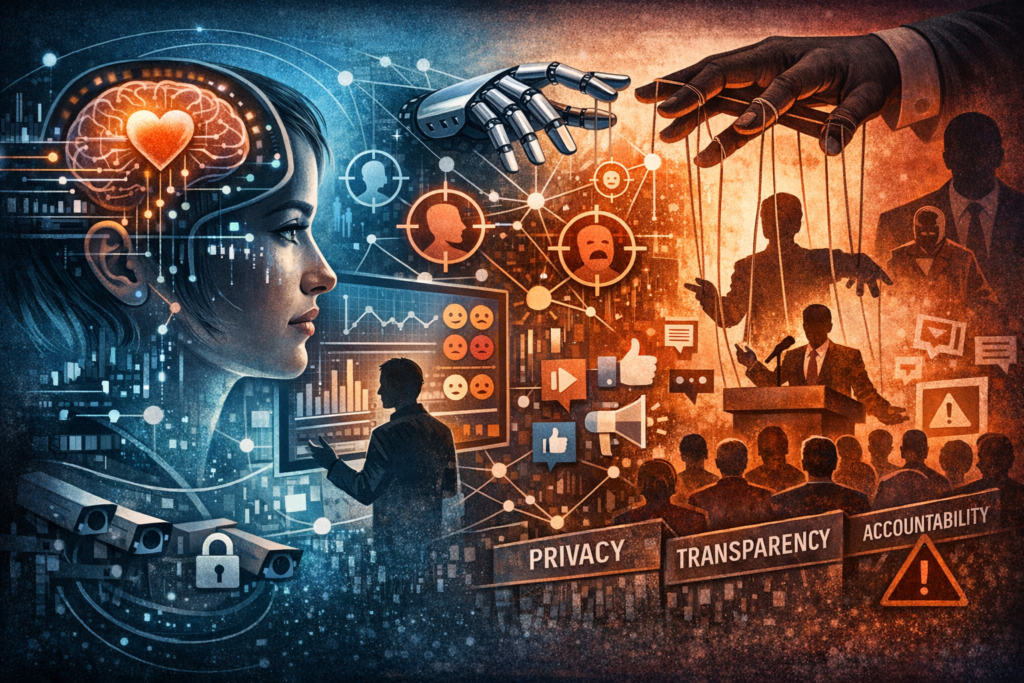
Emotional AI fundamentally reshapes the terrain of influence by converting inner states: mood, stress, empathy, anger; into measurable and actionable data. When such systems are paired with large-scale data collection, behavioural profiling, and automated delivery mechanisms, persuasion no longer relies on broad messaging or conscious deliberation. Instead, persuasion becomes personalized, adaptive and largely invisible — people are not self-aware of the persuasion as it is operating below the threshold of awareness. This marks a qualitative shift from traditional advertising or political communication toward scalable social engineering.
The impact is especially significant because emotional signals are more intimate than demographic or preference data. They reveal vulnerability, not just interest. Systems that can detect hesitation, fear or emotional resonance can time messages for maximum psychological leverage, subtly nudging decisions rather than openly arguing for them. This erodes the conditions of informed consent and meaningful autonomy, as individuals are influenced not through reasons they can evaluate, but through emotional cues they may not even recognize as being read or acted upon.
Politically, this creates asymmetric power. Actors with access to emotional AI: governments, social media platforms, or well-resourced organizations; can shape public opinion, mobilization or disengagement with unprecedented precision, while citizens remain largely unaware of how or why their perceptions are being steered. Ethically, it blurs the line between persuasion and manipulation, particularly when deployed at scale and optimized by machine learning systems whose objectives are opaque even to their designers.
Without strong safeguards, emotional AI risks normalizing a form of governance and commerce based on psychological extraction rather than deliberation. Robust privacy protections, strict limits on inference by AI systems, transparency around emotional data use, and enforceable accountability mechanisms are therefore not optional add-ons. They are essential to preserving human agency, participating in political and civil institutions, and ensuring trust in a digitally mediated public sphere.
https://substack.com/profile/152321377-perspective-undercurrents-pu/note/c-207878431