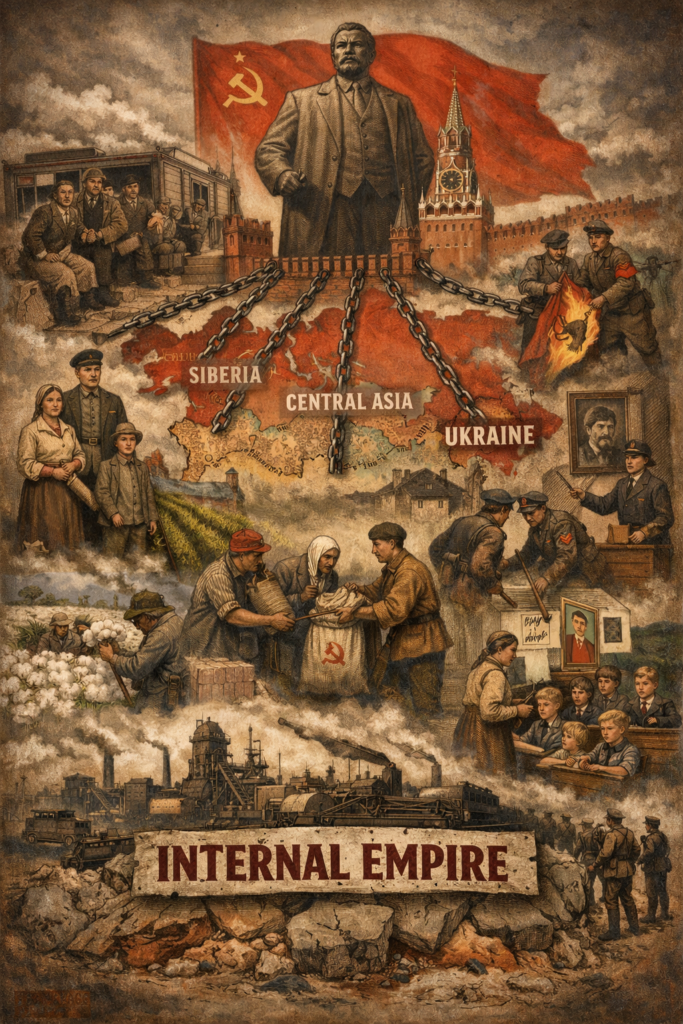
The USSR (Union of Soviet Socialist Republics, 1922–1991) was a colonial project, even though the Soviet state defined itself as an anti-imperialist and anti-colonial power. The USSR was constitutionally framed as a voluntary union of equal socialist republics, with policies like korenizatsiya (indigenization) in the 1920s promoting non-Russian languages and cultures in the republics. However, this was largely ideological window-dressing. In practice, the USSR reproduced colonial dynamics, with Moscow/Russian SFSR functioning as the political, economic and cultural metropole and the non-Russian peripheries (Ukraine, Baltic states, Caucasus, Central Asia, Siberia) as internal colonies. There was no real equality of socialist republics — there was instead a hegemonic empire.
The USSR inherited almost the entire territory of the Russian Empire during 1917-1922 (the Civil War period) and subsequent border wars. Independent states like Georgia (invaded 1921), Armenia, Azerbaijan and the Central Asian khanates were forcibly incorporated. In Central Asia, Siberia and Kazakhstan, Russian/Slavic settlers received priority in jobs, housing and land. Massive forced population transfers under Stalin (1930s–1940s) deported entire peoples (Crimean Tatars, Chechens, Ingush, Meskhetian Turks, Volga Germans, Koreans) to remote areas, opening space for Slavic settlement. The Baltic states (Estonia, Latvia, Lithuania) were annexed in 1940, followed by mass deportations and Russification. Engineering large-scale migration of ethnic Russians (and to a lesser extent Ukrainians and Belarusians) into non-Russian regions altered demographics and secured control. In the Baltic republics after 1945, hundreds of thousands of Russians were resettled, dropping the share of titular nationalities (e.g. Latvians from ~84% in 1945 to ~60% by the 1950s; similar in Estonia).
Economic exploitation was classic internal colonialism. Peripheries were often turned into raw-material suppliers for the Moscow/Russian SFSR. Central Asia became a cotton monoculture zone (“king cotton”), with irrigation projects like the Aral Sea disaster devastating local environments while feeding Soviet industry. Ukraine’s grain, Caucasus oil, and Siberian resources were extracted to industrialize the Slavic core. While some republics received investment in infrastructure and education, decision-making remained centralized in Moscow; local needs were subordinated to all-Union priorities.
There was also cultural and linguistic imperialism – Russification. Russian was promoted as the language of “inter-ethnic communication”, science and advancement. Non-Russian cultures were allowed only within strict ideological limits. This also involved national elites being periodically purged (e.g. the 1930s Great Terror hit non-Russian leaders especially hard). By the late Soviet period, Russian language dominated higher education, media and urban life in most republics.
Through cultural, economic and political subordination real power lay in Moscow. Key control mechanisms were put in place. The Communist Party’s Second Secretary in the republics was almost always ethnic Russian (with veto power over the nominal First Secretary from the titular nationality). The KGB and military were heavily Russified. Any sign of genuine national autonomy or dissent was labeled “bourgeois nationalism” and crushed.
Many scholars have described the USSR as a hybrid empire — part multinational federation, part colonial state — with Russia as the informal metropole. Terms like internal colonialism (Stalin-era forced resettlement in Central Asia) and settler colonialism (demographic replacement favouring Slavs) are widely applied by scholars, especially in relation to Central Asia, the Caucasus, and the Baltic states. Indeed, post-1991, many non-Russian successor states frame their history as colonial oppression and the 1991 dissolution as incomplete decolonization, with calls to further “decolonize” the now Russian Federation itself. Of course, while there was some investment, there was largely centralized extraction in the republics.
In short, while the narrative was that the USSR was not a classic overseas colonial empire, a substantial body of evidence supports viewing it as a colonial project. One that preserved and modernized Russian imperial space under socialist rhetoric, using many of the same tools (settlement, extraction, cultural domination, forced assimilation) as traditional empires. This perspective has gained traction especially since the Russian Federation’s 2022 invasion of Ukraine, which many interpret as neo-imperial continuity.
https://substack.com/@macropsychic/note/c-203125905