Application of maximum utilization and rational distribution to open data as a supramundane resource, considering both its benefits and perils
In PROUT (Progressive Utilization Theory), supramundane resources are non-material assets including those created through collective human intellect. This includes knowledge of all kinds, information systems and compilations of data. These have greater social value through increased use. While their storage is in material forms and their use is via some physical means, the mundane form is not where the real value lies. The real value lies in their supramundane aspects.
Open data is public-interest data, such as statistics, maps, environmental measurements, weather details, regulatory registers, etc. People want to use not so much the storage medium but the knowledge and information in the data sets stored in or on the relevant medium. They really want access. Not only that, open data can be reused simultaneously by many actors without exhaustion.
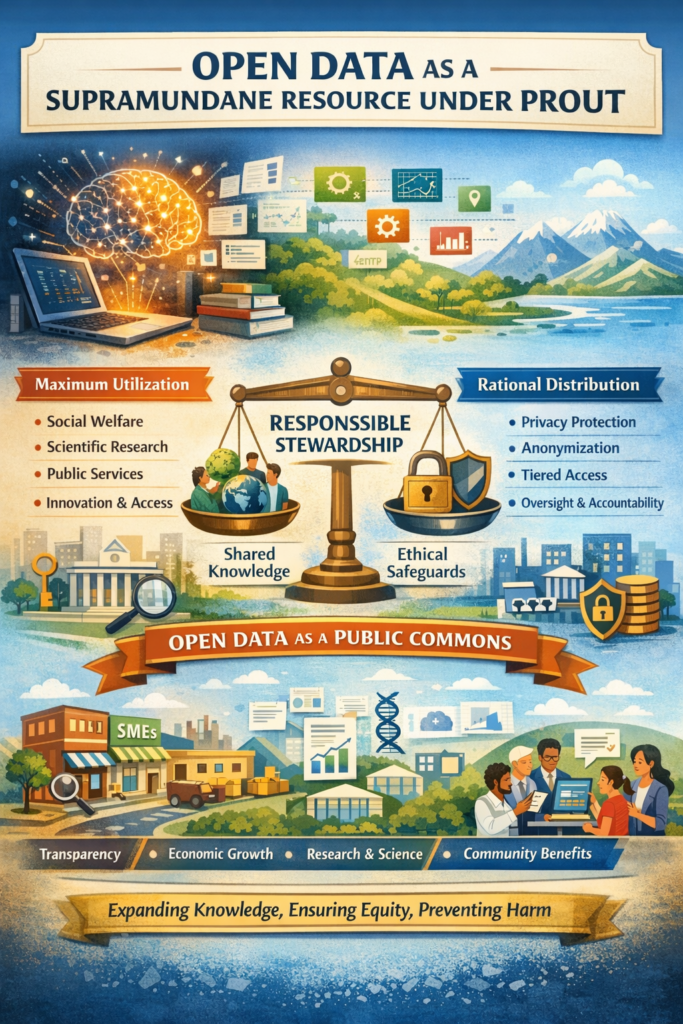
Maximum utilization
The PROUT principle of maximum utilization demands that the relevant data not be hoarded, underused or enclosed by narrow interests, but actively deployed to serve important aims such as social welfare, collective understanding and innovation. This can be achieved by treating open data as a public commons under stewardship, with clear legal mandates for release, open licensing and institutional responsibility by its holder or keeper for data quality (which maximizes its socio-economic utility) and ease of accessibility to aid its distribution.
Open data maximizes social value when it increases transparency of the data, enables scientific research, improves public services, and lowers barriers for community or socio-economic use, including by small to medium enterprises and innovators. Indiscriminate release would likely reduce the possible maximum utilization of data. However, withholding publicly funded data that poses no real harm would constitute under-utilization of a common resource; it restricts social progress and concentrates informational power. In this regard, open data emphasises collective benefit over private accumulation.
Accordingly, from a PROUT lens, open data should be treated not as a commodity to be privatized nor as a raw asset to be dumped indiscriminately, but as a commons requiring proper stewardship. This stewardship must be guided by reasonableness — the steward must act reasonably, ensuring that openness is calibrated to the social value of the data and considering the risks its release may entail. In this way, access is expanded where it advances collective welfare, while appropriate safeguards are maintained where unrestrained disclosure would cause harm or injustice.
Furthermore, open data delivers real value when users can correctly understand and reuse it. Therefore, a steward of open data must ensure high-quality metadata that explains the origin, meaning, limitations, methodology and intended use of a dataset, adhere to common data standards, maintain documentation about provenance, methodology and limitations, and attend to update cycles to ensure data is interpretable, comparable and trustworthy, preventing misinterpretation or misuse. Utility is also maximized when openness is paired with proportionate safeguards and protections, such as anonymisation, aggregation and tiered access. These are necessary so that data can be widely reused without undermining privacy, security or public trust.
Rational distribution
As can be seen, well-designed governance allows data to circulate productively while preventing harm and capture by powerful actors. Productive circulation relates to the principle of rational distribution of open data, which usually happens through requests for or means of access by those persons who want to use it. Again, this requires governance mechanisms. Rational distribution is not achieved through uncontrolled use of data or data dumping. Once more, matters such as tiered access and its controls, anonymisation, aggregation and oversight come into play. These measures ensure data is widely usable while preventing capture by a few, gaming, misuse or harm to vulnerable groups.
Applied to open data and data governance, rational distribution would generally require graduated openness. For example, non-personal, public-interest data should be open by default, while sensitive datasets should be aggregated, anonymized, delayed or stewarded through trusted institutions. Governance mechanisms can also involve licensing and conditions of use, accountability for misuse, and contextual metadata enabling open data to be correctly interpreted and responsibly used and reused. Clearly, public or institutional oversight is needed to ensure that open data does not become a tool of exploitation by powerful actors or a source of harm when used. In PROUT terms, this preserves the collective ownership of value in open data while preventing this supramundane resource from being captured by monopolistic or destructive forces.
So, the principle of rational distribution is critical in addressing the perils of open data. Rational distribution does not mean equal access without conditions; it means distribution guided by ethics, human welfare, and contextual intelligence so that data can be applied appropriately. The risks of open data, such as privacy erosion, misuse, power asymmetries, misinformation and security exposure, arise not from openness itself, but from ungoverned or poorly designed openness. This would be irrational. PROUT rejects both extremes, i.e. total enclosure (which starves society of value) and reckless transparency (which enables harm). This is why the synthesis is responsible stewardship of data over enclosure of data.
Tentative conclusion
The above is very much first thoughts on open data and application of PROUT principles to open data. In short, open data fulfills PROUT principles when it is widely accessible, ethically governed, and institutionally stewarded so that its expanding value benefits society as a whole, not a powerful few. This relates to maximum utilization of resources or potentialities which can certainly be achieved by openness. Open data is a powerful supramundane resource and through good governance and sensible access regimes and therefore its distribution, it can expand knowledge, strengthen participation in civil, political, cultural, social and economic affairs, and accelerate innovation, while remaining anchored to notions of human dignity, social equity and long-term collective well-being.
https://open.substack.com/pub/macropsychic/p/open-data-as-a-supramundane-resource

While the word supramundane means beyond the mundane, it does not suggest being detached from the world. Instead, it suggests operation through mundane forms or media. Technically, supramundane comes from the Latin supra (above) + mundus (world). However, words in philosophy (as in law) take their meaning from their context and a purposive interpretation has to be taken, i.e. what is the purpose of the word in its context. In the Prout context the word supramundane is commonly used in relation to resources or the potential of something so that it becomes a useable resource.
In terms of a resource, supramundane things:
* are not exhausted by material exploitation,
* cannot be fully measured, owned or depleted,
* are qualitatively different from land, labour or capital
Examples:
* mathematical truths,
* compilations of knowledge
* cultural memory,
* language as a meaning system.
These are non-material in essence.
At the same time, supramundane things are:
* manifest through material carriers,
* shape mundane life decisively,
* require social institutions, methodologies or practices to function.
Examples:
* law → written statutes, courts, buildings,
* knowledge → books, servers, school premises,
* language → sound waves, ink, computers,
* culture → art, architecture, physical performances or rituals.
They are above the mundane in nature, but commonly embedded in it in operation. This understanding becomes crucial when discussing:
* knowledge as a public good,
* language and culture as civilizational capital,
* law, norms and trust as socio-economic infrastructure,
* standards and protocols (e.g. telecommunications, internet, accounting)
They are not extractive, yet they govern extraction. They are not commodities, yet markets are inefficient or do not work without them.
The Open Definition, available at https://opendefinition.org/od/2.1/en/
The Open Definition clarifies what “open” means in relation to data, content and knowledge, with the aim of building a shared commons that anyone can use and contribute to, while ensuring interoperability.
At its core, knowledge is open if anyone is free to access, use, modify and share it, with at most minimal conditions to preserve attribution, integrity and continued openness. This understanding aligns with the meanings of open, free and libre in open-source software and free cultural works.
An open work must:
• Be in the public domain or released under an open licence.
• Be freely accessible at no more than a reasonable reproduction cost.
• Be machine-readable and provided in an open format.
• Include any information needed to comply with licence terms.
An open licence must irrevocably allow:
• Use, redistribution and modification of the work.
• Distribution of parts, derivatives and compilations.
• Use by any person, for any purpose, without fees or discrimination.
• Automatic transfer of rights to all recipients, without additional agreements.
Licences may impose limited conditions, such as attribution, integrity notices, source disclosure, share-alike requirements, or prohibitions on technical restrictions, provided these do not undermine the fundamental freedoms granted.
The Open Definition is historically grounded in the Open Source Definition, the Debian Free Software Guidelines, and the Free Software movement, reflecting a long-standing commitment to freedom, openness, and the public commons.
https://macropsychic.substack.com/p/open-data-as-a-supramundane-resource/comment/207808102