Some ideas/proposals that are necessary regarding decolonisation, income, housing, food and energy with a relational ethos
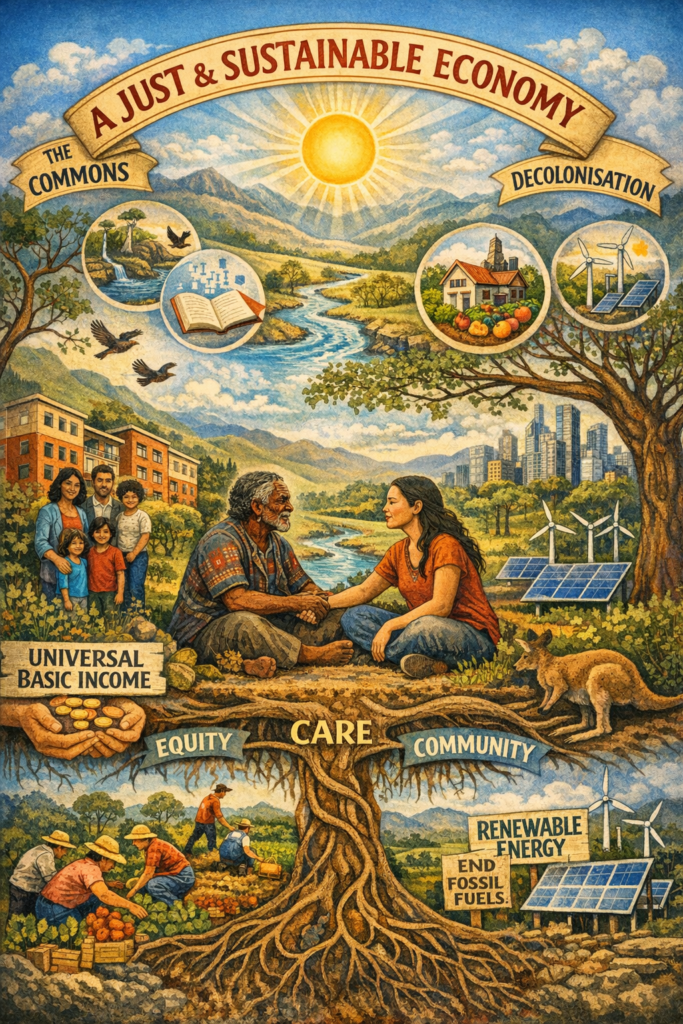
The economy is not a law of nature. It is a social construct: a system human beings design to organise how resources are controlled, produced, utilized, distributed and shared within communities. Because the economy is made, it is also shaped by values, by power, and by political choices about whose needs matter most. In contemporary Australia, this constructed system has often reproduced colonial capitalist logics, generating inequalities in access to essentials such as housing and food, and creating problems of economic security. This has led to a growing movement that argues the economy can and must be remade: toward something more just, sustainable and relational, drawing on Indigenous wisdom, decolonising principles, and practical institutional reforms.
A central idea in this reimagining is the commons: the shared foundations of collective wellbeing. The commons include: land, water and air as a shared foundation of life that everyone depends on, material resources governed with collective obligations, not just individual rights; urban infrastructure and public services; digital systems and platforms; and the vast, accumulated inheritance of human knowledge. Of course, individual usage or property rights exist with responsible obligations, but these assets should not be treated as mere commodities whose purpose is private extraction only or rentier profits. Instead, they can be governed as shared resources that are stewarded to ensure equitable access and rights, ecological resilience and obligations, and long-term collective benefit, so that collective welfare leads to individual welfare and, in turn, individual wellbeing leads to collective wellbeing.
Decolonisation and relational ethos
Decolonisation is crucial to this shift because it requires more than symbolic inclusion in economic matters. It involves interrupting the privileges, entitlements and securities for the benefit of the few embedded in modern capitalism that has come out of colonialism. These have structures that systematically elevate some groups while rendering others precarious. Decolonising economic thinking challenges the assumption that markets alone should determine what people deserve, and it demands new models of governance rooted in reciprocity, dignity, ecological responsibility and a relational ethos.
Indigenous Australian philosophies offer powerful guidance for such a transformation. Philosopher Mary Graham describes First Peoples’ governance systems as collaborative, sacralised and grounded in ecological stewardship. This is fundamentally different from the hierarchical, extractive logic of industrialists and merchants of the modern nation-state, who have become acquisitors at the expense of society as a whole.
At the centre of her thinking is a relationist ethic: the foundational relationship between people and land. The land created us, and therefore we are obliged to care for it in reciprocity: it sustains us, and we sustain it. This principle is often expressed in Australia today as Caring for Country. In this view, the relationship between land and people becomes the template for human society itself, shaping how we care for one another and organise collective life. Through Caring for Country and mutual assistance, life moves toward balance: there is a stable but dynamic way of reciprocal living where human needs are met without harming other people and the land. A community remains healthy, sustainable and fair in its practices and rules. This means abundance is not hoarded, connection replaces isolation, and wellbeing becomes a shared condition rather than a private achievement.
Some fundamental changes
To translate these principles into contemporary Australia requires reforms that directly reshape material conditions. Arguably, Universal Basic Income (UBI) is one such mechanism. It is a regular, unconditional payment made by the state (as a collective expression) to all that is envisaged to reduce poverty and financial distress, soften insecurity, and expand real freedom of economic choices, while allowing and expecting people to contribute to family, community, learning and care without the constant threat of deprivation. UBI that works on the basis of reciprocity expresses a relational ethos by guaranteeing each person the material security to live with dignity and respect and to contribute to society. So, wellbeing is treated not as something earned through hierarchy and scarcity, but as a shared foundation of collective care, like Caring for Country itself. This reflects a wellbeing economy.
Housing must be another pillar of a wellbeing economy. Safe, secure, affordable housing underpins physical and mental health, yet Australia’s housing crisis imposes severe financial and emotional strain. Over the last 5–10 years, Australia’s housing crisis has intensified as prices and rents surged faster than wages, driven by tight supply, rapid population growth, tax and investment settings that reward property speculation, and planning/construction constraints. The result has been worsening affordability and insecurity, with more people being forced into overcrowding, long commutes from cheaper areas to workplaces, rental stress, and homelessness. Home ownership has become increasingly out of reach for younger and lower-income Australians. This overall situation, and the expenses involved, also limits access to education, employment and community life while deepening marginalisation. Treating housing as a human necessity rather than primarily an investment vehicle would be a defining step toward economic justice.
The food system also demands transformation. Australia’s grocery sector is dominated by Coles and Woolworths which are large supermarket chains that together account for around 70% of sales, with smaller shares held by chains such as ALDI. Such concentration can squeeze producers through unfair terms and narrow margins, while limiting consumer choice and so contributing to high prices for food items. One alternative is Community Supported Agriculture (CSA), but it needs collective power of consumers to implement it. This could be through cooperative buying power.
CSA is a farm-to-community model where people pay upfront for a share of a farm’s seasonal harvest and receive regular produce deliveries, directly supporting local growers and sharing both the risks and rewards of farming. In this regard, CSA offers a more relational model: consumers (through cooperative buying) purchase a share of a farm’s harvest in advance—often for a season or year—and receive regular deliveries directly from growers (through a cooperative). This shortens supply chains, strengthens small-scale farming, builds trust and community ties, and reconnects people to land through reciprocal exchange. It may not work in large cities due to logistics, but offers prospects in smaller cities and regional and rural areas.
Finally, an economy aligned with Caring for Country cannot remain dependent on fossil fuels. The extraction and burning of coal, oil and gas are major drivers of anthropogenic climate change, destabilising ecosystems and threatening communities and future generations. A rapid transition toward renewable energy, localisation where possible, and reduced material throughput is not simply a technical necessity—it is an ethical realignment, consistent with stewardship and ecological limits.
Concluding note
Ultimately, building a new economy in Australia means bringing these strands together: recognising the commons, practising decolonisation as structural change, learning from Indigenous relationist frameworks, and implementing reforms such as UBI, universal affordable housing, fairer food systems, and clean energy transition. The goal is not merely a more efficient economy, but a more humane one—an economy that serves people while Caring for Country, and that makes balance in life, dignity and care the foundation of prosperity for all on an equitable basis.
https://macropsychic.substack.com/p/caring-for-country-and-economics

Mary Graham is an Australian Indigenous philosopher from the Kombumerri people of south-east Queensland, known for articulating Aboriginal philosophy as a distinct intellectual tradition grounded in Caring for Country, kinship, and collective responsibility. Her core contribution is the “relational” or “relationist” ethos: the idea that reality and personhood are constituted through relationships. First with land (Country), and then through interconnected obligations to family, community, and the more-than-human world. So, ethics is fundamentally about care, reciprocity and maintaining balance, rather than individual ownership, domination or accumulation.