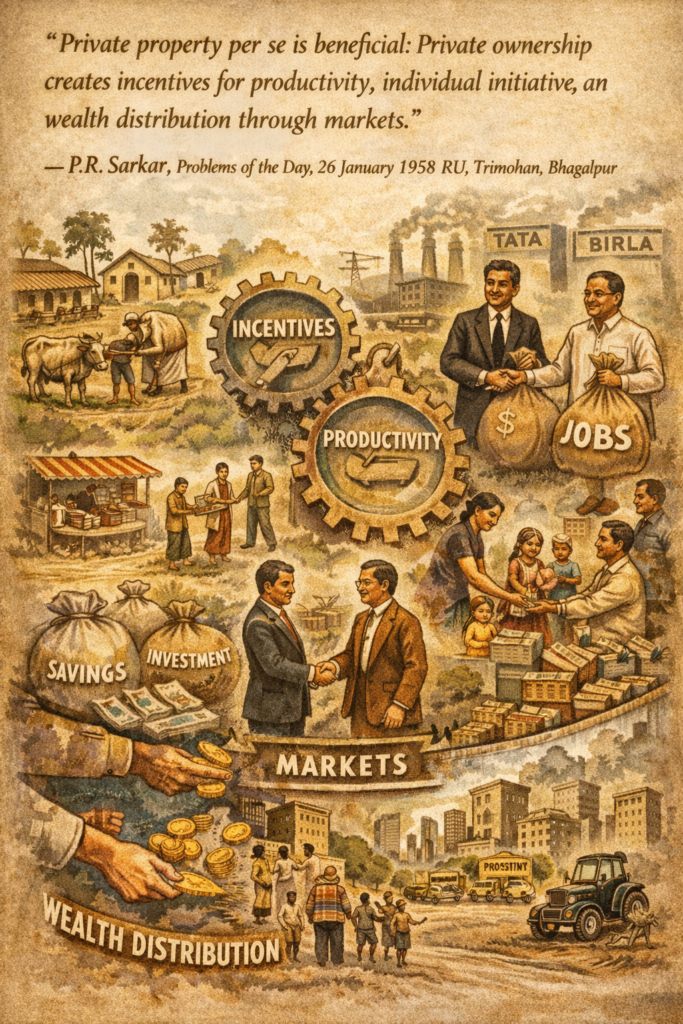
“Private ownership has been created by selfish opportunists, as the loopholes in this system provide them with ample scope for self-aggrandizement through exploitation.” PR Sarkar, Problems of the Day, 26 January 1958 Renaissance Universal, Trimohan, Bhagalpur
The system of private property – what it means in substance
The 1950-1960s was a very specific era in Indian intellectual, political and economic history, and the phrase “the system of private property” carried a politically distinct meaning. This differs from the ordinary meaning of how people use it today. The period back then was shaped by post-independence nation-building and Fabian-influenced planning that sought to use the state as a rational, ethical planner to guide economic enterprise toward social ends. In that period there were also many debates over land reform, industrial policy and social justice, in which “private property” was often associated with colonial-era concentration of wealth and feudal exploitation. As a result, critiques of private property in that era were less about abolishing ownership per se and more about redefining it in service of developmental equity, state-led modernization, and national self-reliance.
In post-independence India, the phrase “the system of private property” basically referred to the inherited colonial-era capitalist property regime, especially as it concerned land ownership and industrial and commercial holdings. This was the most important context. It was less a technical legal description than a normative critique of how property relations had evolved to privilege elites and constrained broad-based participation in economic opportunity and national reconstruction.
Before land reforms, India’s rural economy was defined by large landlords, zamindars* and jagirdars**, tenant farmers with insecure rights, sharecroppers, and bonded relationships of labour and debt. Under the Permanent Settlement of 1793 (a land revenue system), the zamindars were legally recognized as landowners, with the obligation to remit a fixed revenue to the colonial state. In practice, they became entrenched absentee landlords. Calling this “the system of private property” was often shorthand for unequal land distribution, landlord dominance, exploitation of sharecroppers, absentee ownership, and rent extraction. Indeed, these concerns became the central target of later land reform debates.
* Zamindars: hereditary landlords with increasingly legalized ownership, especially under British rule, often absentee landlords.
** Jagirdars: feudal grantees, whose rights were temporary or conditional usually awarded by a ruler (Mughal or prince) in return for military or administrative service.
In relation to industrial and commercial property, the phrase “the system of private property” also implied dominance of large private industrial houses (Tata, Birla, etc.), concentration of capital in limited private hands, and limited state control over heavy industry. Critics framed this as a continuation of colonial capitalist structures, and as obstacles to equitable development. There was also a push to counterbalance this with state-owned enterprises, which influenced India’s Second Five-Year Plan – called the Mahalanobis model.
Indian thinking in the 1950-60s
P.C. Mahalanobis was the architect of the Second Five-Year Plan and spoke about private property limiting industrial growth. He advocated for a large public sector to counterbalance private concentration of wealth and use of resources. His position reflected a broader developmental belief that strategic state ownership of heavy industry and capital goods (tools of production) was necessary to accelerate industrialization, achieve technological self-reliance, and prevent entrenched private interests from distorting national economic priorities in a newly independent India.
However, he was not anti–private property in principle. Mahalanobis accepted private ownership and private enterprise as legitimate parts of a mixed economy. He did not argue for collectivization or the elimination of markets. He distinguished clearly between abolishing private property (which he did not support) and limiting its dominance in strategic economic sectors during their early development. Mahalanobis was not opposing private property as a moral or ideological matter. He was arguing for temporary, strategic state primacy in key sectors to overcome structural underdevelopment. His position was developmental and pragmatic.
So, in the Indian discursive environment of the 1950s–60s, “the system of private property” basically meant a socio-economic order dominated by private ownership of productive assets, markets operating with minimal redistribution, and wealth concentrated in elite hands. It was a normative phrase, often politically thrown around, and used to justify land reforms, state-led industrialisation, some ideas of cooperative enterprises and movements, and socialist or semi-socialist planning. But it was not a doctrine to abolish private property.
Indian thinkers
Many Indian thinkers spoke in these terms. The main categories were Indian socialists, left-nationalists, Gandhian economists, and post-colonial economists. Indian socialists and left thinkers used the phrase to critique capitalism. These thinkers included:
- Dr. Ram Manohar Lohia, who critiqued landlordism and capitalist private property. He advocated for “decentralized socialism”, and wrote directly about abolishing private property in key economic sectors. But he did not call for abolishing private property altogether.
- Jayaprakash Narayan, whose thinking moved from Marxism to “partyless democracy” but in doing so he kept critiquing private property and spoke of “the private property system” as a cause of inequality. He also did not call for abolishing private property altogether. His critique was of a system, not ownership as such. When he spoke of “the private property system” he was criticising a social order dominated by concentrated ownership, inherited privilege and exploitation. He was not arguing that all private ownership should be eliminated.
- M.N. Roy (a radical humanist), who criticized the private property system as incompatible with democracy. He argued for cooperative ownership. He made an important conceptual distinction between private property as a system of power and private ownership as a legal form. When Roy argued that the private property system was incompatible with democracy, he meant a system in which productive assets are concentrated in the hands of a few, enabling economic domination that undermines political equality. He was not referring to private property per se or its abolition.
As well, there were a range of Indian communist thinkers from the Communist Party of India (CPI) and later the Communist Part of India (Marxist). They used the Marxist terminology of “system of private property” and “private ownership of the means of production”. This language appears openly in CPI literature of the time. They went a bit further and invoked Marxist theory of abolishing private ownership of the means of production, while not opposing personal property.
Gandhian and Post-Gandhian economists also used similar language to critique inequality. Again, they did not call for abolishing private property. They used critical language about “private property”, but rejected abolition for moral, practical and political reasons. These thinkers included:
- J.C. Kumarappa, who critiqued private property when it produced hoarding and exploitation. He advocated for village industry and trusteeship. Kumarappa opposed exploitative ownership, not ownership itself. He believed property becomes illegitimate only when it violates moral economy — that is, when it harms community welfare.
- Vinoba Bhave (of the Bhoodan movement), who talked about land as not truly “private property” but held in trust. In particular he criticized inequitable distribution of land. Vinoba rejected coercion entirely, including forced redistribution or nationalisation. The Bhoodan (land-gift) movement relied on voluntary transfer, not abolition. Bhave’s statement that land is “not truly private property” was moral, not legal. Ownership was still to remain legally private. The more important thing was that the obligations in relation to property should be ethical (and at a higher level, rooted in conscience).
Gandhians and Post-Gandhians sought moral transformation of ownership, not structural abolition. Indeed, they believed abolishing private property through the state would undermine moral agency, create bureaucratic domination, and replace one form of injustice with another. Clearly, for them, abolishing private property would require coercion — Gandhians reject this on principle. They believe in moral agency over compulsion. So, justice must arise from conscience and voluntary restraint, not force.
It’s not to do with abolishing private property per se
This short commentary shows that the phrase “system of private property” was common in India because in the 1950s–60s India was dealing with vast rural inequality, landlordism, agrarian debts, lack of industrial capital, and also the pressure to modernise. In essence, the phrase meant the inherited, unequal, exploitative structure of property ownership, especially rural land, that needed reform to achieve equality, development and national reconstruction. It was not a call for abolishing all private property or the legal notion of property and legal entitlements. The use of the phrase focused only on the concentrated, feudal or exploitative forms of private property inherited from colonial and pre-colonial systems.
Likewise, when P. R. Sarkar stated in 1958 that “private ownership has been created by selfish opportunists”, he was not calling for the abolition of private property per se. He was condemning a historically distorted system of ownership that enabled exploitation through societal norms and institutional support. Read in light of Indian debates of the 1950s–60s, Sarkar’s target is private ownership as a system of power and accumulation, not personal property or productive ownership in itself. This is the same approach taken in Mahalanobis’ developmental planning, Gandhian trusteeship, Roy’s cooperative democracy, and by others, and even in Indian Marxist critiques.
Sarkar’s emphasis is moral–structural: ownership becomes illegitimate when it enables excess wealth accumulation (hoarding), domination and rent extraction rather than serving collective welfare. His concern was economic arrangements that were unjust and anti-social. His statement fits squarely within a broader Indian intellectual tradition that sought to reform, decentralise and ethically subordinate property to social purpose, rather than abolish ownership outright. The legal concept of property was not under attack.
A reminder as to what property means in law
From a strictly legal standpoint, there is no separate legal category called “private property” — there is only property. Law recognises property through defined rights, interests, titles and obligations (which are related to ownership, possession, use, exclusion, transfer), all of which are created, limited and enforced by the state. The adjective “private” does no real legal work; it is a political, economic or sociological label, not a juridical one.
In law, property is never absolute or purely “private”: it is always conditioned by public oriented law, subject to taxation, regulation, compulsory acquisition, zoning, environmental law, and emergency powers. What is often called “private property” simply refers to non-state ownership, but even that ownership exists within a framework of public authority. There are also social obligations, which may seem minimal in today’s capitalist system, but they do exist and have to be strengthened. Thus, debates about “private property” are really debates about how property rights are structured, distributed and constrained. Property is not a thing, but a bundle of rights and so does not exist apart from society or the state.
https://open.substack.com/pub/macropsychic/p/what-was-meant-by-the-system-of-private