What are they, an attempted classification, utilization and distribution
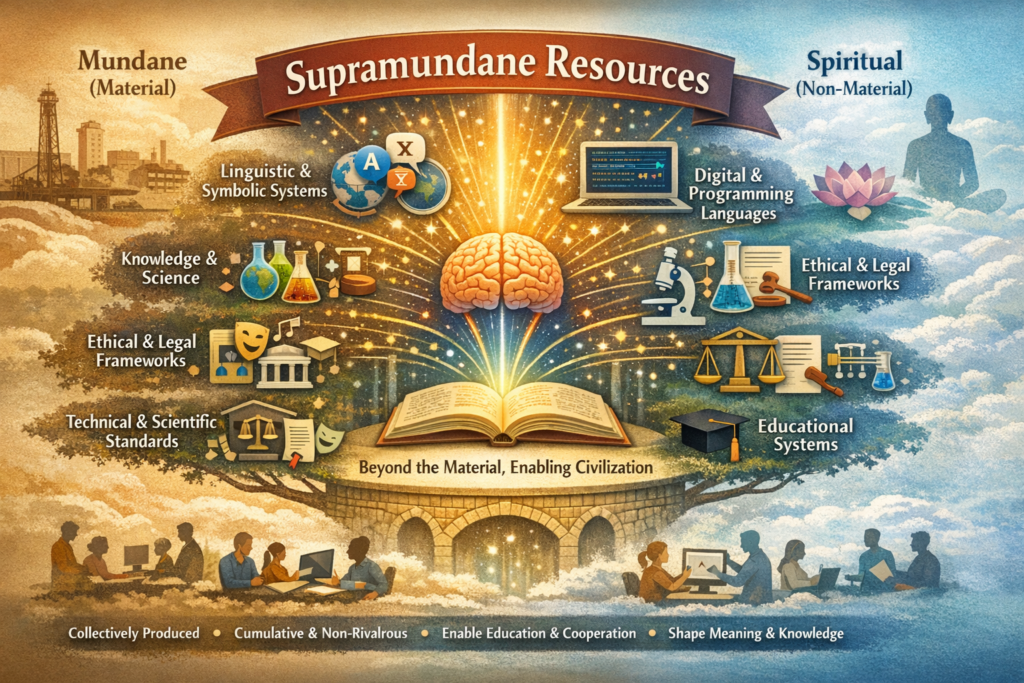
In a broad general sense, resources can be classified as mundane (material), supramundane (above the material) and spiritual (non-material). Supramundane resources are above the material yet socially and economically decisive, so they do have a connection to the material world. While they are intangible assets primarily created through collective human intelligence, and often over time, rather than through extraction from the physical world, they still need some manifestation in the physical world to be useful.
What might fall within supramundane resources? A short list could include spoken languages, computer programming and markup languages, scientific knowledge, mathematical systems, and numerous forms of data, information and knowledge, as well as accumulated learning across millennia, and systems such as law, accounting and so. Cultural memory and ethical frameworks could also be supramundane resources. Many supramundane resources shape meaning and understanding for human beings. These resources are not depleted by use; on the contrary, they often increase in value through sharing, learning and refinement.
General characteristics
Supramundane means beyond the ordinary, everyday or purely material world. It refers to things that transcend the physical or mundane realm. However, while essentially non-material (even if stored in a material form), they do not have characteristics that are transcendental or spiritual in nature. Many supramundane resources tend to be human-created, and essential for the development of civilisation. In contrast, the origin of spiritual resources is more fundamental and even beyond the scope of human mind.
Some general characteristics of supramundane resources are:
- Cumulative: They are built incrementally across generations, but may be built more quickly today than in the past (or at least their foundational elements are).
- Collectively produced: In their totality, they are rarely attributable to a single individual, though particular individuals may contribute specific or new aspects.
- Often non-rivalrous: Where one person’s use generally does not diminish another’s use, even if barriers to access exist, or access may have to be based on some notion of merit.
- Civilizational enablers: They are essential for education and shape how societies learn and transmit meaning, and how people innovate, coordinate, cross-collaborate and govern themselves.
They constitute the cognitive and also cultural infrastructure of humanity. Without them, material resources cannot be effectively organized, technologies cannot be built, and societies cannot plan rationally.
An attempted classification
Below is a possible classification of some supramundane resources.
1. Linguistic and symbolic systems (foundations of communication and shared meaning)
- Spoken languages (English, Mandarin, Arabic, Indigenous languages)
- Writing systems and alphabets
- Mathematical notation
- Markup and symbolic languages (HTML, XML, LaTeX)
These are collective cognitive tools enabling thought, coordination and transmission of knowledge across generations.
2. Digital and computational languages (abstract systems that power modern civilization)
- Programming languages (Python, C++, Java)
- Open-source software frameworks
- Algorithms and computational models
- Data structures and protocols
These are non-material systems that organise digital reality and enable global technological cooperation.
3. Knowledge and intellectual capital (accumulated human understanding)
- Scientific knowledge (physics, biology, medicine)
- Medical and epidemiological knowledge
- Engineering principles
- Philosophical and ethical frameworks
- Historical records and social learning
These are knowledge systems and knowledge databases that are cumulative, usually non-rivalrous, and essential for rational planning and innovation.
4. Cultural and civilizational heritage (meaning, identity and values)
- Literature, music, art, folklore and mythology
- Collective memory and storytelling
- Cultural norms and social practices
- Educational traditions
These shape directions in life and careers, and provide social cohesion, without being materially consumed (though their means of storage may be materially consumed).
5. Ethical, moral and legal frameworks (structures guiding collective behaviour)
- Concepts of justice, fairness and dignity
- Human rights doctrines
- Legal principles (rule of law, due process)
- Social contracts and civic norms
These govern power, cooperation and restraint beyond material force, and can orient human action toward collective well-being and long-term harmony.
6. Scientific and technical standards (invisible coordination infrastructure)
- Measurement systems (SI units)
- Accountancy (debits and credits)
- Internet protocols (TCP/IP)
- Health, safety, sustainability, etc standards
- Interoperability norms
These enable large-scale cooperation and trust without physical ownership.
7. Educational and cognitive systems and methods (human development assets)
- Literacy and numeracy
- Critical thinking skills
- Scientific reasoning
- Systems thinking
These amplify other supramundane resources and determine societal potential.
Maximum social utilization
For maximum social utilization, supramundane resources should generally be:
- Universally accessible (though this does not imply for free), especially through education, but also through devices and communications infrastructure.
- Continuously updated, re-understood, re-interpreted and re-applied, not frozen or monopolized.
- Applied toward collective needs, e.g. health, education, culture, sustainability and governance.
- Supporting mutual understanding and peace, by shaping how societies communicate, reason and cooperate beyond narrow material interests.
- Widely available (though this does not imply for free), or available on a transparent meritorious basis or to users who value it the most, so as to amplify human potential, allowing creativity, innovation and problem-solving to emerge at every level of society—not just among elites.
Rational distribution
Equitable distribution of supramundane resources does not mean uniform outcomes, but fair and equitable access, particularly to the foundations of knowledge, on a non-discriminatory basis. Attention has to be given to aligning access with social needs and ensuring human development and expression of potential which varies across societies. Examples of how rational distribution may be achieved are:
- Strong public education systems emphasizing literacy, digital competence, and critical thinking.
- Open knowledge frameworks (open science, open data, open standards) rather than proprietary enclosure.
- Making use of citizens science, citizens journalism, citizens sensing (data collection), citizens mapping, and other citizens systems that treat citizens as co-producers of knowledge and value, not merely consumers.
- Cultural pluralism, ensuring that diverse languages, traditions and knowledge systems are preserved and valued.
- Protection from monopolization, e.g. where knowledge is locked up resulting in concentrated power in the hands of a few.
For the good and happiness of all
When supramundane resources are treated as a shared heritage of humanity, societies can better move toward cooperation and collective upliftment. Knowledge becomes a tool for emancipation rather than domination. Know-how and technology become instruments of well-being rather than control. The rational distribution of supramundane resources and their maximum social utilization is a moral imperative for a just society and a sustainable civilization over time.
https://open.substack.com/pub/macropsychic/p/supramundane-resources
