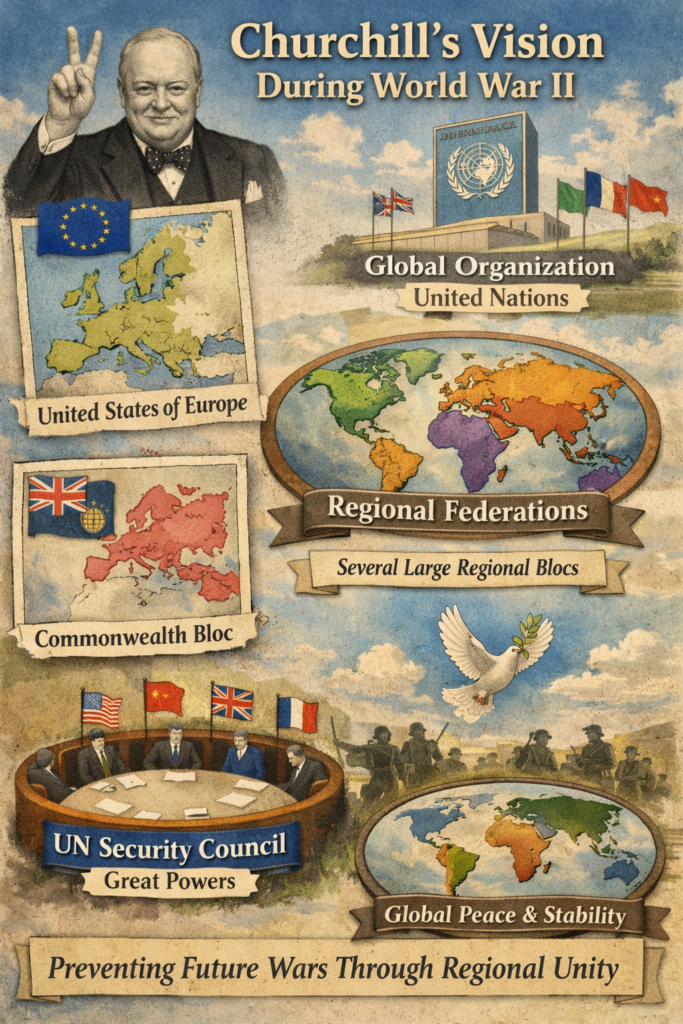
Regional federations in a governing world organization
Winston Churchill promoted a regional–federal world order during World War II as a way to prevent another global conflict and as a stepping-stone to a new international organization. His ideas did not find their way into the United Nations (UN), which was established soon after the war, but have inspired the development of supranational political units like what is now the European Union and the developing African Union, and other lesser unions. His ideas are scattered through speeches given from 1940 to 1945, implicit in the Atlantic Charter (Roosevelt & Churchill, 1941) which set out high level principles for a post–World War II international order, and in postwar reconstruction statements. Although his regional-federal ideas were ultimately overshadowed by the UN’s more international structure, they reflect an early recognition that layered world governance that combined regional cooperation with global oversight could offer a pragmatic path to lasting peace.
Churchill’s core idea: world order built on regional federations
During World War II, Churchill believed that lasting peace required grouping states into regional federations or large quasi-political units that would cooperate internally and collectively (externally) with each other. These regional bodies would then form the building blocks of a global organization. He envisioned something like:
- a United States of Europe (minus Britain),
- a British Commonwealth system,
- a Pan-American Union,
- a Soviet Eurasian bloc, and
- possible regional groupings in the Middle East and/or Balkans.
It was actually by 1943–1945, that Churchill had reasoned out his four or five major geopolitical blocs:
- A United Europe (with the alignment of Ireland being a matter for its choice), being a federation of continental states in order to prevent German militarism by embedding Germany within shared political and security institutions.
- The English-Speaking Commonwealth, being a loose confederation led by Britain, which included the entire United Kingdom, Dominions of the British Commonwealth (Australia, Canada, New Zealand, South Africa), and India (then still British), basically to preserve Britain’s global influence in the postwar order.
- The United States and the Pan-American region, which supported Roosevelt’s plan for a hemispheric bloc, as this provided collective defence, economic coordination and political stability needed for a durable global security order.
- The Soviet Union as a Eurasian regional power, which would dominate a region of satellite states, as this would contain Soviet power and integrate it into a wider security architecture, so reducing the risk that unchecked regional dominance would translate into global instability.
- A Middle Eastern or Balkan federation (which was sometimes added).
Also, Churchill (1921/2012) privately discussed:
- a Greek–Yugoslav federation,
- an Arab federation, and
- an Asian federation.
These ideas were never realised but reflected his thinking on global security and prosperity. Essentially, these federations, or rather confederations, would collectively uphold a global security system by aggregating the power of smaller states into stable regional blocs capable of deterring aggression and preventing any single nation-state from acting unilaterally. By pooling sovereignty while preserving national identity, these federations could restrain destructive nationalism and provide reliable regional enforcement of peace, reducing the burden on a central global authority. Together, such federated regions would form mutually reinforcing pillars of a wider international order, enabling collective security to function in practice rather than merely in principle.
United States of Europe: Churchill’s most famous regional idea
In the early period of World War II, Churchill (1943) discussed his ideas for a Council of Europe and United States of Europe. In his BBC radio broadcast on 21 March 1943, titled Post-War Councils on World Problems (also known as the Post-War Planning or The Four Years’ Plan speech), he proposed a post-war world organization with large continental or sub-continental regional councils, including a Council of Europe. He stated: “One can imagine that under a world institution embodying or representing the United Nations… there should come into being a Council of Europe and a Council of Asia… We must try… to make the Council of Europe… into a really effective league.”
Churchill proposed that continental European nations should federate after the war. This comes through in his well-known Zürich Speech (Churchill 1946). In this speech delivered on 19 September 1946, Churchill called for the reconciliation of France and Germany as the foundational step toward building “a kind of United States of Europe” to ensure lasting peace and prevent future wars on the continent. He envisioned this regional federation as a means to recreate a unified “European family”, while notably excluding Britain from direct membership but positioning it as a supportive partner.
He thought Britain should support the Council of Europe but not join it because Britain was the centre of the British Commonwealth, the British Empire, and transatlantic alliances. So, Britain had separate work to do. Churchill imagined Britain as a bridge between world regions. That is, he viewed Britain as uniquely positioned at the intersection of three overlapping “majestic circles” (Churchill, 1950): the British Empire and Commonwealth, the English-speaking world (particularly the special relationship now developing with the United States), and a uniting Europe. This would allow Britain to serve as a connector and mediator among these spheres of influence. A prominent example of this view comes from his speech on 9 October 1948 (after the formation of the UN) at the Conservative Party Conference, where he declared that Britain stood “at the very point of junction” (Churchill, 1950) of these circles, enabling it to link transatlantic alliances with European reconciliation and British Commonwealth ties for global stability.
Why he favoured regional federations
The bases of Churchill’s arguments for regional federations are that:
- small states were vulnerable to aggression if left alone because they typically lacked sufficient military, economic and strategic capability to deter aggressors,
- regional federations could best achieve collective security because aggression against any one member state is an attack on all,
- federations would prevent the recurrence of aggressive nationalism by binding states into shared institutions that channel national ambitions toward cooperative goals,
- federations would create stable political and economic blocs that could negotiate peace because they have institutionalized long-term cooperation which aligns the strategic interests of their member states, and
- federations could pool sovereignty, or aspects of sovereignty, without abolishing national identity.
Accordingly, these larger units or federations would be capable of resisting dictatorships and avoiding future wars. As regional groupings they were envisioned as vital building blocks for a more stable world order, bridging national sovereignty with federated collective strength, and ultimately global strength and harmony. This architecture was required for lasting world peace, with authority exercised at the lowest effective level, i.e. national or regional, while those functions that could not be managed nationally or regionally would be coordinated and handled at the global level. This would depend on the type of issue being considered, i.e. is it really a national, regional or global issue. This is basically an application of the principle of subsidiarity.
Blocs in the United Nations
Before its formation, Churchill did not see the UN as one monolithic world government, nor was it ultimately established as such. Instead, he envisioned it as a global system resting on regional pillars. He described a proposed UN as a world organisation supported by regional councils, which were in turn supported by nation-states. He expected that Europe would act as one regional bloc within a UN, the British Commonwealth would act as another, and the United States, Soviet Union and China would each anchor their own regions. This would produce a multi-layered global architecture of: Nations → Regional Federations → United Nations. He saw these stages as a natural evolution: regional unity → continental unity → global security.
Crucially, Churchill’s layered conception was also a response to political realism and historical failure. He believed that peace could not be sustained by abstract universalism alone, but required institutions holding actual power, with consent of its members (via blocs or federations), as this was likely to be the practice in the near future. Regional federations would absorb local rivalries, manage day-to-day security, and reduce the likelihood of a dispute escalating to the global level. In this way, a proposed UN would act as an ultimate forum of coordination and restraint rather than a substitute for national or regional responsibility. In this sense, a UN was intended not to replace sovereignty, but to discipline it. This would prevent both aggressive nationalism and overcentralised global authority by balancing power across at least three mutually reinforcing layers: national, regional, global.
Summary
During World War II, Churchill advocated for:
- a world order built on several large regional federations, including a United States of Europe and a British Commonwealth bloc,
- a global organisation (later the UN) built on these regional foundations,
- a global Security Council led by great powers overseeing global peace.
Churchill’s thinking on design of a world authority rested on:
- balance of power across regions, not by separate nation-states,
- collective security within regions, and
- a supreme global body (UN Security Council) to enforce peace.
He believed regional federations would:
- stabilize each continental area,
- reduce conflicts between neighbours,
- strengthen the global system against future dictatorships, and
- prevent the scourge of war without eliminating sovereignty.
References
Churchill, W. S. (1921/2012). Middle East correspondence (D. Carlton, Ed.). Cambridge University Press.
Churchill, W. S. (1943, March 21). Post-war councils on world problems [Radio broadcast speech]. BBC. https://www.ibiblio.org/pha/policy/1943/1943-03-21a.html
Churchill, W. S. (1946, September 19). United States of Europe [Speech transcript]. Speech delivered at the University of Zurich, Zurich, Switzerland. International Churchill Society. https://winstonchurchill.org/resources/speeches/1946-1963-elder-statesman/united-states-of-europe/ (This is a reliable full transcript. The speech is commonly referred to as the Zurich Speech or Let Europe Arise.)
Churchill, W. S. (1950). Conservative Mass Meeting: a speech at Llandudno, 9 October 1948. In Europe Unite: Speeches 1947 & 1948 (pp. 416–418). Cassell. https://web-archives.univ-pau.fr/english/special/SRdoc1.pdf
Roosevelt, F. D., & Churchill, W. S. (1941, August 14). The Atlantic Charter. The Avalon Project, Yale Law School. https://avalon.law.yale.edu/wwii/atlantic.asp
https://open.substack.com/pub/macropsychic/p/winston-churchill-and-world-governance