Problems with methodology and other matters
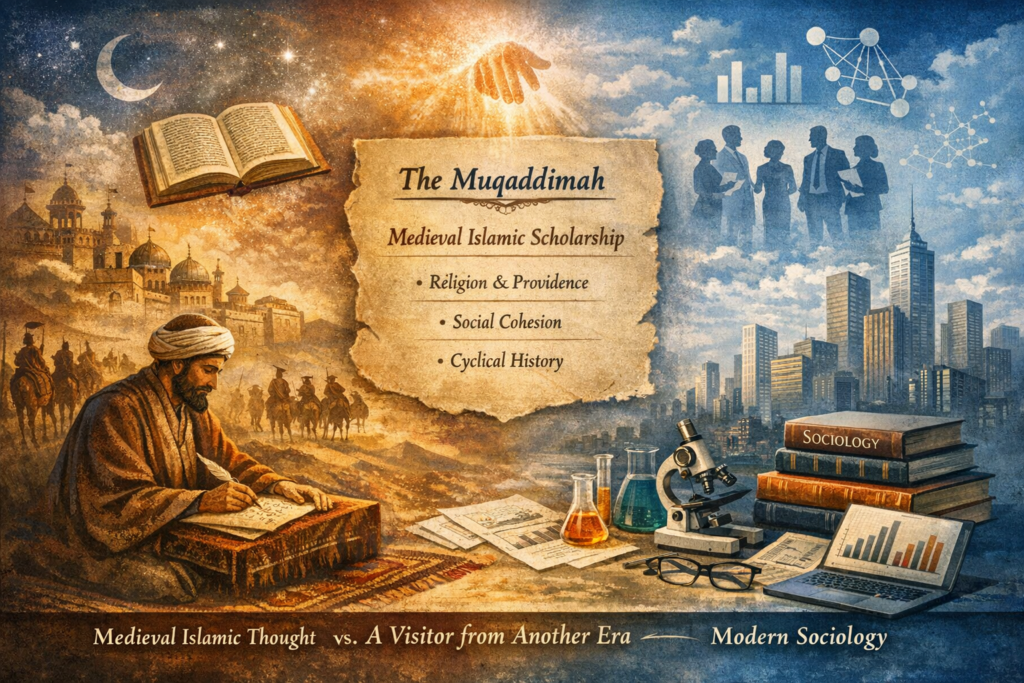
Ibn Khaldun (1332–1406) was a Tunisian-born Arab scholar and author in 1377 of the book al-Muqaddimah (Ibn Khaldun, 2005), which is the introduction (Prolegomena) that falls within his seven volume universal history series: Kitāb al-ʿIbar (Book of Lessons). Although it is formally an introduction, the Muqaddimah became independently famous because it treats history as a science with laws. Also, as a theoretical introduction to history, society, and civilisation, it anticipates sociology. So, Ibn Khaldun is frequently celebrated as a precursor to sociology for his insights into social dynamics, theory of polity formation and decline, group solidarity (ʿasabiyyah), economic factors, and the cyclical rise and fall of civilizations. However, can he really be considered the founder of the sociology discipline?
Sociology as a formal and systematic field of study emerged in 19th-century Europe. Auguste Comte first coined the term sociology in 1838 and argued that social life could be studied scientifically through the discovery of underlying laws. Karl Marx, while working primarily in political economy, developed a structural analysis of society centred on class relations and material conditions that profoundly shaped sociological thought. This intellectual groundwork was followed by Émile Durkheim, who established sociology as an empirical academic discipline through systematic methodology and the concept of social facts. Then came Max Weber, who further refined the field through interpretive, comparative and historically grounded analysis of social action and meaning.
In contrast, Ibn Khaldun’s work, while innovative for its time, belongs more to early historical scholarship, philosophy and political theory than to modern sociology. This is based on the premise that he did not venture into a formalized, systematic approach for studying society. Rather, he provided analytical insights into social cohesion, power, and historical change. This anticipated many concerns of later sociological theory, though without constituting a formal discipline in itself.
Moreover, and importantly, his integration of religious themes rooted in Islamic theology, mysticism, and a providential view of history, introduces elements that diverge from sociology’s secular, empirical and value-neutral foundations. This effectively renders his contributions incompatible with the discipline’s modern definition. So, while Ibn Khaldun remains a towering intellectual figure whose insights continue to inspire interdisciplinary study, he is more accurately a pioneering philosopher of history and civilization rather than a founder of sociology in its contemporary form. In many ways, his true legacy lies in bridging faith and reason to illuminate human societal dynamics. He operated fully within an Islamic worldview yet insisted that social phenomena follow discoverable patterns and causes. Religious belief need not obstruct scientific thinking about society.
Why Ibn Khaldun Is Not the Founder of Sociology
Several reasons explain this. They are as follows:
Chronological and Disciplinary Context
Ibn Khaldun wrote in the 14th century. His Muqaddimah analyzes human society through observation and reason, but it serves more as an introduction to history, not as a standalone social science. Modern sociology emphasizes empirical methods, including statistical analysis, and hypothesis testing, which are more rigorous than what was possible in Ibn Khaldun’s time. He did not really advance the need for such methods, which developed in the West over time. Today’s sociology also benefits from institutional frameworks, e.g. universities, journals and professional associations, which did not exist in his era. Again, these developed over time. In this context, Ibn Khaldun is better seen as an influential precursor rather than the originator of sociology.
This is because, in its usual sense, sociology is the systematic study of social relationships, social structures, and social processes. That is, how human life is shaped by patterns of interaction rather than by individual biology or psychology alone. Sociology examines how societies are formed, how they function, how they persist, and how they change, and decline. More scientific and rigorous approaches to this study emerged in the late 19th and early 20th centuries, as thinkers such as Durkheim and Weber established sociology as a distinct empirical discipline. This period saw the introduction of systematic data collection, comparative analysis, and critical methodological awareness, marking a shift from speculative social philosophy toward evidence-based inquiry.
Ibn Khaldun observed and reasoned, but did not develop real tools for a sociological approach. This came into prominence through Durkheim and his insistence on treating social facts as objective phenomena and Weber through his development of interpretive yet methodologically disciplined analysis of social phenomena. They laid the foundations for modern sociological research, which increasingly combined theory with quantitative and qualitative methods to study social life with analytical rigour. Ibn Khaldun may have had this in the back of his mind, but did not advance it. So, he is more a precursor than a founder of sociology.
One can argue that ethnocentrism in Western academia has also played a role in often prioritizing figures like Durkheim and Weber as founders of sociology, due to cultural bias, and overlooking or marginalizing non-Western thinkers. However, other thinkers did ask the core question of how patterned social forces shape what individuals can do as members of society, not merely what individuals do. Whereas, Durkheim and Weber shaped sociology’s foundations, by seeking to understand and methodically explain:
- social structures and institutions, such as family, economic systems and order, religious life, the state as collective conscience, class differentiation and division of labour;
- social relationships of power, cooperation, collaboration, solidarity, and conflict arising from opposing interests, and how they are shaped by established norms;
- social processes of socialization, stratification, mobility, transition and modernization;
- collective meaning through values, symbols, culture and ideology.
Methodological Differences
Ibn Khaldun did carry out critical examination of historical sources and empirical observation of social phenomena, so far as possible within his historical context. For example, he analysed the character of nomadic Bedouin tribal confederations, particularly Hilalian descendants of the Banū Hilāl and Banū Sulaym, and the manner in which they conquered or dominated sedentary Hafsid urban centres in Ifriqiya (modern Tunisia and eastern Algeria – part of the larger Maghreb region), during the 14th century. Ibn Khaldun witnessed many of these processes firsthand. He used such observations to argue that the dynamics involved showed recurring cycles of political consolidation, prosperity, and decline. In this cycle, nomadic solidarity (ʿasabiyyah) enables conquest but gradually dissipates as ruling groups become urbanised. Note that while initial nomadic Hilalian migrations began earlier, in the 11th century, their continued political influence and recurrent dominance across parts of the Maghreb persisted into Ibn Khaldun’s own lifetime.
During that time, nomadic tribes with strong group solidarity periodically used military might to overpower urban dynasties such as the Hafsid Sultanate. They extracted tribute, asserted control over agricultural lands and trade routes, and captured cities such as Kairouan and Tunis, or reduced them to dependency. Ibn Khaldun personally observed how nomadic Bedouin tribes, while effective in conquest, often lacked the administrative capacity required for sustained urban governance, undermining taxation systems, commercial activity, and infrastructure maintenance. Over time, this contributed to economic contraction and urban decline. This recurring pattern: dynasty → nomadic conquest → new dynastic rule → urban prosperity → decay → replacement (e.g. by a new nomadic group), forms a central empirical basis for Ibn Khaldun’s cyclical theory of dynasty/polity formation.
However, critics argue that his theories, while highly insightful, often remain anecdotal and closely tied to specific North African and Islamic contexts, which limits their universality. Today, his approach can be seen as lacking the positivism and objectivity associated with modern sociology. Also, he did not use systematic data collection, experimental or quasi-experimental methods, and falsifiable hypotheses to test explanations of social life, that make sociology a scientific discipline despite the complexity of its subject matter. Nevertheless, sociologists use historical events and records as empirical material to trace the development of institutions, e.g. the state, religion, capitalism, as structured systems of norms in social life. They compare social structures across periods, and test sociological theories over time. For example, Weber used historical cases to explain rationalization and authority. Historical-comparative sociology though is a subfield of sociology.
While Ibn Khaldun articulated general principles such as ʿasabiyyah (social cohesion) and the cyclical formation, maintenance, decline and renewal of authority through polities (states), he did not formalise these ideas into a clearly articulated methodological framework that could be tested across different societies. Nor did he develop a replicable research design that could be independently applied. His reasoning blends observation, historical narrative, moral reflection, and theological assumptions, leaving the boundary between explanation and interpretation often indistinct. As a result, Ibn Khaldun is best understood as a pioneering proto-sociological thinker whose analytical insights laid important groundwork for later social science, but who remained embedded in pre-modern historical scholarship rather than establishing a fully systematic science of society.
Overemphasis in Modern Retellings
The narrative of Ibn Khaldun as the ‘father of sociology’ gained traction in the 20th century through scholars like Arnold Toynbee and Ernest Gellner, who highlighted his secular-seeming elements. However, this often involves selective reading, ignoring the holistic nature of his work. As historian Robert Irwin notes (2018), attempts to ‘modernize’ Ibn Khaldun by framing him as a proto-sociologist denature his ideas, stripping away their original context. Irwin’s book on Ibn Khaldun offers one of the most insightful analyses, including that some Western thinkers have tended to put Ibn Khaldun on an undeserved pedestal.
A further problem with these modern retellings is that they risk anachronism and category error, projecting contemporary disciplinary boundaries and methodological expectations backward onto a 14th-century thinker. By extracting concepts such as ʿasabiyyah and treating them as early versions of sociological variables, later commentators often overlook the fact that Ibn Khaldun did not conceive the study of society as entirely detached from theology, providence and morality. Providence (divine power) guides, sustains and orders the course of the world and human social affairs.
This retrospective framing of Ibn Khaldun’s concepts can obscure the fundamentally integrative nature of his thought, in which history, politics, ethics and religion formed a single explanatory worldview. As a result, Ibn Khaldun’s work is praised less for what it actually was than for how neatly it fits into the modern academic discipline of sociology. This flattens its internal complexity and diminishes its value as a distinctive product of medieval Islamic scholarship, rather than being an early version of a well-developed sociology.
How Religious Themes Undermine Khaldun’s Work as ‘Actual Sociology’
Ibn Khaldun’s integration of Islamic religious elements into his writings is not peripheral but central to his framework, infusing his analysis with moral, metaphysical and supernatural dimensions that clash with sociology’s commitment to secularism and to empirical and causal explanations. Modern sociology, influenced by the Enlightenment, seeks to explain social phenomena through human agency, social structures, cultural meanings, institutions, and material conditions, without invoking divine intervention or religious dogma. Ibn Khaldun’s integration of religious assumptions situates his work outside modern sociology as this leads to lack of testable explanations.
The following are three objections that pinpoint how his work is considered as outside of sociology. They are as follows:
Incorporation of Mysticism and the Supernatural
Influenced by Sufism (Islamic mysticism), which he defended as a legitimate religious science, Ibn Khaldun discussed phenomena such as miracles, sorcery, predictive dreams, numerology, letter symbolism and astrology in the Muqaddimah. He accepted the possibility of supernatural forces in principle, insofar as affirmed by Islamic revelation (waḥy). Islamic revelation is knowledge believed to originate from God, validated primarily by the Qur’an and secondarily by reliably transmitted prophetic tradition, i.e. the sayings, actions and approvals of the Prophet Muhammad. It is interpreted through established Islamic scholarly methods rather than individual experience.
Accordingly, he strongly warned against charlatans and false practitioners who claim special knowledge or powers for personal gain. In this way, he drew clear limits around how supernatural phenomena could be acknowledged without allowing mere human claims to serve as their verification. Still, he located such phenomena within the unseen world (al-ghayb), which lies beyond human sensory perception and empirical verification. This darker world, as Irwin (2018) observes, reflects a view in which divination and occult knowledge coexist with Ibn Khaldun’s historical analysis. Such elements do not align with sociology’s rational methodological framework, which does not admit supernatural explanations within empirical inquiry.
Providential View of History
Ibn Khaldun viewed history as ultimately unfolding within divine providence, consistent with Qur’anic teachings, but insisted that historical events be explained through identifiable social, economic and political causes. In his analysis the erosion of religious commitment and moral decay are treated as contributing factors that weaken ʿasabiyyah (social cohesion), alongside fiscal mismanagement, luxury and institutional decline. Religion functions as a powerful unifying force that can strengthen collective solidarity and legitimate political authority; its weakening removes an important source of cohesion. Even though religious decline does not serve as a trigger for divine punishment, still Ibn Khaldun asserted that divine providence operates through social mechanisms, and this is even predictable. Hence, civilizational cycles.
Civilizational cycles are not treated as a core object of analysis in modern sociology, which tends to focus on specific social structures and processes rather than holistic civilizational trajectories or providence. This is the case even though sociology can and does engage with long-term societal change, including rise and decline, but does so indirectly and selectively. Ibn Khaldun’s approach means his work sits between causal historical analysis and theological interpretation, aligning it more closely with pre-modern historical scholarship than with value-neutral social science.
Moral Framework Over Objective Analysis
Drawing from Islamic scholars such as al-Ghazali, Ibn Khaldun’s work is steeped in ḥikma (wisdom) and moral principles derived from religious texts. He reconciles human social regularities (ʿādāt – customs, sunan – patterns,ṭabāʾiʿ al-ʿumrān – inherent characteristics of social organisation) with divine revelation by treating social causation as the means through which divine providence operates. This framework is religiously grounded, even though in his analysis of observable social mechanisms, religion functions as a powerful source of moral discipline and collective cohesion that reinforces political authority. This is particularly so in the formative stages of dynastic rule. For example, in the Maghreb, Bedouin tribes following conquest often used religion instrumentally for legitimation, cohesion and discipline, rather than engaging in theology for its own sake.
Still, his normative framework means that social outcomes are evaluated within a religious moral horizon, even as they are explained through socio-economic and material causes. In contrast, modern sociology seeks methodological neutrality, deliberately bracketing religious belief and avoiding prescriptive judgements grounded in faith. In this regard, while Ibn Khaldun insists on causal explanation, he holds that God governs history through regular social laws (sunan). Moral decay does not trigger direct divine punishment; instead, it removes the conditions under which societies can flourish. Collapse follows because God has ordered the world such that injustice and excess undermine social order. Conversely, justice, moderation and fair administration reinforce social cohesion and uphold durable political order. Providence thus gives history moral meaning without displacing causal analysis.
Conclusion
In conclusion, while Ibn Khaldun’s Muqaddimah represents one of the most original and sophisticated analyses of society produced in the pre-modern world, it does not constitute sociology in the modern disciplinary sense. That said, his insights into social cohesion, political authority, economic life, and cyclical historical change undeniably anticipated later sociological concerns. However, his work remained firmly embedded in medieval Islamic historical scholarship, shaped by a normative religious framework and a providential view of history, even though demonstrating rigorous reflection on social patterns and causes.
In essence, while Ibn Khaldun’s observations on society were groundbreaking, his religious worldview within which God, revelation (waḥy) and divine providence ultimately shape the meaning and limits of human affairs, places his work outside the secular methods of modern sociology. The Muqaddimah remains a product of medieval Islamic scholarship, valuable for its analytical insights but distinct from the scientific discipline of sociology that emerged centuries later. As Irwin (2018, p. xiii) aptly puts it, reading the Muqaddimah feels like “encountering a visitor from another planet”, highlighting its otherness in relation to the modern social science of sociology.
References
Ibn Khaldun. (2005). The Muqaddimah: An introduction to history (F. Rosenthal, Trans.). Princeton University Press. (Original work published 1377)
Irwin, R. (2018). Ibn Khaldun: An intellectual biography. Princeton University Press.
https://macropsychic.substack.com/p/was-ibn-khaldun-really-the-founder
