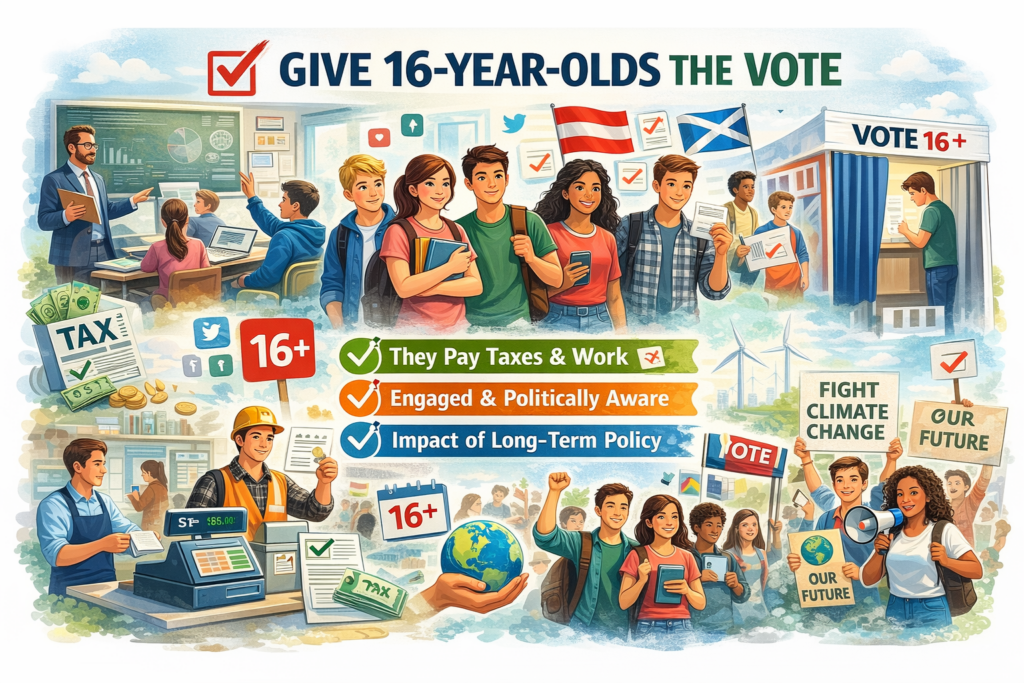
Yes, 16- and 17- year-olds have cognitive abilities comparable to adults in evaluating complex issues. Adolescents can process political information and make reasoned choices, especially when engaged through education. Denying them the vote dismisses their intellectual maturity.
Many 16-year-olds work, pay taxes, and contribute to society but lack a voice in how those taxes are used. This mirrors historical grievances that sparked previous changes/reforms for a participatory society when it comes to political and other matters. Allowing the vote to persons above 16 years of age ensures their economic contributions are matched with political agency.
Voting at above 16 years of age encourages lifelong civic participation. In Austria the voting age is 16, and there is a higher turnout among young voters and sustained engagement into adulthood. Austria lowered its voting age to 16 for all elections (local, regional, national, and European Parliament) in 2007. Early voting fosters a culture of responsibility and counters apathy.
Young people are disproportionately affected by long-term policy decisions – climate change, education, and economic stability. Yet, they are excluded from shaping these outcomes. Giving 16-year-olds a vote ensures their interests are represented.
Today’s youth are well-informed, thanks to widespread access to information via the internet and social media. Involvement in various political and social movements, e.g. climate strikes, are indicative of their political awareness and activism. Voting rights would channel this energy into participatory processes of governance, including government.
At 16, individuals can drive, work, pay taxes, and face legal consequences as adults in some jurisdictions. If society trusts them with these responsibilities, it is inconsistent to deny them the right to vote. Scotland also allows 16-year-olds to vote in certain elections: Scottish Parliament elections, Scottish local government elections, Scottish referendums. This was first introduced in 2014.
Older generations can dominate voter turnout, skewing policy toward their interests. In the USA the 2020 election data showed 65% of voters over 65 turned out compared to 51% of those 18-24 (US Census Bureau). Lowering the voting age diversifies the electorate, ensuring a broader range of perspectives.
Integrating knowledge of voting systems and processes into high school civic education creates a practical learning experience. Schools can prepare students with non-partisan resources. This aligns with progressive values of inclusion, equity, diversity and empowering marginalized groups. Then these voices that are ready, willing and deserving of voting rights.
Links:
