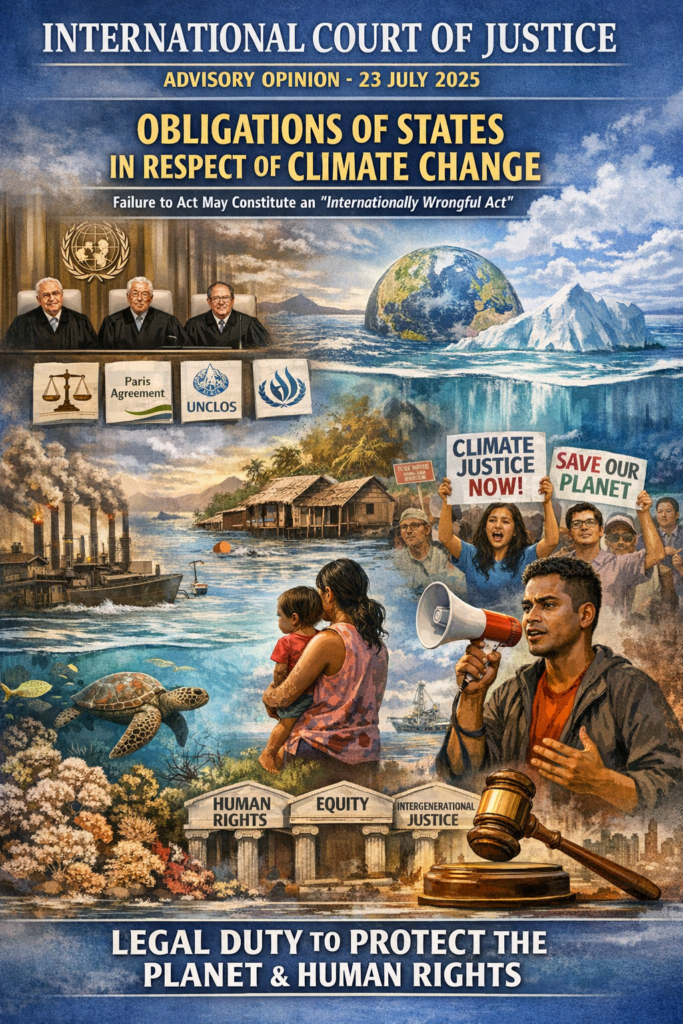
On 23 July 2025, the International Court of Justice (ICJ) issued a landmark advisory opinion – OBLIGATIONS OF STATES IN RESPECT OF CLIMATE CHANGE – declaring that states have a legal obligation under international law to address climate change, and that failure to meet this obligation may constitute an “internationally wrongful act”. An internationally wrongful act is a concept in public international law referring to conduct attributed to a state that breaches international legal obligations and gives rise to state responsibility. While the opinion is non-binding, it carries significant legal and political weight and is widely regarded as a pivotal moment in the evolution of international climate law.
International obligations
The ICJ affirmed that states are bound by obligations under existing international environmental and human rights frameworks, which includes the Paris Agreement, the United Nations Convention on the Law of the Sea (UNCLOS), and customary international law. Human rights referred to were the rights to life, health, and a healthy sustainable environment. International obligations require states (and, in some cases, other international actors) to act, refrain from acting, or achieve certain standards of conduct under international law. International customary law binds all states, as a general rule (except persistent objectors which seldom occurs), regardless of whether they have signed or ratified a particular treaty.
The Paris Agreement to the United Nations Framework Convention on Climate Change (UNFCCC) was adopted collectively, by consensus, by all Parties to the UNFCCC at the 21st Conference of the Parties (COP21) in 2015 in Paris and entered into force in 2016. It unites nearly all nations, and the European Union, in legally binding commitments to limit global temperature rise and strengthen resilience to climate impacts through collective, transparent action. Obligations require states to reduce greenhouse gas emissions, exercise due diligence to prevent environmental harm, and engage in international cooperation to combat climate change. The Paris Agreement is characterised by nationally determined contributions (NDCs) and a facilitative, non-punitive compliance framework, reflecting a hybrid model that combines legal obligation with flexible, state-driven ambition.
UNCLOS is the international treaty governing the oceans, often described as the ‘constitution for the oceans’. It was adopted in 1982 and entered into force in 1994, and binds the vast majority of states. Note the United States is not in UNCLOS, but is in the previous 1958 Geneva Conventions on the Law of the Sea, and also accepts many UNCLOS rules as customary international law. UNCLOS contains general obligations to protect the marine environment and prevent marine pollution. Although UNCLOS does not mention climate change explicitly, marine environmental harm in UNCLOS is interpreted to include negative impacts of climate change. Climate impacts such as ocean warming, sea-level rise, ocean acidification and coral bleaching are increasingly framed as marine environmental degradation, bringing them within UNCLOS obligations so that states are required to do something about them.
Crucially, the ICJ rejected arguments advanced by major emitters such as the United States and China, and also by Australia, that their legal responsibilities are confined solely to the UNFCCC and the Paris Agreement, and not by other treaties. Instead, the ICJ emphasized a broader legal framework, incorporating human rights obligations, the principle of equity, and intergenerational justice. It made clear that climate obligations arise across the whole corpus of international law. Accordingly, states cannot avoid responsibility by relying on fragmented treaty regimes or narrow interpretations of consent to do something, particularly where fundamental rights and long-term harm are at stake.
Implications
The advisory opinion, though not legally binding, could pave the way for climate-vulnerable nations, such as Vanuatu and other small island developing states (SIDS), to seek reparations for climate-related harm. Reparations might include restitution, such as rebuilding infrastructure or restoring ecosystems, or monetary compensation, although establishing causation between a specific state’s emissions and particular damages remains a significant legal hurdle. The ICJ also highlighted that states have an obligation to regulate private actors, including fossil fuel companies, and that continued subsidies or approval of new fossil fuel exploration could be incompatible with these international obligations.
The ruling is viewed by many climate advocates and vulnerable nations as a turning point. As state inaction on climate change can amount to a violation of international law, this advisory opinion could encourage climate litigation around the world, both in international and domestic courts, against states and corporations. It aligns with other recent international rulings. Namely, CLIMATE EMERGENCY AND HUMAN RIGHTS by the Inter-American Court of Human Rights and CLIMATE CHANGE AND INTERNATIONAL LAW by the International Tribunal for the Law of the Sea, which have similarly underlined states’ responsibilities in addressing climate threats.
People’s movement
The initiative for the ICJ case was launched in 2019 by a group of law students from Vanuatu, which ultimately led to a United Nations General Assembly resolution in 2023 (A/RES/77/276) requesting an ICJ advisory opinion. The unprecedented scale of participation by 96 countries and 11 international organizations who submitted arguments, demonstrates the global urgency of the climate crisis, particularly from frontline states facing existential risks like sea-level rise. Climate justice advocates, including Vishal Prasad (a Pacific/Fiji climate justice activist and director Pacific Islands Students Fighting Climate Change) and Vanuatu’s Climate Minister Ralph Regenvanu, hailed the opinion as a major victory. Even though symbolic (in that it is advisory) it has already shown its practical significance in empowering smaller nations and youth-led movements.
Still, its implementation depends on state willingness, as it is not legally enforceable. Major emitters, such as the United States, have expressed reluctance to accept new binding obligations, potentially limiting the ruling’s near-term impact. Nor did the ICJ outline any timelines in regard to liability concerning historical emissions, leaving some legal ambiguity about those past emissions and claims. However, people’s movements and civil-society mobilisation can play a critical role in translating the advisory opinion into practice by sustaining political pressure, shaping public discourse, and encouraging domestic courts and legislatures to align national law and policy with the ICJ’s reasoning. By framing the opinion as a moral and legal benchmark rather than a mere statement of principle, such movements can help narrow the gap between formal international law and actual state behaviour.
Conclusion
Climate advocates have called the ruling a huge victory for climate justice and a powerful new legal and moral tool to hold governments and corporations accountable. It has the potential to reshape future climate negotiations, reinforce legal arguments in courtrooms, and pressure high-emitting states and industries to take stronger action. Nonetheless, enforcement and compliance remain uncertain, particularly in the face of resistance from powerful polluters.
In sum, the ICJ’s advisory opinion represents a historic milestone in elevating climate obligations upwards to the level of legal duties under international law. While challenges remain in implementation and enforcement, it significantly strengthens the hand of climate-vulnerable nations, catalyzes potential policy and legal reforms, and adds to the growing body of jurisprudence that treats climate inaction as a breach of international norms. It does hail a turning point in international law by affirming that climate change is not merely a political or policy concern, but a matter of legal responsibility grounded in the protection of human rights, equity, and the interests of present and future generations.