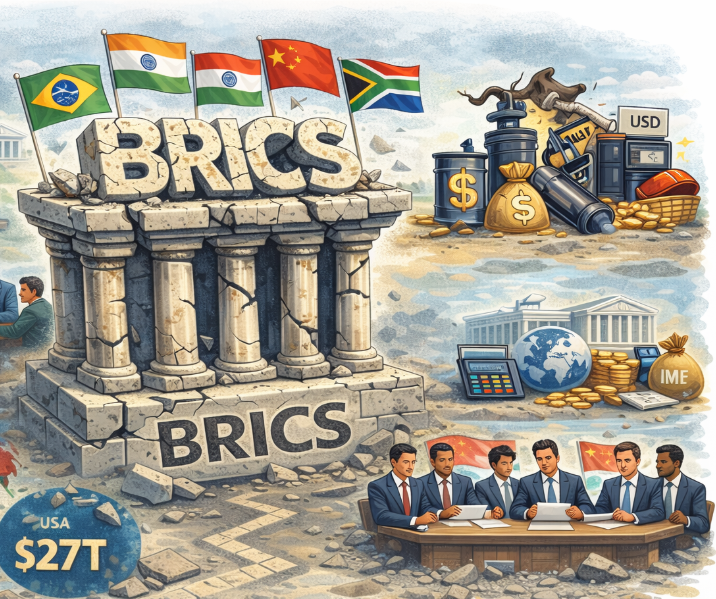
In 2025, if case anyone thinks BRICS has great combined economic power or some semblance of transnational political power, there is nothing of the sort.
The BRICS alliance is sometimes touted as a counterweight to Western dominance in the global political economy. Analysis of its founding members (Brazil, Russia, India, China, South Africa) reveals that BRICS lacks cohesion, economic clout, and institutional robustness to be a truly potent force.
1.
BRICS is riddled with internal divisions and conflicting interests. The member states are diverse in their political systems, economic structures and strategic priorities:
– China and India are geopolitical rivals with ongoing border disputes and competing ambitions in Asia.
– Russia focuses on energy exports and military influence which clashes with India’s and Brazil’s aspirations for broader economic diversification and sensible global diplomatic credibility.
– South Africa struggles to assert itself among the larger players.
These divergences undermine a hope for a unified agenda. BRICS is more a loose coalition than a coherent bloc capable of decisive action.
2.
The economic weight of BRICS is overstated. While China’s GDP is substantial, rivaling the USA, the other members lag far behind. In 2024, China’s nominal GDP was approximately $18 trillion, but India’s was $3.9 trillion for about the same population. Russia’s was $2.1 trillion, Brazil’s $2.2 trillion, and South Africa’s only $0.4 trillion. All combined it is about the same as the USA’s $27 trillion, but take out China and for the rest it is about 1/3rd of the USA’s. Figures are in US dollars (USD).
3.
Interestingly, Australia’s nominal GDP in 2024 was approximately $1.78 trillion USD, which accounts for purchasing power parity (PPP). According to the Australian Bureau of Statistics, Australia had a quarterly nominal GDP of 690,644 million AUD (0.7 billion AUD) for Q4 2024, which, when annualized and converted to USD, aligns closely with annual estimates of around $1.8 trillion USD. This is hardly different to Russia with 6 times the population, and a bit under half that of India with over 40 times the population of Australia. It is about 1/10th that of China with again over 40 times the population of Australia. It is close to that of Brazil, but it has about 9 times the population. Australia’s total GDP is smaller than China and the USA in absolute terms, but very large per person (high GDP per capita). A high GDP per capita reflects strong institutional quality, stable legal and financial systems, and good education and health of the population, among other things. For the other countries mentioned above, they lack high per-capita productivity. In the short run, don’t expect much out of BRICS in terms of efficiency other than from China.
4.
The G7 economies, despite their challenges, remain far more integrated and collectively dominant, with a combined GDP exceeding $50 trillion. Now, most important point —-> BRICS economies are heavily dependent on Western markets and institutions. China’s export-driven growth relies on access to US and European consumers. Russia’s economy is very heavily dependent on energy exports when it comes to international trade – basically a giant gas and oil hole. These arrangements are vulnerable to global price fluctuations and sanctions. This dependency dilutes ability to challenge the existing global order. Overall, BRICS does not have real collective economic power. China can exercise power alone economically. Russia only has military power.
5.
BRICS lacks robust institutional mechanisms to project power. The New Development Bank (NDB), BRICS’ flagship financial institution, has a capital base of $100 billion, much smaller than the World Bank’s $300 billion and the IMF’s $1 trillion in lending capacity. The NDB’s impact is further limited by bureaucratic inefficiencies and disagreements over funding priorities. Also, BRICS has no formal treaty, military alliance, or binding commitments under international law, leaving it without the structural depth to influence global governance meaningfully. Its summits often produce vague declarations rather than actionable policies, reflecting a lack of strategic convergence.
6.
ASEAN which is an economic treaty arrangement (not a political alliance), topped with ASEAN+3 and ASEAN+6, is far more active and productive than BRICS in terms of policy formulation on trade and economic integration. In comparison BRICS looks like a kindergarten kid trying to find a way around and issuing cry-baby statements. Moreover, ASEAN’s web of formal agreements, working groups, and meaningfully enforceable trade commitments (though not as strong as WTO and EU law) contrasts sharply with BRICS’ largely declaratory posture, where grand rhetoric routinely outpaces institutional capacity and practical follow-through.
7.
The geopolitical influence of BRICS is constrained by its members’ domestic challenges and external vulnerabilities.
– Russia’s economy is strained by sanctions and war expenditures, limiting its global leverage.
– Brazil and South Africa grapple with internal economic stagnation, reducing their international clout.
– India, while growing, faces infrastructure deficits and poverty that demand inward focus.
– Even China, the bloc’s powerhouse, is contending with a property sector crisis (time and again, but somehow manages to divert some disaster), demographic decline, and trade tensions with the West, which curb its ability to lead BRICS as a transformative force.
8.
The narrative of BRICS as a counter-hegemonic force ignores the reality that its members are deeply integrated into the Western-led global system. They rely mostly on the US dollar for trade, on SWIFT to varying degrees for financial transactions (which is a standardised global financial messaging system, not a payment system), and Western technology for innovation. While more regular use of the yuan currency is happening for trade in BRICS, it is small in comparison. The use of CIPS (which is China-centric) for financial transactions is also there, but again small in comparison. CIPS is a yuan-centric payment and settlement system. There is no Western equivalent needed because Western systems are instead plural, market-based, and interoperable, so their equivalents are a network of systems, not one platform.
9.
Efforts to ‘de-dollarize’ have gained little traction – it is hardly (if at all mentioned) in BRICS statements after annual meetings. Intra-BRICS trade in local currencies remains under 10% of their total trade volume. The group’s rhetoric about reshaping the global order often outpaces its capacity to deliver, as seen in the limited uptake of China’s CIPS.
Conclusion
All in all, BRICS is not a potent force in the global political economy because it lacks unity, economic dominance, institutional strength, and the ability to decouple from the Western-led system. It functions more as a symbolic platform for emerging economies than a transformative power capable of rivaling established global structures. Without significant reforms and alignment—unlikely given its internal contradictions—BRICS will remain a secondary player, not a game-changer. It is an illusion or delusion to expect BRICS to be suddenly powerful.
