Regulation of Blockchain Securities, Commodities and Stablecoins
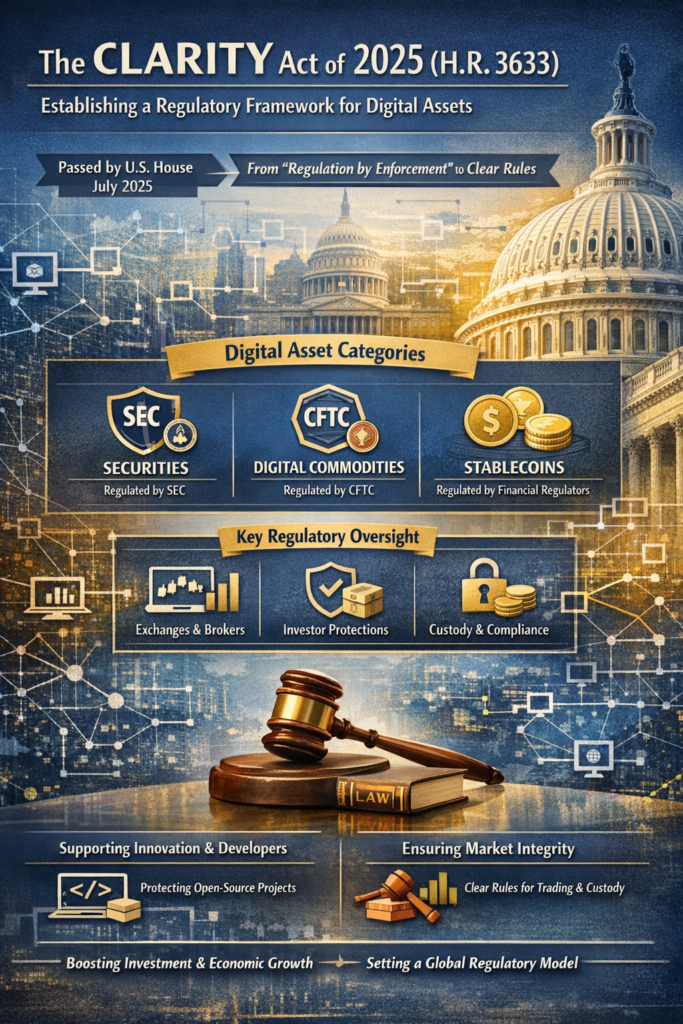
The Digital Asset Market Clarity Act of 2025 (H.R. 3633), commonly known as the CLARITY Act, represents the most significant attempt by the United States (U.S.) Congress to establish a comprehensive legal framework for digital assets. This includes cryptocurrencies, but it covers blockchain systems and distributed ledger technology (DLT) more generally. Passed by the U.S. House of Representatives in July 2025 and currently under consideration by the Senate, the Act seeks to resolve years of regulatory uncertainty that emerged as blockchain technologies expanded rapidly while federal oversight remained fragmented.
For more than a decade, digital asset markets in the U.S. have operated under what critics describe as “regulation by enforcement”. This term describes a regulatory approach where government agencies establish new rules, interpretations, or policy expectations primarily through enforcement actions (like lawsuits, settlements, fines or penalties) rather than through traditional, upfront processes like notice-and-comment rulemaking or clear guidance. For digital assets, two different federal agencies, the U.S. Securities and Exchange Commission (SEC) and the Commodity Futures Trading Commission (CFTC), have pursued overlapping enforcement actions against blockchain projects without a clear statutory framework defining which agency has authority over particular digital assets. The Act aims to replace this uncertainty with a structured legal regime that defines categories of digital assets, allocates regulatory jurisdiction, and establishes compliance obligations for blockchain-based market infrastructure.
Purpose and Structure of the CLARITY Act
At its core, the CLARITY Act introduces a formal classification system for digital assets. The proposed legislation divides digital assets into the following three primary regulatory categories:
- securities,
- commodities,
- stablecoins.
Each is explained as follows:
- Securities are digital assets that represent an investment contract or financial interest where purchasers expect profits primarily from the efforts of others. They are regulated by the SEC. This requires issuers and trading platforms to comply with securities laws, including disclosure, registration and investor protection requirements.
- Commodities are digital assets, particularly blockchain-native tokens, whose value derives from their use within a blockchain network rather than from the managerial efforts of an issuer. They fall under CFTC oversight. Blockchain-native tokens are those digital assets that originate from and operate within a specific blockchain network.
- Stablecoins are digital assets designed to maintain a stable value by being pegged to an external reference asset such as a fiat currency (e.g. the U.S. dollar) or a basket of assets, typically used for payments or settlement within digital asset markets. They would be regulated under a dedicated payment-stablecoin framework, with oversight primarily assigned to federal financial regulators responsible for payment systems and banking supervision. Mainly, the Federal Reserve System, Office of the Comptroller of the Currency, and Federal Deposit Insurance Corporation.
This classification directly addresses the long-standing jurisdictional problems between the SEC and the CFTC. Under the proposed legislation, as mentioned, securities remain under SEC supervision, while digital commodities fall under CFTC oversight. By clearly separating these domains, the Act seeks to eliminate ambiguity that has historically complicated the legal status of blockchain tokens.
The Act will establish rules governing issuance, trading, custody, and market infrastructure for digital assets. Blockchain exchanges, brokers and dealers are all brought within a defined regulatory perimeter. This ensures that firms operating in digital asset markets must comply with relevant federal disclosure, operational and risk-management requirements.
More broadly, the policy rationale behind the Act is twofold. First, it aims to restore legal certainty for blockchain innovators who have faced unpredictable enforcement actions. Second, it seeks to protect investors and market integrity by applying clear regulatory standards to entities that facilitate trading and custody of digital assets.
Recognition of Blockchain-Based Digital Commodities
One of the most important innovations of the CLARITY Act is the creation of a new legal category: the “digital commodity”. The Act defines a digital commodity as a digital asset intrinsically linked to a blockchain system, where the value of the asset is derived from, or expected to be derived from, the use of that blockchain network. Generally, the value of a digital commodity is derived primarily from the users and participants of the blockchain network, rather than from a centralized issuer or promoter. This is because the asset gains value through its utility within the network, such as paying transaction fees, securing the network, accessing services, obtaining goods, or participating in governance, which increases as the blockchain is used and adopted.
The core definitions in the Act place blockchain infrastructure at the centre of regulatory classification, but do not target any particular form of blockchain or DLT. Many blockchain-native tokens, such as those used to secure networks, pay transaction fees, or enable governance, may qualify as digital commodities rather than investment securities because their value derives from their utility within the blockchain network rather than from the managerial efforts of an issuer. If classified as commodities, they fall under CFTC jurisdiction rather than SEC oversight.
This approach recognises that certain digital tokens function not as investment vehicles/securities but as integral components of decentralized blockchain network operations. In practice it would be expected that this category is designed to encompass widely used blockchain tokens associated with Layer-1 networks and related ecosystems. Layer-1 refers to the base blockchain network itself, which provides the core infrastructure for transaction processing, consensus mechanisms, and network security; digital tokens, applications, and higher-level protocols operate on top of this foundational layer.
Regulation of Blockchain Market Infrastructure
The CLARITY Act will establish a regulatory perimeter around DLT-based market infrastructure. Blockchain-related entities, mainly digital commodity exchanges, brokers and dealers, must comply with federal oversight requirements administered primarily by the CFTC. This is sensible because these intermediaries act as market gatekeepers handling trading, custody and customer funds, so regulating them helps protect investors and maintain market integrity without restricting the underlying decentralized technology.
Under the Act, the CFTC receives exclusive jurisdiction over digital commodity spot markets, extending its traditional authority beyond derivatives markets into blockchain-based trading environments. Entities facilitating trading in digital commodities must register and comply with requirements concerning operational disclosures, custody and treatment of customer assets, recordkeeping accessible to regulators, and cybersecurity and risk management standards. These provisions ensure that the rapid expansion of blockchain trading platforms is accompanied by regulatory safeguards similar to those applied to traditional financial markets.
Investment Contract Assets and Evolution of Blockchain Networks
A particularly notable feature of the CLARITY Act is the introduction of the concept of “investment contract assets”. This category reflects the reality that many blockchain tokens initially emerge through fundraising events that resemble securities offerings. In U.S. law, whether an asset constitutes a security is often determined using the Howey test, which asks whether a transaction involves the following:
- an investment of money,
- in a common enterprise,
- with an expectation of profits,
- derived from the efforts of others.
Under the Act, a blockchain token initially sold as an investment contract may later transition from SEC oversight to CFTC jurisdiction if the underlying blockchain network becomes sufficiently decentralized and operationally mature as such. This mechanism recognises the evolutionary nature of blockchain networks where early-stage development may involve centralized promoters, but later stages may operate autonomously through distributed consensus. By creating a pathway for such regulatory migration, the Act acknowledges that blockchain systems can evolve from centralized startup projects into decentralized infrastructures.
Compliance Obligations for Blockchain-Based Systems
The CLARITY Act introduces provisional registration frameworks for blockchain exchanges and intermediaries. It is called “provisional” because the registration is intended to be temporary or transitional, allowing blockchain exchanges and intermediaries to operate legally while regulators, primarily the CFTC, develop detailed rules and a permanent regulatory framework for digital commodity markets. This approach enables oversight to begin immediately without forcing emerging blockchain businesses to wait for the full regulatory regime to be finalised, which could delay their emergence.
Entities that are blockchain exchanges and intermediaries must provide disclosures concerning operations, governance structures, and risks associated with digital commodity trading. This is sensible because transparency requirements help investors understand the risks of digital asset markets and ensure that intermediaries operate with accountability and proper oversight. Additional obligations include the following:
- maintaining detailed records of transactions,
- adhering to risk management standards tailored to digital asset markets,
- implementing cybersecurity protections suited to distributed ledger systems,
- complying with CFTC inspection and oversight procedures.
Through these measures, the Act seeks to integrate blockchain-based financial activity into a transparent regulatory environment while preserving the technological advantages of decentralized blockchain systems. This benefits the investor public by improving market transparency, reducing fraud and manipulation, and ensuring that trading platforms meet clear operational and disclosure standards. It also promotes broader market confidence and encourages responsible innovation, helping the U.S. remain competitive in the rapidly developing global blockchain and digital asset economy.
Protection of Developers and Decentralized Innovation
Another important component of the CLARITY Act is the explicit protection of software developers and peer-to-peer activity. Legislative background materials emphasise that writing and publishing software code, including open-source blockchain code, should not automatically be treated as providing regulated financial services. This distinction is especially relevant for decentralized finance (DeFi). Therefore, under the proposed framework:
- Developers who create blockchain protocols or open-source code are generally not regulated financial intermediaries.
- Centralized entities that operate front-end interfaces or control access to DeFi platforms may be subject to regulation.
The Act therefore distinguishes between protocol development and market-facing financial services, attempting to preserve innovation in decentralized blockchain systems while ensuring that centralized operators remain accountable. This sensibly targets regulation at the entities that actually control customer funds or trading activity, rather than at developers who simply write software. It benefits the investor public by ensuring that intermediaries handling digital assets operate under regulatory oversight, while still allowing technological innovation and open-source development to continue.
Implications for Blockchain Networks and Market Participants
If enacted, the CLARITY Act would significantly reshape the blockchain and DLT landscape in the U.S. However, the passing of the Act has generated debate in the Senate. Some lawmakers are concerned that shifting many digital assets into the digital commodity category could weaken the authority of the SEC and reduce investor protections if digital tokens are too easily deemed decentralized. Others argue that expanding the role of the CFTC may require additional resources and clearer rules to supervise rapidly growing crypto markets. As a result, senators are debating amendments and coordinating the proposed legislation with related stablecoin legislation before allowing it to proceed to a final vote.
Nevertheless, for blockchain networks, the legislation provides a clearer path for digital tokens associated with Layer-1 and Layer-2 protocols to qualify as digital commodities. Blockchain networks that demonstrate sufficient decentralization may avoid classification of their digital tokens as securities, and a network may also evolve over time into a mature decentralized blockchain system in which its digital tokens are treated as digital commodities rather than securities. The fundamental reason for applying securities law is designed to regulate investments that depend on the managerial efforts of a central issuer, whereas decentralized mature blockchain networks may operate without a controlling entity. Once a blockchain network becomes sufficiently decentralized and digital tokens function mainly as utility assets used within the network rather than investment instruments, it is considered more appropriate to regulate them as commodities rather than securities.
For developers and DeFi projects, the Act offers legal reassurance that coding activity remains protected, provided developers do not exercise controlling authority over financial services. DeFi is mentioned here because decentralized finance systems are largely built and maintained through software code, often written by developers who publish smart contracts that automatically execute financial functions such as lending, trading or payments. The Act therefore clarifies that writing or publishing this code alone does not make developers financial intermediaries, unless they also operate or control the DeFi service in a way that interacts with users’ digital assets.
If developers or operators do exercise such control, such as managing user funds, directing transactions, or operating the platform’s financial services, they may assume fiduciary responsibilities because they are effectively acting on behalf of users in a position of trust. Meanwhile, exchanges, custodians and brokers operating in digital commodity markets would face new compliance obligations under CFTC supervision. They would already be considered fiduciaries because they hold, manage or transact assets on behalf of customers, creating a relationship of trust that requires them to act in the clients’ best interests and with due care.
Concept of Blockchain within the CLARITY Act
Interestingly, the CLARITY Act does not provide a detailed standalone definition of blockchain. Instead, legislative analysis indicates that Congress conceptualised blockchain as a distributed ledger system in which data is propagated among network participants to reach consensus on the state of the ledger. The thinking behind the Act is to emphasise functional characteristics rather than technical architecture, so the focus is on distributed propagation of data and consensus mechanisms determining ledger state. These are functional characteristics, not technical architecture. That is:
- Distributed propagation of data describes what the blockchain system does, i.e. how information is shared across participants.
- Consensus mechanisms determining ledger state describes the function of agreeing on the valid state of the ledger.
These do not specify how a blockchain system is built. How a system is built brings in proof-of-work, proof-of-stake, Directed Acyclic Graph (DAG) structures for records, and node topology, which are elements of technical architecture. This is important because the technical architecture determines how a distributed ledger system achieves security, consensus, scalability and decentralization, which in turn affects how the system operates.
The end result is that the Act regulates blockchain systems primarily through definitions of digital commodities and digital assets and their relationship to blockchain networks, rather than through a detailed technical description of the technology itself. This functional approach is important because it allows the law to remain adaptable as blockchain technologies evolve and new architectures emerge. Lawmakers often prefer such technology-neutral drafting so that legislation does not become obsolete as technical designs change, while still allowing regulators to apply the rules to new forms of distributed ledger systems.
Evaluating Definitions in the CLARITY Act
The CLARITY Act’s approach in relation to blockchain offers both advantages and limitations.
Strengths
First, definitions are legally functional and technology-neutral. By avoiding references to specific consensus mechanisms or architectural features, the framework remains compatible with a wide range of distributed ledger designs. This includes:
- proof-of-work systems,
- proof-of-stake systems,
- DAG-based ledgers, and
- permissioned consortium blockchains.
Second, as already alluded to, the flexible approach helps future-proof the legislation. As DLTs evolve, the statutory language is less likely to become obsolete. Such evolution is already evident in the rapid shift from early proof-of-work blockchains such as Bitcoin to proof-of-stake systems, Layer-2 scaling solutions, and alternative architectures like DAG ledgers.
Weaknesses
However, the absence of a detailed technical definition for blockchain may also create interpretive challenges. Because the Act focuses on functional systems rather than blockchain and DLT in a specific form, some non-blockchain distributed ledger architectures, such as certain DAG-based networks, may fall into ambiguous regulatory territory. In such cases, courts would likely interpret the statute purposively, examining the functional characteristics of the technology and the legislative intent behind the Act to determine whether the blockchain system falls within the regulatory framework.
In addition, the functional definitions could potentially encompass replicated databases with consensus-like features, blurring the distinction between traditional distributed systems and decentralized blockchains. Replicated databases are systems in which identical copies of a database are maintained across multiple servers to improve reliability, availability and fault tolerance. This is relevant because some enterprise systems use replication and coordination mechanisms that resemble distributed ledgers, raising questions about whether they might inadvertently fall within the Act’s broad scope of blockchain systems.
Permissioned and Permissionless Systems
Another notable aspect of the CLARITY Act is that it does not require blockchain systems to be permissionless. The focus is on consensus and distributed data propagation rather than open participation. A permissionless system allows anyone to join the blockchain network, validate transactions, and participate without prior approval, whereas a permissioned system restricts participation to authorised users or organisations that are granted access by a controlling authority.
As a result, both permissionless networks (such as Bitcoin or Ethereum) and permissioned systems (such as enterprise or consortium blockchains) may fall within the Act’s regulatory framework. This design appears deliberate. By avoiding a rigid requirement for permissionless participation, Congress ensures that the legislation accommodates emerging hybrid architectures and enterprise DLT applications. At the same time, this neutrality may blur meaningful distinctions between trustless public blockchains and controlled consortium ledgers. Trustless public blockchains rely on open participation and cryptographic consensus so users do not need to trust any central authority, whereas controlled consortium ledgers are governed by a limited group of known organisations that manage participation and validate transactions.
Conclusion
The CLARITY Act represents the most ambitious effort by the U.S. to establish a comprehensive regulatory framework for critical features of blockchain and DLT that relate to investment decisions, commodities and assets. By defining digital asset categories, clarifying the jurisdiction of federal regulators, regulating blockchain-based market infrastructure, and protecting software developers, the Act seeks to provide the long-awaited legal certainty necessary for the continued growth of digital asset markets. If enacted, the Act could help in developing a model for a future international regulatory framework, if this were called for. It would certainly influence and shape how other jurisdictions approach the governance of blockchain-based financial systems.
At the same time, the proposed legislation reflects a pragmatic regulatory philosophy. Rather than imposing rigid technical definitions or ideological commitments to particular blockchain architectures, the Act adopts a functional, technology-neutral approach that prioritises regulatory clarity and adaptability. If enacted, the Act would mark a turning point in the governance of blockchain technologies, moving the U.S. from a fragmented enforcement environment toward a structured legal framework capable of supporting both innovation and investor protection in the emerging digital economy.
More broadly, the legislation aims to make the U.S. a competitive hub for blockchain innovation by replacing uncertain enforcement practices around security investments and commodities with a predictable regulatory structure. Investment facilitated through well-regulated markets can help individuals and firms build financial security by enabling savings and capital growth over time. In turn, this capital formation, whether invested directly or through intermediary financial institutions, supports economic activity in the economy as a whole.
https://macropsychic.substack.com/publish/posts/detail/190967414