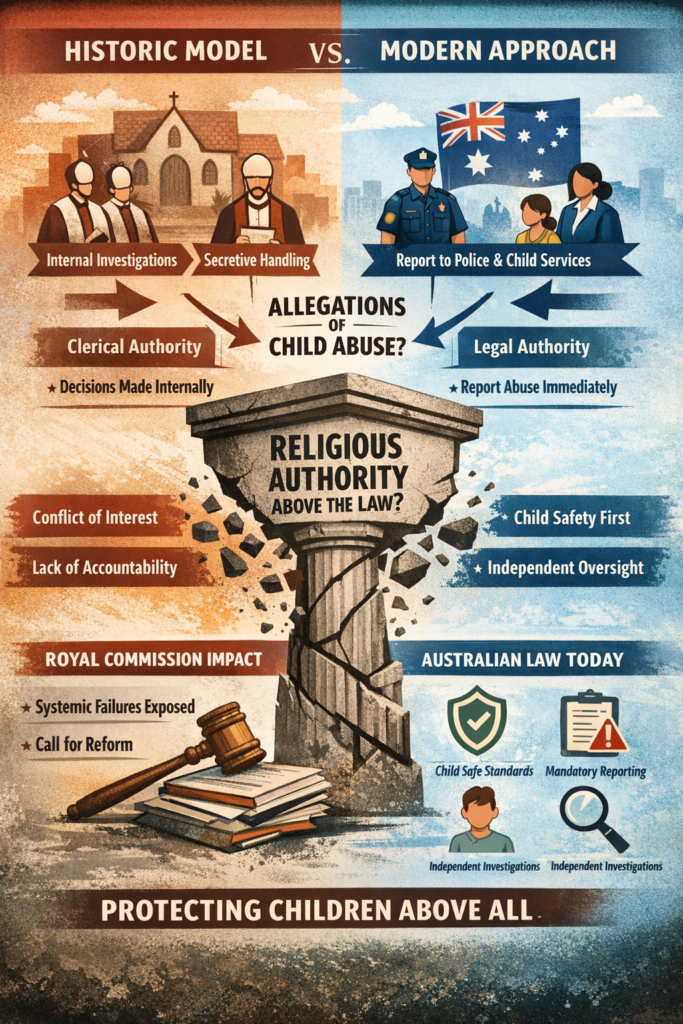
Religious institutions have had to adjust since the findings of Royal Commission in Australia
In Australia, religious and spiritual organisations had to confront a question that the Royal Commission into Institutional Responses to Child Sexual Abuse made impossible to ignore: when allegations of abuse arise, who should act and how quickly must that action occur? The Royal Commission exposed systemic failures across multiple institutions and fundamentally reshaped public expectations about safeguarding. Since then, the relationship between religious authority and legal obligations has come under renewed scrutiny.
The modern versus the historical
Often the dispute within faith communities is not simply about the wording of child safeguarding policies. Rather, it reflects a deeper tension between two competing models of authority. One model is grounded in modern child-protection law, transparency and external accountability. The other reflects longstanding religious governance structures in which clergy or spiritual leaders exercise internal authority over disciplinary matters.
Today, the practical issue at stake is straightforward. Allegations of child sexual abuse must be reported immediately to external authorities such as police or child-protection agencies. Yet historically many religious organisations dealt with such allegations internally, relying on clergy or senior officials to investigate and determine the appropriate response. This approach is problematic because it places decisions about serious criminal conduct in the hands of individuals who may lack investigative expertise, face conflicts of interest, and operate within structures that prioritise institutional protection over the rights and safety of victims.
Under this older model, internal investigations were conducted within the organisation itself, and findings were passed up the chain of authority. In some cases, this meant decisions were ultimately made by leadership far removed from the communities where alleged abuse occurred. Critics have pointed out that such systems often produced silence rather than resolution, leaving victims unsupported while alleged perpetrators were quietly reassigned or shielded from scrutiny.
The Australian break
Modern Australian law now requires a decisive break from that pattern. This is reflected in requirements to develop child safe standards, legal obligations for reportable conduct concerning abuse, and mandatory reporting obligations by specific categories of professionals. These legal duties on individuals cannot be overridden by internal authority. These three elements generally exist across Australian state and territory jurisdictions, though in various forms. This approach is seen to be morally preferable because it places the protection and dignity of victims above institutional loyalty, ensuring that allegations of harm are assessed by independent authorities, rather than internal systems that are perceived as reflecting vested interests in protecting a religious organisation.
This legal shift challenges embedded institutional traditions. Many religious organisations developed governance systems designed to preserve internal unity and spiritual authority. From this perspective, external intervention may appear disruptive or even threatening to the integrity of the community. Yet this view is problematic because it risks placing institutional cohesion above the protection of vulnerable individuals, allows conflicts of interest to delay reporting, and weakens accountability.
Contemporary framework
Contemporary child-protection frameworks operate on different premises to that of the past. Their core principles are:
(1) The best interests of the child are paramount. This principle appears in child-protection legislation across Australia and means that the safety and wellbeing of the child must take precedence over institutional, organisational or reputational concerns that may arise from breach of a duty of care regarding child safety. It is also saying that protecting a poor internal reputation (or poor governance) is not a real concern for external purposes.
(2) Independence and external accountability. Serious allegations about harm to a child should be assessed by independent authorities, not solely by the institution in which a person allegedly the cause of the harm is involved. Of course, institutions can have processes, but they need to be reasonable. The premise is that institutions (and their personnel) can have conflicts of interest, independent oversight increases credibility, and victims are more likely to be protected.
(3) Early reporting and intervention regarding harm to children. Child-protection systems emphasise early reporting of reasonable suspicions, not proof. However, reasonableness still prevails — so not any kind of lesser suspicion is justified or sufficient. The goal is to prevent ongoing harm, allow trained authorities to investigate, and avoid delays caused by internal processes.
(4) Institutional responsibility. Modern frameworks recognise that organisations themselves can create environments where abuse occurs or is concealed. Organisations that work with or involve children should implement safeguarding systems (either mandatorily or voluntarily, depending on the organisation), train personnel, and respond transparently to allegations of harm. This reflects lessons from the Royal Commission, which found that institutional cultures often enabled abuse to remain hidden.
(5) Transparency and victim-centred responses. Contemporary frameworks aim to ensure that children who are victims of harm are believed and supported, processes are transparent, and complaints are handled independently. The premise is that safeguarding must prioritise victim protection rather than institutional reputation.
Historical problems
Accordingly, the protection of children from incidents of harm cannot depend solely on the discretion of internal authorities, regardless of their intentions or standing within the community. As a result, faith-based organisations across the world are grappling with the challenge of adapting hierarchical governance structures to modern safeguarding expectations. The shift requires not only legal compliance but also cultural change. This tension between institutional autonomy and legal accountability is not unique to any one religious tradition.
Reform therefore involves more than drafting new policies. It requires addressing longstanding institutional instincts that may prioritise reputation, loyalty or internal harmony (or more often perceived or supposed harmony) over the interests of victims. These instincts are not always malicious; they often arise from a desire to protect the community itself. Yet history has shown that such instincts can inadvertently allow abuse to remain hidden.
Safeguarding experts have repeatedly identified similar patterns across many institutions, including schools, charities and religious bodies. Authority structures, gender dynamics and deference to leadership (including undue influence) have sometimes discouraged victims from speaking out and inhibited independent investigation. The Royal Commission’s findings demonstrated how these dynamics could persist for decades when external accountability mechanisms were weak or absent.
Times are changing
Australia’s legal environment has changed precisely because those failures became impossible to ignore. Indeed, they became extremely noticeable. Governments have strengthened reporting obligations and introduced clearer child-protection standards to ensure that institutions cannot quietly handle allegations behind closed doors. The message is clear: the protection of children must take precedence over seeking to protect institutional reputation (which itself has been done in underhand ways).
For religious organisations, adapting to this new reality may be uncomfortable but it is unavoidable. Faith communities operate within societies whose laws exist to protect the vulnerable. Furthermore, society (through its laws and customs) gives quite a number of privileges to religious institutions, including religious freedom itself, a high degree of institutional autonomy, and respect for clergy–congregant relationships, as well as tax exemptions, employment law exemptions, and other forms of regulatory flexibility.
The High Court of Australia in Church of the New Faith v Commissioner for Pay‑Roll Tax (Vic) [1983] HCA 40 (the Scientology case), also set out a generous definition of ‘religious institution’, which can be recognised under law, but it must operate within the bounds of the law of the land. While the Court articulated two criteria of religion:
- “belief in a supernatural Being, Thing or Principle”, and
- “acceptance of canons of conduct in order to give effect to that belief”,
the judges also emphasised an important limitation that:
- “canons of conduct which offend against the ordinary laws are outside the area of any immunity, privilege or right conferred on the grounds of religion”.
Effectively, religious belief does not place a person or institution above the law. In particular, canons of conduct associated with a religion must not conflict with ordinary law. If religious practices or procedures involve conduct that violates criminal or civil law, the state is not required to recognise or protect those practices or procedures simply because they are claimed to be religious.
It is also important to note that the criteria for what is a religion are not to do with anyone’s ideological notions of what is a religion. People’s different ideological notions are not relevant to the legal definition, though which can also be considered a sociological definition, as the court drew on sociology. Similarly, the religious versus spiritual meme, or being spiritual but not religious, is generally a superficiality that is not relevant to a broad-based definition of religion intended for social and legal purposes. Indeed, the court said the two criteria “may vary in their comparative importance, and there may be a different intensity of belief or of acceptance of canons of conduct among religions or among the adherents to a religion”. Such differences are not inherently relevant to individual or group/collective freedom to profess and exercise religion.
So, when it comes to allegations of child abuse (sexual or otherwise), the question of whether internal authority of a religious institution should prevail has effectively already been answered. Religious autonomy protects belief and internal governance, but it does not extend to procedures that delay or replace legally mandated reporting of child abuse, because safeguarding laws apply equally to persons involved in religious institutions and cannot be overridden by internal authority. Tolerance for diversity in belief does not extend to conduct that harms others or undermines legal protections.
Conclusion
What is being resolved is how quickly religious institutions built on hierarchical traditions can adjust to these expectations. It also means that genuine child safeguarding reform requires more than compliance with legal requirements. It requires a willingness to place transparency and accountability at the centre of institutional life. These are modern day community expectations.
In the years ahead, the credibility of faith communities will depend on their commitment to the principle of non-harm, which includes protecting anyone from harm. This is a duty of care. For religious schools this applies to children entrusted in their care. For religious communities more broadly, this applies to any child participating in activities and events.
In this regard, child safeguarding is no longer simply a matter of internal governance. It has become a test of moral leadership, and that is related to putting a duty of care into practice. The simple first step is a child safeguarding policy consistent with Australian law. Modern Australia demands a willingness of religious institutions to uphold the law and protect the vulnerable above all else.
https://open.substack.com/pub/macropsychic/p/faith-authority-and-legal-duty-to