The United Nations is approaching a financial precipice. Senior officials, including Secretary-General António Guterres and spokesperson Stéphane Dujarric, have warned that the UN is on an unsustainable financial trajectory, with the real possibility that it could run out of cash! By the end of 2025, unpaid assessed contributions reportedly exceeded US$1.5 billion, forcing the UN to contemplate emergency measures under the UN80 reform initiative to prevent a liquidity crisis. This is a reform program to modernise the UN ahead of its 80th anniversary by reviewing mandates, reducing duplication across agencies, improving efficiency, and addressing the UN’s financial sustainability.
Much international commentary places primary blame for unpaid dues on the USA, which is a permanent member of the UN Security Council. Washington’s willingness to withhold payments, no doubt related to the USA’s ‘America First’ policy thinking, has increasingly been used as leverage to pressure the UN on issues ranging from perceived institutional bias toward Israel to operational inefficiencies. These inefficiencies are often said to include the duplication of programs across multiple UN agencies, outdated mandates that remain active for decades, and a complex bureaucracy that slows decision-making and inflates administrative costs — exactly the things that UN80 is supposed to address.
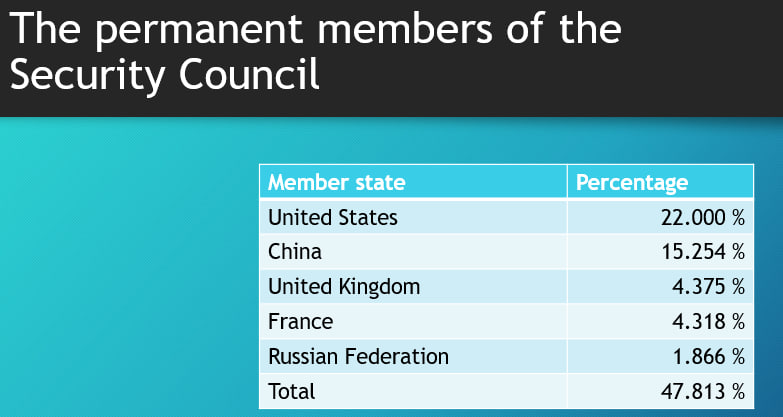
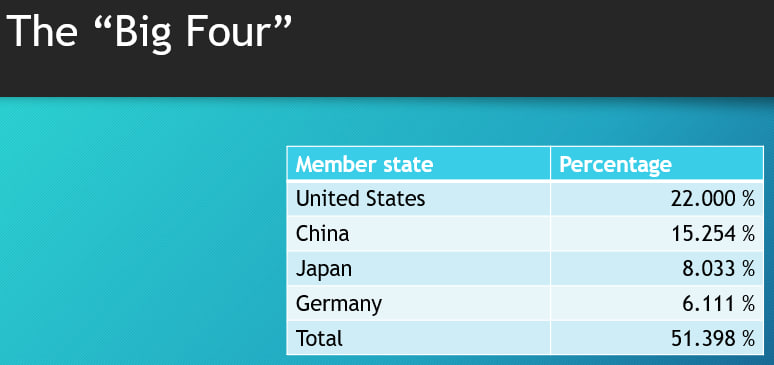
Now, let’s consider the percentage contributions. The USA is assessed at approximately 22% of the UN regular budget, by far the largest share of any member state. Reports frequently note that a large portion of outstanding dues are that of the USA, creating immediate cash-flow pressures. The consequences are already visible: spending cuts, limits on meeting times, reviews of thousands of outdated mandates, and proposals to merge or restructure agencies. This situation can though lead to positive changes.
Yet the financial crisis is often oversimplified by focusing almost exclusively on Washington. What about the Russian Federation? As another permanent member of the UN Security Council, it has also contributed to the UN’s financial fragility through a pattern of late payments, though the impacts are much less, because it contributes much less. Russia’s assessed contribution is around 2% of the regular UN budget, roughly one-tenth of the USA’s share. While Moscow ultimately paid its 2025 dues in full late in the year, it has frequently appeared in UN liquidity reports among member states that delay payment, contributing to periodic shortfalls that weaken the UN’s financial stability.
Still, the withholding of funds by the USA attracts global headlines and diplomatic controversy, while Russia’s recurrent tardiness receives comparatively little attention despite its veto power and central role in international security debates. Yet both practices erode a core principle of the UN system: that member states must pay their assessed contributions in full and on time to sustain collective institutions. On the surface, the differences in contributions between the two member states are readily understandable. The UN’s assessment system is based on the principle that member states should contribute according to their economic ability. The main indicator used is Gross National Income (GNI) of each member state, so generally contributions are calculated as a share of total global GNI. Member states with larger economies therefore pay a larger share of the UN budget.
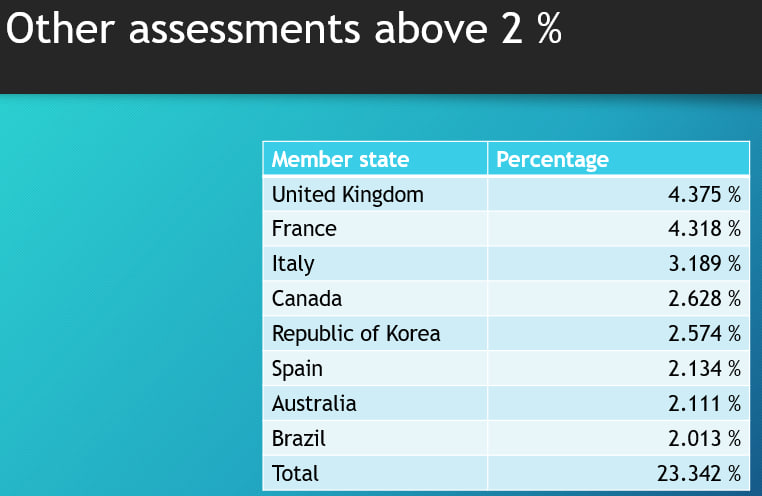
However, there is a strong argument that all permanent members of the UN Security Council should shoulder even greater financial responsibility than they currently do. Why not at least 5% each of the regular UN budget? The other permanent members of the UN Security Council already pay over or near that. The different financial contributions between the USA and Russia are currently glaringly obvious at 22% versus 2%. Wouldn’t 20% versus 5% be a better reflection of global responsibility? China pays a little over 15% and the UK and France each pay a little over 4% of the UN regular budget. Russia is way behind.
Now consider that the five permanent members of the UN Security Council enjoy extraordinary institutional privileges, including the veto power that allows them to block resolutions affecting international peace and security. With such influence over the UN’s most consequential decisions should come a proportionally greater obligation to ensure the UN’s financial stability. In effect, the authority to shape global security (which happens to be in disarray) should carry a corresponding duty to help fund the UN in greater proportion to other member states. Doing so, should underpin the power of the five permanent members on the UN Security Council. In this regard, Russia must pay more!
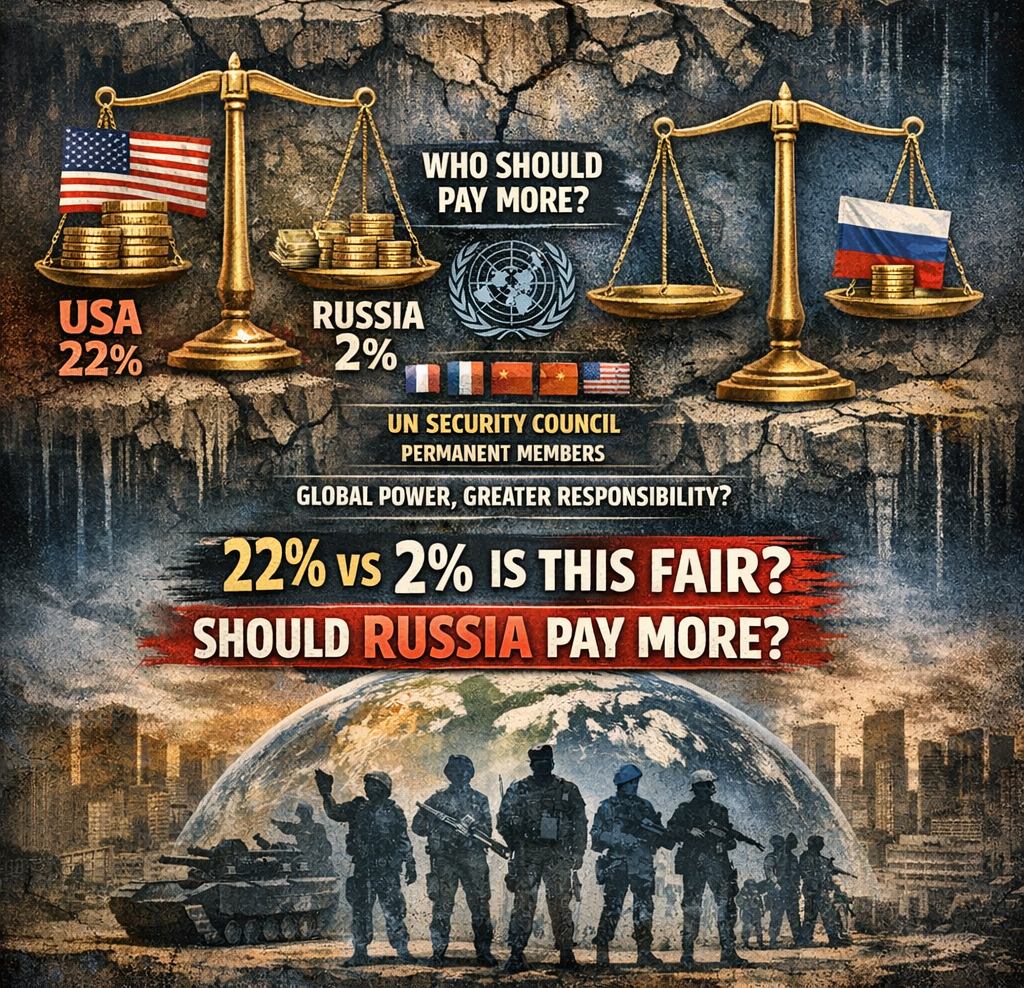
As General Assembly President Annalena Baerbock works with the Secretary-General to identify reforms and cost reductions, the financial crisis raises a deeper question about responsibility in the multilateral order. Shouldn’t responsibility as a permanent member of the UN Security Council come with greater costs for those permanent members? Reform of the UN is necessary, but it should consider why powerful member states pay relatively little (Russia’s 2% compared to the USA’s 22%), while having huge geopolitical leverage on the UN Security Council. Of course, one can also argue for total reform of the UN Security Council or its abolition.
If the UN is to remain viable, accountability must apply to all major powers equally or at least more equitably, which includes in terms of financial contributions. Sure, paying assessed contributions promptly and fully is the minimum obligation of membership in the international system the UN represents, but ignoring the weight of power held on the UN Security Council, while paying relatively little in UN contributions, is itself problematic. Russia’s 2% contribution, compared to the USA’s 22%, means Russia leverages off the USA in asserting geopolitical dominance. Such an imbalance raises a stark question for the future of multilateralism: should permanent members of the UN Security Council that wield great geopolitical power also bear a proportionately greater financial responsibility for sustaining the UN as a whole due to having that extra power?
https://substack.com/profile/152321377-perspective-undercurrents-pu/note/c-225021424