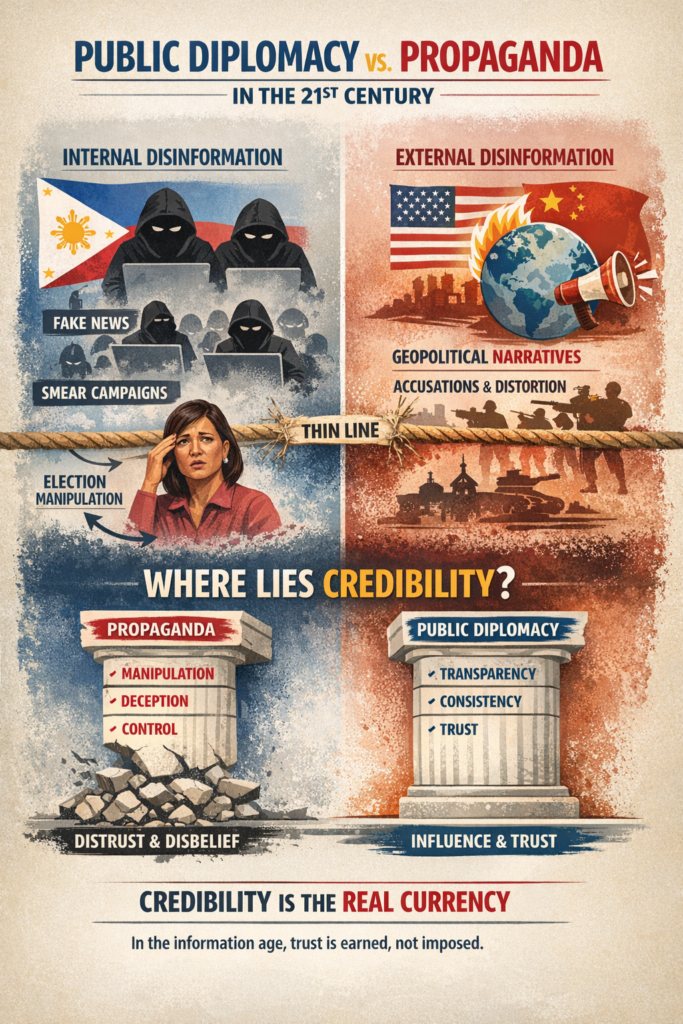
In the 21st century, the boundary between public diplomacy and propaganda has grown thin. Digital platforms have transformed state influence into a scalable, real-time contest, where disinformation can reshape political realities, distort historical memory, and advance geopolitical objectives with unprecedented speed and reach. The battle for global influence by a state is no longer fought through means of strong alliances (military or otherwise) or economic arrangements via treaties, but through narratives aimed at foreign publics. Often this involves competing claims about truth, legitimacy and trust.
Same problem – internal and external
The same problems occur internally. The Philippines is an illustration. Both the 2016 presidential election that brought Rodrigo Duterte to power and the 2022 election won by Ferdinand Marcos Jr. were marked by widespread allegations of coordinated disinformation. Users of online networks often formed “troll armies” to circulate information which included many false claims against political opponents. As a strategy, they flooded the informational environment, amplified favourable narratives, attacked critics, and brought back controversial political legacies. Their power lay not simply in persuasion but in saturation: overwhelming factual discourse with emotionally resonant messages and fiction. The second-placed candidate in 2022 later acknowledged one of her central strategic failures: it was that she waited too long to confront these networks. She should have used quick and open honest responses, instead of allowing falsehoods to harden into public perception before they could be challenged.
Disinformation has also become an instrument of international statecraft. So, the problem exists in international geopolitics. During the 2021 riots in Honiara, Solomon Islands, Chinese state-affiliated media outlets rapidly disseminated claims that the unrest was orchestrated and funded by the United States and Taiwan. These allegations lacked credible evidence. Of course, their purpose was not legal proof but narrative positioning – narrative poisoning. By framing geopolitical rivals as destabilising forces, such messaging sought to reshape regional perceptions, weaken competing partnerships, and reinforce China’s strategic influence in the Pacific. The informational environment itself has become the arena of geopolitical competition.
Where lies credibility?
However, it is still a decisive truth that credibility is the real currency of modern public diplomacy. This is a type of diplomacy of a state engaging with a foreign public. The opposite of public diplomacy is propaganda. Propaganda relies on manipulation, concealment and narrative control. Effective public diplomacy depends on trust. Public diplomacy requires transparency, consistency and genuine engagement with foreign publics. In today’s open digital ecosystem, credibility cannot be imposed; it must be earned. States that blur the line between persuasion and deception may achieve short-term informational advantage, but they ultimately degrade the very trust of a foreign public on which long-term influence depends.
What is worse, the consequences of losing credibility are profound. Once a state is perceived as manipulating information to a foreign public, its messaging becomes suspect, its intentions questioned, and its diplomatic voice weakened. In a networked world, reputational damage travels quickly and is difficult to reverse. The state’s influence erodes not through confrontation, but through disbelief by the foreign public of what it says. An example of this is Russia’s loss of credibility following its repeated denials before and during the February 2022 invasion of Ukraine. Those denials were public — but not real public diplomacy, but rather a form of propaganda. Many foreign publics simply did not buy into what Russia said. Even many of its own residents decided to move to neighbouring states.
Good public diplomacy is not about louder messaging — that often verges into propaganda. Of course, the message should be strong and profound, but it must also be better messaging that is grounded in fact, sustained by consistency, and reinforced through authentic relationships. Bad public diplomacy and propaganda by one state to a foreign public just forces a foreign government to invest in monitoring disinformation, on top of the tasks of coordinating strategic communication and empowering credible institutions and voices.
Above all, states have to recognise that public diplomacy is not a contest of volume, but of credibility. In the information age, credibility is no longer merely a diplomatic asset. It is a strategic necessity, and the foundation upon which enduring influence is built. A state’s public diplomacy has to prioritize genuine messaging to foreign publics. And follow up with an alignment between words and deeds to cultivate trust and authenticity among foreign publics. Today, that public is already aware that in an era of rapid information flows, sheer loud volume of messaging by a state rarely wins lasting influence?
Case Study: Russian invasion of Ukraine
Russia’s Presidential Press Secretary, Dmitry Peskov, on 20 February 2022: “We appeal to reason! What sense would it make for Russia to attack anyone?! Russia has never attacked anyone in its entire history. Russia is the last country in Europe to even utter the word ‘war.'” Four days later, Putin announced the invasion of Ukraine.
In the months leading up to the Russian invasion of Ukraine, Russian officials (including senior diplomats and government spokespeople) publicly insisted that Russia had no intention of invading Ukraine, despite mounting intelligence and visible troop buildups near Ukraine’s borders. When the invasion began on 24 February 2022, these assurances were immediately exposed as false. This had profound diplomatic consequences. Foreign publics, especially in Europe and North America, began to treat subsequent Russian statements with deep scepticism, especially those related to peace negotiations and humanitarian corridors. This resulted in the general attitude of ‘what is the point of believing Russia or making a deal with them’.
Thus, the credibility damage extended beyond governments to public perception. European public opinion shifted sharply against Russia, strengthening support for sanctions, military aid to Ukraine, and NATO expansion. Ultimately, we saw Finland and Sweden join NATO. Russian state media narratives about the war were widely dismissed in foreign societies as propaganda, limiting Russia’s ability to influence international opinion through public messaging. In this case, Russia’s influence eroded not because its voice was silenced, but because its claims were no longer believed. The loss of credibility weakened its diplomatic effectiveness and hardened foreign public resistance to its geopolitical objectives.
This example illustrates how once a state is seen as manipulating information, its ability to shape narratives, build trust, or persuade foreign publics is severely diminished. This demonstrates that credibility is a strategic asset that, once lost, is difficult to recover. It is not worth losing because credibility is the foundation of diplomatic influence. Without trust, even truthful statements are met with scepticism, alliances weaken, and a state’s ability to shape outcomes erodes.
https://substack.com/profile/152321377-perspective-undercurrents-pu/note/c-217106553
https://substack.com/profile/152321377-perspective-undercurrents-pu/note/c-217151873