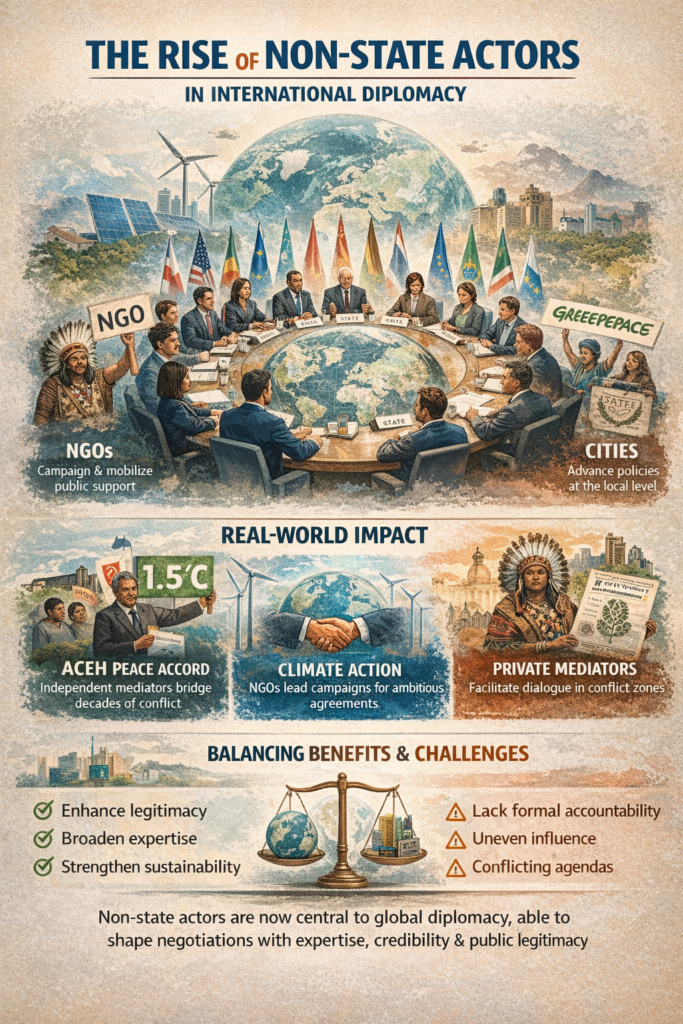
Participation in international diplomacy is no longer the exclusive domain of sovereign states. Across peace negotiations, climate agreements, and intellectual property treaties, non-state actors have emerged as influential participants. They range from NGOs and private mediators to indigenous communities, cities, and industry groups. Once confined to the margins, they can now influence agendas, broker agreements, and mobilize public legitimacy. Modern diplomacy increasingly reflects a multi-stakeholder reality, where influence flows not only from formal authority, but from credibility, expertise, and trust.
One example is the Crisis Management Initiative (CMI), founded by former Finnish President Martti Ahtisaari. Operating as an independent mediation organisation, CMI helped facilitate the 2005 Helsinki Memorandum of Understanding between Indonesia and the Free Aceh Movement. After decades of violent conflict, CMI’s neutral status allowed it to bridge deep mistrust between the parties. Unencumbered by national political interests, it created space for compromise, leading to autonomy arrangements, disarmament, and international monitoring. The success of the Aceh peace process demonstrated how non-state mediators can unlock negotiations when official diplomatic channels stall. Their strength lies not in coercive authority, but in their perceived impartiality and ability to foster dialogue.
Environmental diplomacy offers another illustration. Under the UN Framework Convention on Climate Change, organisations such as Greenpeace and the World Wide Fund for Nature have played critical roles in shaping international climate negotiations. Ahead of the 2015 Paris Agreement, they and other civil society groups mobilised global public pressure, reframed climate change as a moral and scientific imperative, and influenced states to adopt more ambitious targets. Over 1,000 NGOs eventually participated in the negotiations, amplifying the voices of vulnerable communities and helping establish the agreement’s 1.5°C goal. That is, the globally agreed target to limit long-term average global warming to 1.5°C above pre-industrial levels in order to significantly reduce the most severe risks and impacts of climate change. Their influence did not derive from formal voting power, but from their ability to shape the political environment in which decisions were made.
Indigenous groups have also transformed diplomatic outcomes. The 2024 WIPO Treaty on Intellectual Property, Genetic Resources and Associated Traditional Knowledge requires patent applicants to disclose the use of indigenous knowledge—an achievement resulting from decades of indigenous advocacy. Their participation ensured that traditional knowledge systems were recognised and protected within international law, correcting longstanding exclusions from global governance.
States themselves increasingly recognise the value of engaging non-state actors. Ministries of foreign affairs now consult NGOs, academics, youth activists, and industry experts to inform negotiation strategies. These actors provide technical knowledge, local insight, and social legitimacy that governments alone cannot command. In an interconnected world, influence depends as much on persuasion and coalition-building as on formal authority.
This evolution though does raise some challenges. Importantly, non-state actors often lack formal accountability to the broad public, and they are not bound by implementation obligations. Their agendas may conflict with national or supranational priorities, and their influence can be uneven, favouring well-resourced organisations over marginalised voices. Participation in international diplomacy therefore has to have some balances regarding inclusivity and responsibility, ensuring transparency, and equitable representation.
Still, despite this, non-state actors are no longer peripheral participants but integral to modern international diplomacy. Their involvement enhances legitimacy, broadens expertise, and strengthens the durability of agreements. The future of diplomacy will not abandon the state, but it will no longer belong to the state alone.
https://substack.com/@macropsychic/note/c-217138027