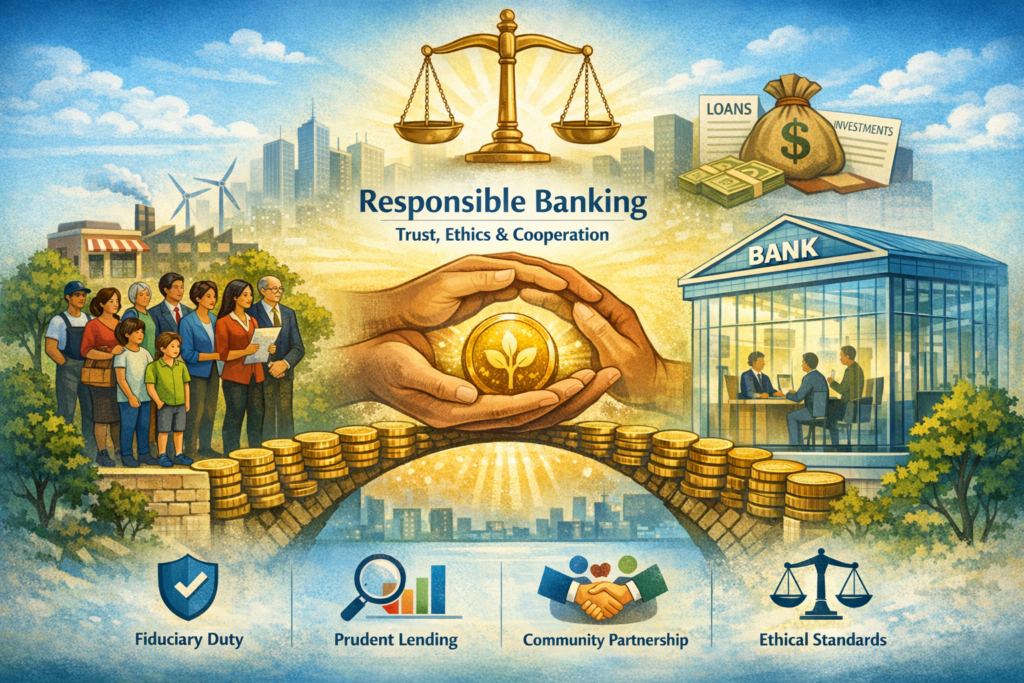
Confidence, prudence, ethical practices, cooperative spirit are all fundamental
“… it remains a self-evident fact that we must take human honesty for granted, that we must assume that the man with whom we do business intends to do it rightly and honorably, that he is actuated by a settled principle of fair conduct that will work automatically, and that without this automatically working standard of behavior all our guarantees and safeguards and securities would really have very little value. It is the universal expectation of fair dealing that makes business possible …” [ in ‘Morals in Trade and Commerce’, a lecture by Frank B. Anderson to students of University of California, Berkeley on 15 February 1911]
PR Sarkar stated that vigilance is required within the banking system so that systemic greed of banks does not arise to jeopardize the life of the common people [in ‘Keep Money Circulating – Section B’, 21 December 1986, Calcutta]
General suspicion about banks
It is not unusual for a widespread attitude of suspicion, even hostility, to prevail towards the financial sector of the economy. The banks in the banking system have great responsibilities from which they cannot be absolved. Often, vital questions of the day will be around finance and financing. This is because finance means, or should mean, constructive work. It means mobilizing and organizing the wealth of a country, or socio-economic zone, “so that the scattered monetary resources of various individuals may be united and guided into a mighty current of fruitful co-operation—a hundredfold, nay ten-thousandfold as potent as they would or could be in individual hands” [in ‘High Finance’ by Otto H. Kahn, an address delivered to American Newspaper Publishers Association on 27 April 1916, Waldorf-Astoria, New York].
In this regard, finance does not mean speculation, although some speculation when it does not degenerate into mere gambling can have some proper and legitimate place in the scheme of things economic. Sometimes speculation can play a useful role — this cannot be ruled out altogether, but this is on the uncommon end of economic activity. No doubt, a few things are for sure and they are that: finance should not be akin to a gambling industry; most emphatically finance does not mean fleecing the public; and finance is not for fattening parasitically those in the industry or in commerce generally.
What banking should be about
What banking or finance more generally is about is promoting and facilitating a country’s trade at home or abroad, creating new wealth so as to raise standards of living, retaining and generating new jobs for all range of workers (be they of physical, warrior/security, intellectual or mercantile psychology) in a whole range of constructive projects. Understanding use of money for betterment is in itself a skill that requires continuous study of the conditions prevailing throughout the relevant socio-economic zone, country, or federation, and indeed the world. It does involve understanding risks and some imagination of what is possible, but combined with care, foresight and integrity. Ethics in banking is fundamental.
A whole range of commercial propositions, that require financing, will always be submitted for scrutiny evolved by a whole range of persons. The banker/financier has to be duly careful about each, as well as the bank’s reputation, and most importantly conscious of their responsibility to the public. There is also the skill of looking ahead so that ventures can properly be provided with funds to conduct their business. And sometime the difficult task of finding ways and means to obtain what is needed when a business is not doing so well, or to make other decisions about that enterprise.
Perhaps only three out of ten propositions will ever get accepted or materialize when put to the bank for financing approval. Though the ratio would be much higher today due to advancement in financial understanding and technology. Whatever the case, banks have to be held responsible to the public for better or for worse. This is a continuous responsibility. A bank must always recognize that it has an important relationship and responsibility toward the larger monetary affairs of the public — of the socio-economic zone, country or substate in which it operates. For that and similar reason, PR Sarkar (the propounder of Prout) stated that banks should be operated on a cooperative basis.
Banks essentially administer deposits and loan funds — it is not their money. Rather, the money comes out of the whole range of commercial activities carried on by individuals or groups of individuals in the economy. In addition, banks both offer and obtain securities, which gives some extra confidence in the working of the banking system as a whole. The role of banks carries a heightened duty of prudence and stewardship: they are custodians of other people’s savings, not proprietors of speculative capital. Sound risk assessment, capital buffers, and disciplined lending are not optional virtues but structural obligations arising from this entrusted position. This is the fiduciary logic of banking.
Confidence and cooperation in the banking system
Confidence in the ability of banks is necessary for the public welfare and is absolutely vital. It is best achieved in an economy where the spirit of cooperation is the norm. Cooperation between customer and banker, between banker and regulator, between regulator and the interests of customers. This is a form of coordinated cooperation.
Enterprises undertaking commercial transactions need to finance them and so depend upon the cooperation of their bank(s) and the rational operation of the banking system as a whole. This arises because a bank brings together financial and related resources and then disperses them in an orderly way — depositors and borrowers, and banks as debtors and creditors, are all participating. All have an interest in stability of the banking system.
The processes happen in this way because combining financial resources of a community, or more commonly parts of the community, leads to better outcomes, and because generally one individual cannot supply the needed funds for an enterprise, so an appeal is made to depositors/investors which is a way of absorbing the power of the community, or even power of a country, as a whole. It is that community or country which becomes the ‘ultimate investor’ (at least implicitly). Therefore, it would seem natural that the banking sector should operate in an overall cooperative spirit and the retail or commercial banking sector be structured on a cooperative basis.
Cooperation naturally requires integrity. Accordingly, banks must also maintain a high standard of integrity in dealing with the public. There cannot be room for lack of thoroughness, diligence or care. It is bad judgements of banks, which are motivated often by greed, that causes loss of confidence by depositors or by the public more generally.
Prudential supervision of banks, as well as supervision of conduct of banks, is vital, and part of the vigilance that society expects over banks. It is well-known that in the past there have been periods of lax enforcement of such laws by those in authority (policy makers and regulators), who have also been blinded by the lobbyists of all manner of enterprises. Lack of standards and disregard of community expectations can lead to adverse consequences and loss of confidence in banks.
Banks, and their management, like anyone else in the community, must come under reasonable ethical and moral obligations. The persons in charge of banks must be honourable and right thinking. Fundamentally, the role of banks is the social facilitation of commerce, which also requires sound banking practices, so managers and directors of banks should always be anxious about retaining good opinions about them from the public. They need to show striking proof of their devotion of the public well-being.
Remuneration and ethics
The remuneration of bankers is rightfully brought into question numerous times. There is great temptation for greed, because banks are seen as tangible expressions of the depository of wealth — they personify wealth, and so are widely seen as an easy way to acquire wealth without adequate service. For sure this happens far too often, and bankers receive ludicrous bonuses for achieving very little real results. This immorality must be stopped.
A new ethos is required. Again, it revolves around the theme of cooperation. Fundamentally, when one understands that banks are dependent upon the confidence of the depositing public, the relationship of banks to the public must necessarily entail that banks be structured along the lines of cooperatives, in whichever way that fulfils a cooperative spirit. The cooperative spirit and resultant structures will give the best sense of confidence to the public. Take away confidence and there is an empty shell.
While confidence in a bank cannot simply be compelled, and is in many respects tied to the quality and ethics of management and directorship of a bank, and so to the personal integrity of such persons, no conduct should fail or be omitted that reduces that sense of confidence. It is for those occupying management and directorship positions to show why they should be considered fit and proper persons to be entrusted with such positions. That test is not merely about ability, but just as much, if not more, about character, self-restraint, fair-mindedness and due sense of duty towards the public.
Remember again that the role of banks is one of social facilitation of commerce, and ultimately so that everyone benefits to some degree. Persons occupying manager and director positions must deeply understand that they do not hold such positions solely for their own interests. They are there as fiduciaries and for the full range of their beneficiaries: shareholders, depositors, workers and anyone else who must interact with the bank. Ultimately, for the people’s interests. This means they are legitimate objects for public scrutiny in the exercise of their powers and carrying out of their functions.
Conclusion
Cooperative banking is the best foundation to achieve these high aims of banking and to preserve ethical integrity around banking. Ethical standards in the banking sector is a top priority. Integrity of banks, prudential oversight, and high standards of conduct are critical to maintain confidence in banks. This makes banks successful, and as confidence depends on the public, banks must never forget the public role they play.
https://open.substack.com/pub/macropsychic/p/what-should-role-and-integrity-of