What are their roles and do they coalesce?
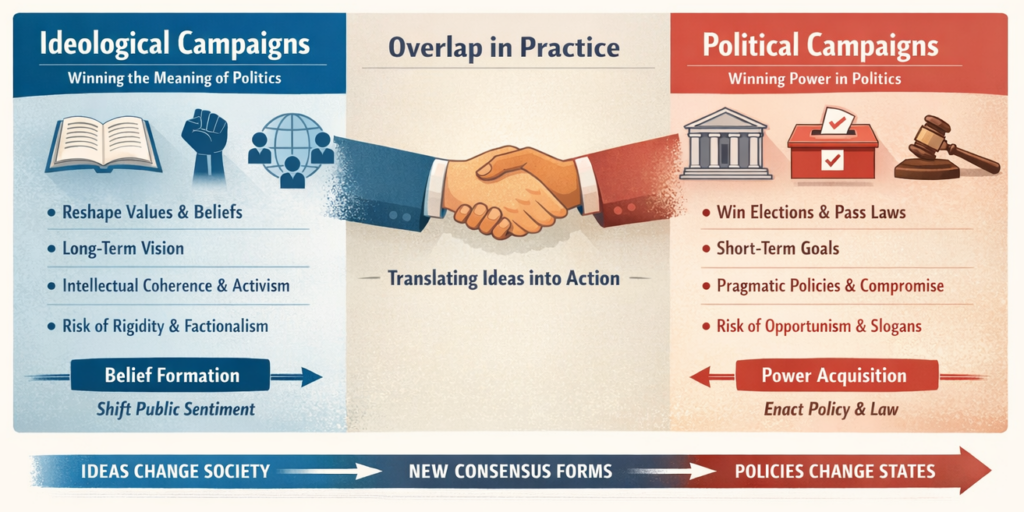
In practice, ideological campaigns and political campaigns often overlap, but they are driven by different goals, time horizons, and methods of winning. These difference can actually be seen ‘on the ground’. Ideological campaigns primarily seek to reshape values and identity with what are considered ‘common sense’ propositions so as to win hearts and minds, while political campaigns focus on capturing institutional power through votes and presenting policy proposals while being aware that often representative government has to be exercised through coalitions.
In this regard, ideological movements tend to prize a sense of unified coherence in thought and moral framing of socio-economic issues, whereas political movements are typically defined by pragmatic messaging, tactical compromise (internally and externally) and asserting competence and do-ability for implementation of primary policies. These types of campaigns can operate with different time horizons and measure success by different criteria, even when they draw on overlapping ideas or constituencies. Each derives its legitimacy from different foundations and approaches: ideological campaigns being grounded in normative conviction, and political campaigns in deliverable outcomes. It is worth examining further some key differences.
1) Core purpose: belief formation vs power acquisition
Ideological campaigns aim to change how people interpret reality. Their ‘win condition’ is when people adopt an ideology’s worldview. The focus is on convincing people about a set of ideas that have a moral framing and some kind of grand doctrine or vision, so that people identity with the ideology. This can be a long-term narrative that goes well beyond electoral cycles.
In contrast, political campaigns revolve around electoral cycles. The aim to win formal government or at least to influence decisions to be made by an incoming government. Their ‘win condition’ is votes, seats, policies that can become laws, and power to appoint persons to implement those laws. The focus is on institutions, elections, control of political institutions, ability to pass legislation, and budgets.
2) Time horizon: medium or long term vs short term electoral cycles
Ideological campaigns tend to work over many years or decades. They require deep psychological commitment and time commitment. They may seem to want fast results, but in reality are more willing to accept slow conversions.
Political campaigns work on weeks, months or a year or so. In most instances they run to a deadline: election day. Then followed by particular days for getting the required number of votes in a legislature to pass a Bill so it becomes an Act. Annual budget cycles can also attract political attention for getting a budget approved.
3) Target audience: hearts/minds vs swing blocs
Ideological campaigns seek to reshape values, assumptions and outlook. Promoters often see their ideological stance as being common sense, though members of the public may not see it that way when questioning what are the practical objectives and how can they actually be achieved. Interestingly, action to stem anthropogenic climate change began as a scientific finding and policy problem, but over time also become an identity- and values- based cause (climate activism), organised over decades of sustained public persuasion efforts. So, for many people it functions like an ideological campaign with a moral framing involving question of responsibility, justice and care for future generations, not merely a technical debate on emission levels and maths.
Of course, political campaigns also involve climate activism but with more immediate goals being to win seats in a legislature at elections or to pressure sitting representatives especially in swing constituencies and thereby secure a legislative majority (usually by consensus) so as to pass concrete legal measures such as emissions targets, renewable-energy subsidies, green-energy infrastructure spending, and tighter regulation of high-polluting industries. The focus of political campaigns is then on marginal seats, persuadable swing voters, turnout demographics, and establishing coalition partners inside the legislature. This is because swing voters in marginal electorates can have significant influence and even decide how a majority is formed in the legislature. Thus, even a small shift in their preferences can determine and control the legislative agenda, and in particular whether climate policies become achievable laws.
4) Messaging: coherence and clarity vs flexibility and triangulation
For ideological campaigns, consistency in values is very important. This is seen to promote ideological clarity, perhaps too often in terms of a binary right or wrong, backed by moral language and principles. However, this same consistency can harden into rigidity, discouraging engagement with complexity. When moral certainty becomes the primary organising logic, it can marginalise plural perspectives and reduce the capacity for adaptive responses to changing realities. Though, consistency can also mean a sound ethical foundation that supports coherent policies, and the capacity to engage constructively with complexity without losing normative or ethical direction.
While political campaigns acknowledge their ideological roots, they also recognise the practical value of coalition-building in many ways. This often involves strategic compromise in framing policies to take into account multiple views so as to make a policy seem workable. After all, people do tend to vote for policy positions that seem workable. What is ‘good enough to pass’ may suffice in order to secure broader support across a diverse constituency. As a result, political campaigns tend to rely on pragmatic language, emphasising concrete deliverables, incremental gains and achievable outcomes rather than ideological purity (though parameters around this are certainly debatable). What seems important is the translation of values into governing capacity. This is because after a successful political campaign, it is necessary to navigate through established institutions (even if to change them), and any of their constraints, while still advancing core objectives.
5) What counts as ‘success’ in a campaign?
In ideological campaigns, success looks like a shift in public norms. Here, public norms means the shared expectations that many people recognise and internalise, so that they are mutually enforced through approval and disapproval. An ideological campaign is about mainstreaming ideological concepts. New language becomes standard, and opponents now speak in terms of the ideologues.
Political success, however, looks like winning an election, and then being involved in policy formulation that leads to passing a Bill so that it become an enforceable Act: the law of the land. Such success may also involve stopping an opponent’s policy. Yet even these formal victories can remain fragile unless they are reinforced by public norms that sustain compliance, legitimacy and everyday acceptance beyond the moment of legislative triumph. In this sense, political campaigns are ongoing but subject to changes in what issues to tackle. Issues can also be prioritised due to public pressure.
6) Organisational style: movement vs drive
Ideological campaigns build intellectual circles and study groups (offline or online), with some developing into more sophisticated in-depth think tanks over time. Relatively long conversations and discussions take place to get points across, and to develop ideological understanding. Also, smaller groups get together and form larger activist networks. Having effective media channels becomes necessary to spread the ideology and these need to be built up. Over time, these elements cohere into a living movement, which is essential to generate momentum, attract more adherents, and translate ideas into sustained collective action rather than isolated initiatives.
Political campaigns build voter allegiance often centred on a disciplined candidate who, along with their team, take part in field operations such as door knocking, phone calling, and giving speeches at rallies and public events. Short discussions tend to take place with interested persons, as many neighbourhoods have to be covered within an electorate, usually within a short time before an election day. Fundraising operations are constant so as to support media efforts, with media networks and contacts being well-established and resorted to (often on a daily basis during an election campaign). The media strategy is more about fitting into news cycles so as to make critical points on policies when people are listening.
7) Tools: education and narrative vs mobilisation and turnout
A toolset for an ideological campaign typically includes books and long-form essays that develop and clarify doctrine, alongside podcasts and vodcasts that popularise ideas and sustain ongoing engagement. Influence is expanded through presence in colleges and universities, where ideas are debated and refined, and through trade unions and various community groups and networks, where theoretical commitments are worked through in lived experience and collective practice. Online communities are now increasingly common and much development of ideological thought takes place in them. Systematic training of cadres in core ideological principles is also needed, who are good at messaging and can convey strategic communications, which must be coherent and persuasive.
A toolset for a political campaign comprises television and radio advertising, direct mail, polling and focus groups, public endorsements, debates and earning media hits (i.e. mentions or coverage of a campaign in the media without paying for them). Increasingly sophisticated microtargeting is undertaken through digital platforms, especially social media. Indeed, constant participation in online forums is critical, as are other means of social media amplification. Being good at rapid-response communications is vital to mobilise supporters and to persuade undecided voters. The idea is to quickly shape public narratives and convert attention into votes under tight electoral timelines.
8) Ways of convincing: use of doctrine vs persuasion incentives
Ideological campaigns often construe the doctrines they espouse as something to be affirmed rather than interrogated, treating certain propositions as foundational commitments that must be accepted. This helps in coherent representation of the doctrines, but can also make proponents of them take a rigid attitude. At the same time, discussing the fundamental propositions is typically a serious intellectual matter. Participants invest heavily in theory-building, internal debate, textual interpretation, and development of comprehensive explanatory frameworks. This intellectual density gives ideological movements depth and endurance, though it can slow adaptation when empirical conditions or social attitudes shift.
Political campaigns are pressured toward simplification and selective emphasis because the overriding objective is to win sufficient support to govern (through the legislative arm of government) rather than to resolve theoretical questions. This dynamic encourages message discipline and downplaying of internal disagreement, with room for strategic ambiguity to allow for building of broad coalitions with divergent motivations to coalesce around a limited set of headline commitments. As a result, political communication prioritises plausibility, reassurance and perceived competence over doctrinal completeness or intellectual consistency.
9) Risk profile: radical vs disengagement
Ideological campaigning can drift into purity spirals, ‘enemy’ narratives and demonisation. This can happen when deviations from orthodoxy are treated as moral failures. If dominating personalities become too hardline, there is a risk of factional fragmentation and, in some cases, radicalisation in which extreme positions come to be seen as the only legitimate ones. Groups may then retreat into more uncompromising positions to maintain identity.
Political campaigning can drift into empty slogans, voter disengagement and opportunism. This reflects a hollowing out of substantive political meaning and civic trust. These things can happen when there is a breakdown in the relationship between political communication, credibility and public engagement, particularly when messaging becomes untethered from realistic policy substance or long-term vision. Voters may then view short-term vision and electoral competition less as a forum for collective decision-making and more as a performative exercise in manipulation.
10) How they interact (the real-world twist)
Major political shifts do often reflect some kind of ideological shift in society. Most major political shifts happen when ideological campaigns change the culture first or there is a clear socio-economic reason for change. Then, political campaigns harvest the new consensus. For example, the pattern may be that an idea is promoted from an ideology (which is a set of ideas) and becomes legitimate because the particular issue matters, so voters demand action, and political parties compete to advance the issue on various terms. Each then takes policy positions expressed in policy documents and present them to the public in order to attract voters.
The policy positions may be somewhat different but the underlying concern is basically the same. Accordingly, the policy mix, or perhaps a dominant policy position, then gets debated in the legislature and usually some kind of law will be passed that has to be implemented via the executive arm of government. Disputes may even arise in relation to the implementation, which have to be resolved by courts or tribunals or other means. Whatever the case, there has been a fundamental shift in society, which political actors cannot ignore.
Conclusion
Ideological campaigns aim to win the meaning of politics. Political campaigns aim to win power inside politics. However, ideological campaigns and political campaigns do overlap in practice, but they are driven by fundamentally different logics.
Ideological campaigns are oriented toward reshaping values and common sense understandings (which are really ideological principles) over the medium to long term. Their primary aim is belief formation. This means persuading people to adopt a worldview grounded in a moral framing, and to have normative conviction around a coherent and comprehensive doctrine. Success is measured by shifts in public understanding or sentiment, rather than immediate institutional outcomes.
As a result, ideological campaigns tend to emphasise intellectual coherence and consistency of values, which requires in-depth theory-building and sustained education initiatives, as well as being influential in community networks and activist movements. This depth gives ideological campaigns durability and social influence. However, there are risks involved such as rigidity, purity spirals, factional splits and radicalisation when orthodoxy is rigidly policed.
Political campaigns, by contrast, are oriented toward acquiring and exercising institutional power within short electoral cycles. This is primarily accomplished through influencing voters so as to gain seats in a legislature, the outcomes of which, namely laws, flow into the executive and judicial arms of government. Ability and capability to govern are crucial skills, but this often has to be done through coalitions and compromise.
Consequently, political campaigns involve pragmatic messaging around credible policies, though with room for flexibility. It is critical to translate values or principles into actual policies that appear workable to diverse constituencies, especially swing voters in marginal electorates. Political success is defined by electoral victory, passing laws, and also stopping opponents’ policies, though such victories remain fragile without supportive public sentiment. There are risks of simplification, opportunism, empty slogans and voter disengagement, when messaging becomes detached from substantive policy or long-term vision.
In practice, major political change usually occurs when ideological campaigns shift public thinking first, creating conditions that political campaigns then translate into law and institutional action. Political actors rarely lead such shifts; they respond to them. Once a new consensus forms, electoral competition tends to revolve around how (not whether) the consensus should be implemented.
https://open.substack.com/pub/macropsychic/p/some-key-differences-between-ideological

The obvious successful ideological campaign is abolition of slavery. This refers to the abolitionist movement of the 18th–19th century that slavery is morally illegitimate.
A failure of an ideological campaign is the 1960s–70s revolutionary left in Western states that was basically about imminent systemic overthrow of capitalism. They overestimated revolutionary appetite and drifted into sectarianism.
There would be numerous successes and failures of political campaigns. But a prominent successful one would be the New Deal in the United States (1932–1938) as this went ahead and it was F.D. Roosevelt’s electoral campaign with a legislative agenda. A failed one would be prohibition of alcohol sales in the United States (1920–1933) which called for a constitutional amendment and enforcement, but failed.