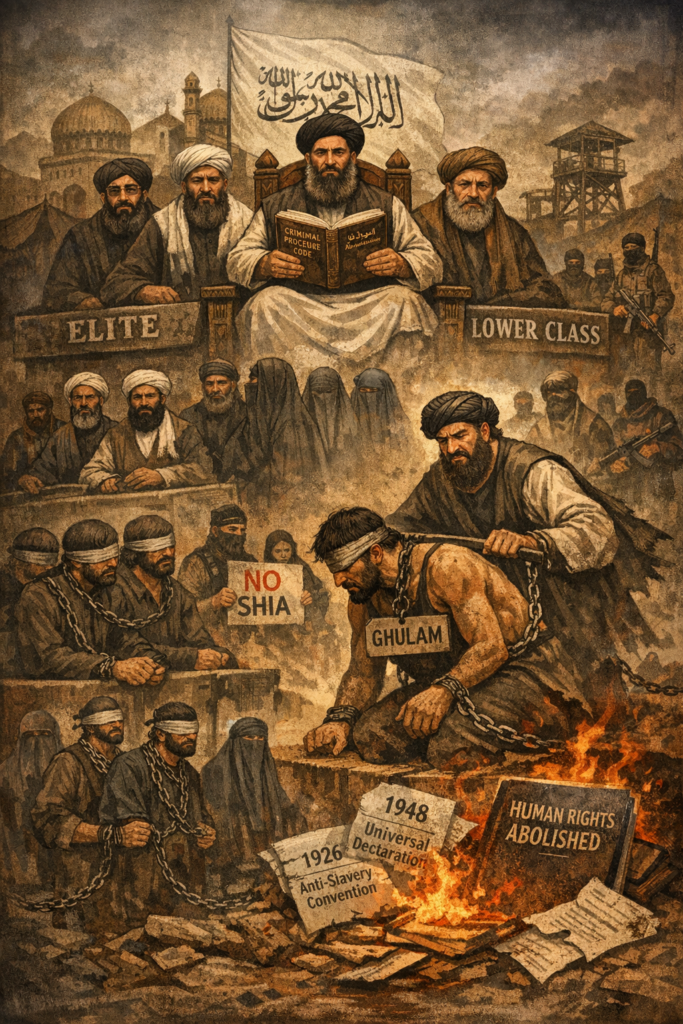
The Taliban’s introduction of a new Criminal Procedure Code in January 2026 is a continuation of their chilling vision for Afghanistan. Signed by Supreme Leader Hibatullah Akhundzada, the document referred to as the Criminal Procedure Code for Courts has been and must continue to be condemned by anyone concerned with human rights as it formally embeds practices that resemble slavery and institutionalising social hierarchy. It also narrows down religious identity under this so-called law.
The code repeatedly uses the term ghulam (Arabic/Pashto for ‘slave’). As reported by The Diplomat and Afghan rights group Rawadari (cited in Hasht-e Subh Daily) this indicates that the code distinguishes between ‘free’ persons and ‘slaves’ in legal proceedings. This constitutes formal legal recognition of a status that modern international law has abolished and that most contemporary Islamic legal scholars regard as incompatible with present-day Islamic ethics. While the Taliban claim fidelity to Sharia ‘law’, this move effectively legitimises ownership or permanent servitude of human beings under religious authority.
The Taliban’s code opens the door to exploitation through forced labour, debt bondage, coerced dependency, and many other abuses. It divides Afghan society into four rigid classes: religious scholars (mullahs and elites), tribal or noble figures, a middle stratum, and a lower class. Legal rights and punishments vary accordingly. Of course, religious scholars, especially Taliban-aligned clerics, enjoy near-total immunity from prosecution, while members of lower classes face harsher penalties for comparable offences. Justice, in effect, becomes contingent on social rank rather than evidence or equal protection. This codified hierarchy resembles feudal or caste-like systems rather than any modern conception of rule of law.
Such stratification reflects a deliberate political theology in which clerical authority is elevated above accountability. The result is a de facto theocratic aristocracy, shielded from scrutiny while empowered to discipline others. In practical terms, this means that abuses committed by those closest to power are less likely to be investigated or punished, entrenching impunity at the highest levels of that so-called ‘society’.
The code also narrows religious identity. That is, full recognition of being muslim (following Islam) is restricted to adherents of the Hanafi school of Sunni Islam, which is the Taliban’s preferred interpretation. Deviations are labelled as bid‘ah (unacceptable innovation) or heresy. Although approximately 99 per cent of Afghans identify as Muslim, this definition marginalises Shia Muslims, Sufis, Ismailis, and other non-Hanafi communities. According to Rawadari, the code risks formalising religious discrimination, potentially justifying exclusion from legal protections and allowing persecution. Then also there will be forced conformity. Notably, opposition to Taliban laws themselves is treated as a criminal offence, eliminating lawful dissent altogether.
These developments come from the Taliban’s return to power in 2021. They are an extension of restrictions on women’s education, employment and public presence — of which is based on negative ideology. Now the 2026 code extends this negative rigid ideology into a comprehensive legal architecture governing social status and religious standing. The so-called ‘law’ (which is really just a set of dogmas) now normalises inequality and coercion as structural features of oppressive governance. All this directly contradicts global norms embodied in instruments such as the 1926 (anti) Slavery Convention and the 1948 Universal Declaration of Human Rights, to which Afghanistan was once a party, as well as subsequent international human rights treaties.
The consequences for Afghan society are obvious — a legal system that legitimises servitude and stratified justice. In turn, this increases vulnerability for minorities and the poor while consolidating elite power. It undermines any prospect of social cohesion or economic recovery. This shows the failure of unchecked theocratic rule: when authority claims divine sanction without accountability, abuses become systemic.
Interestingly, religious scholars in Pakistan and elsewhere have denounced the provisions as un-Islamic, arguing that they violate Quranic principles of justice, dignity and equality before God. The Taliban have dismissed these critiques, insisting that their interpretation alone represents authentic Sharia. What they have done is make depravity legal.
As Afghanistan recedes further from international engagement, this legal framework will go on rejoicing unrestrained fundamentalism. Legalised servitude, class-based justice, and enforced religious uniformity are their instruments of control. For Afghans living under this system, this Islamic governance will see stratified oppression. Everyone is oppressed, and in the Taliban’s rule by law, some more so than others.
https://substack.com/@macropsychic/note/c-206665628