Practice moves faster than static ideology
There are cooperatives that have investors who are not also workers. This is more common than many may think. Across the global cooperative movement this is normal, not heretical, provided governance remains cooperative. That is, the cooperative spirit prevails. What matters is who controls the cooperative, not who supplies capital. These investors are usually called:
- investor-members,
- capital members,
- non-user members,
- associate members.
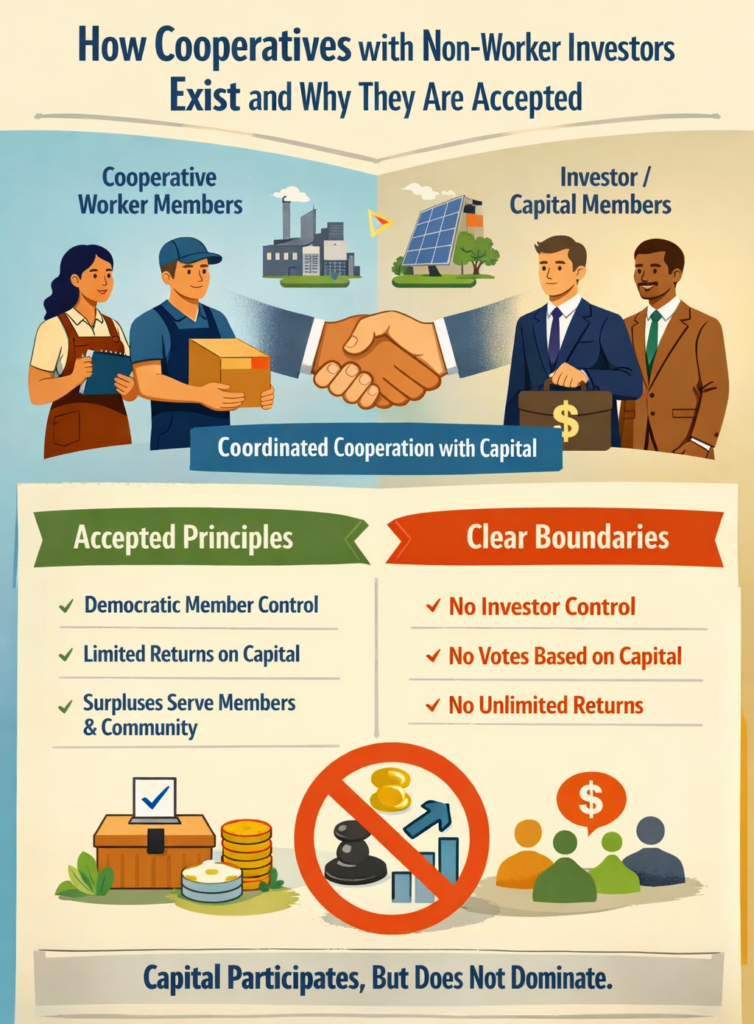
Coordinated cooperation with capital
Coordinated cooperation between capital-only-members and worker members or worker-with-capital members does actually fit into the international cooperative framework as expressed through the International Co-operative Alliance (ICA). The ICA, in its Guidance Note, does recognise that cooperative do exist that have multiple stakeholders and face their own challenges, but it is their responsibility to make membership meaningful to all their members. This means the key driver for membership engagement in all types of cooperatives is the relevance of the cooperative’s mutual purpose to meet members’ needs and aspirations. So, the ICA does leave it open that that a cooperative can have external or non-user capital members, as long as:
- capital does not control the cooperative,
- returns on capital are limited,
- surpluses primarily serve members and community.
Capital members may participate, but must not dominate. This reflects the concept of coordinated cooperation with capital, rather than subordinated cooperation or domination of capital. Reasons for this acceptance are that democracy in cooperatives should be capable of scale and must survive scale, and democracy cannot be arithmetically identical at every level or in every context. Rather than prescribing a single institutional model for cooperatives that would revolve around procedures, the ICA adopts a normative, principle-based approach that emphasises mutual purpose, democratic member control, and the primacy of meeting members’ needs and aspirations.
The ICA does not codify a single institutional form of a cooperative. Rather, it anchors the movement in norms and principles, not fixed governance mechanics. It allows plural legal forms and governance architectures so long as member worker control is real. This does however mean that voting by capital-only-members may have to be weighted or capped to prevent investor capture.
Because there is no single institutional form of a cooperative, this is why not only can federations of cooperatives exist, but also multi-stakeholder cooperatives and cooperatives with investor-members with limits, without violating cooperative identity. Thus, cooperatives can and do exist that formally include different types of members, such as:
- workers, who provide labour and are involved in operations,
- users / customers, who purchase goods and services, and make up part of the demand side,
- investors, who provide capital, but are patient regarding returns rather than speculative,
- community members who can advance a social mandate.
Diversity of cooperative forms
But diversity of cooperative forms are becoming common in Italy, France, Québec (in Canada), Spain and Latin America. Even in ‘pure’ worker cooperatives multi-stakeholder membership occurs. For example, in the Mondragon Corporation (in the Basque region of Spain) external capital is allowed in cooperatives, but one-worker-one-vote remains intact. In Italian social cooperatives external investors are allowed, but voting is capped at or under 33% of voting power. Italian social cooperatives do carry out commercial activity, but this is legally subordinated to a social mission. They are created under Italian Law 381/1991 (Legge 381/91) to deliver public-benefit services through market activity, using the cooperative form.
In many producer cooperatives (such as those of farmers and fishers), the use of external or hybrid investor capital is routine. Fonterra in New Zealand is a prominent example in which farmer-members retain control over voting and governance, while capital instruments (units) exist primarily to provide liquidity and financial flexibility. In Desjardins Group, based in Québec (Canada), strong cooperative governance is preserved alongside the use of hybrid capital instruments. Similarly, Rabobank, founded in 1898 in the Netherlands, with its roots in the Dutch cooperative credit movement, issues capital instruments to investors while governance authority remains with its local member banks. These cooperatives play significant roles in their national economies and represent mainstream, not marginal, expressions of the cooperative model.
A new frontier in the cooperative movement is the emergence of platform/app and digital services cooperatives. These enterprises operate in sectors traditionally dominated by investor-owned digital platforms, such as ride-hailing, freelance marketplaces, app and website development, and various data services, but reorganise ownership, governance and capital around cooperative principles rather than shareholder primacy. They combine worker or user control, community or member investment, and mutual or ethical finance. Their models are evolving (not deviations) but their governance logic is rooted in the cooperative tradition: democratic member control, limited returns on capital, and a primary obligation to meet member needs.
For example, Fairbnb, founded in Bologna (Italy) as an alternative to the Airbnb online digital marketplace for short-term accommodation, has expressed an explicit intention to evolve into a multi-stakeholder cooperative, which would allow other stakeholders (e.g. hosts, guests, local community actors) to acquire ownership and governance rights in the future. Stocksy United, which is in the business of licensing high-quality stock photography and video content, has founding members who provided capital and hold member shares. Fairmondo, a German based online marketplace, has both worker members (platform operators and staff) and investor / capital members (thousands of non-worker cooperative members who invested via cooperative shares). Its capital members have limited voting power, are capped in influence, and cannot control the platform. This means there is worker control and broad capital membership.
Concluding note
There is also some commonsense for having capital shares in a cooperative in relation to retirees and persons who may become disabled and who no longer work. They can retain their cooperative shares as an investment, which will bring them some dividend income. Consider a worker-member in a large, mature cooperative. While actively working, the member’s shares (capital contributions) give the person a single vote, while receiving income from the business primarily through wages, plus the person may receive patronage refunds or dividend linked to the cooperative’s performance. Upon retirement or disability the person ceases to be a worker-member in the operational sense. However, they do not automatically lose their capital stake. Their cooperative shares may be retained as member/investor capital, be reclassified as non-working or capital membership, or be held until redemption under the cooperative’s constitution or rules. The former worker no longer votes on day-to-day labour matters, but their capital continues to earn limited dividends subject to caps and cooperative performance. This provides a supplementary income stream in retirement from a form of investment built over a working life, without converting the cooperative into a shareholder-controlled firm.
Internationally, the cooperative movement already has a quiet consensus that capital is a tool, but is not a sovereign. This aligns with a progressive instrumental view of capital and to keep money circulating (rolling) in the economy. In the examples of the cooperatives above, multi-stakeholder or hybrid cooperatives have existed for some time reflecting a need for adjustments per time, place and social setting. But, as per classic notions of cooperatives, in order to retain the cooperative spirit, what the cooperative movement does not accept is:
- investors controlling the board,
- voting proportional to capital,
- returns that are uncapped and extractive,
- the cooperative purpose becoming secondary to return on investment.
These are important and enduring safeguards. They are prohibitions that mark the clear boundary between cooperative enterprise and shareholder capitalism, regardless of economic sector, industry or technology. They prevent capital dominating governance or purpose, and so ensure that the organisation does not cease to function as a cooperative in substance.
https://open.substack.com/pub/macropsychic/p/how-cooperatives-with-non-worker

In China, many cooperatives, especially in agriculture, rural industry and supply-marketing systems, include investor members (sometimes called capital-contributing members) alongside user or worker members. This is legally permitted and widely practiced, but control is still meant to remain cooperative, not purely investor-driven. Capital only participation is allowed, provided the cooperative’s primary purpose remains service to its members, and governance rules limit investor dominance. The basis for this arrangement is found in China’s modern cooperative framework, which is mainly shaped by:
* the Farmers’ Professional Cooperatives Law (2007, amended 2017), and
* sector-specific rules overseen by bodies such as the All-China Federation of Supply and Marketing Cooperatives.
Investor members, as expected, contribute capital, not labour or primary use. In Chinese cooperatives this typically occurs if there are wealthier farmers who can also act as capital investors, and in agribusiness firms (especially processing and cold storage), rural credit cooperatives, local township or village collectives, and state-linked enterprises (state-owned enterprises or quasi state-owned enterprises). Typical farmer cooperative structures in China are often hybrid forms. For example, investor members who provide capital, managers who can coordinate business activities and have that know-how, and farmers who retain membership and voting rights. These structures are deliberately pragmatic, not ideologically pure.
Still, China’s law does not allow cooperatives to become disguised corporations. The standard safeguard exists of one-member-one-vote as the default. However, investor members may receive capped additional votes or no extra votes at all. Statutory caps usually prevent investors from holding more than 20–30% of total voting power, even if they provide most capital.
An important reason why cooperatives in China use investor members is because of capital constraints in rural China. Most farmer-members have limited savings, lack access to commercial credit, and cannot finance infrastructure alone. Impractical ideologues may call for more land and wealth redistribution, but this is not practical reality and similar measures proved disastrous under Chairman Mao.
So, instead, as a matter of practical reality and to deal with real issues, investor members fill financing gaps by providing upfront capital. As well, they can provide actual machinery, storage facilities, processing plants and market access, which are non-monetary assets that are capitalised into the cooperative. As well, investor members help connect cooperatives to urban wholesale markets, secure export channels, and are important participants who help stabilise pricing through long-term contracts. This aligns with China’s policy goal of modernizing agriculture.
In terms of composition of board of directors, investor members may hold some board seats, but farmer/user members must retain board majority. This is critical in Chinese law and policy guidance. If the cooperative accumulates profit, this surplus is usually divided into patronage-based returns to farmer/user members and limited returns on capital to investor members. Investor returns are capped, subordinate to member service objectives, and often paid only after cooperative reserves are funded. It is important to note also the role of audits, strict registration checks, and clear disclosure rules that help prevent investor capture or informal dominance.
These kind of cooperative arrangements suit the current socio-economic conditions in China where cooperatives are understood as also being developmental institutions that contribute to the overall wealth of the nation. They are not established merely for the purpose of following some ideal form that comes from Western dogma. This aligns with a broader need for multi-stakeholder governance that may also include state involvement, which is seen as better furthering the development of China as a whole. Acceptance of investor members in cooperatives is seen to help further China’s development goals, and revolves around three principles:
* Service primacy – the cooperative must serve members’ production or livelihood needs.
* Controlled capital – capital is necessary and is a tool for development, but politically and legally subordinated.
* Stability and scale – cooperatives are tools for rural resilience, which is not just a matter of member autonomy.
What matters under Chinese law and policy is not who provides capital, but who controls the cooperative and who it ultimately serves – both are important. This fits practically into socialism on Chinese terms. In short, investor members in Chinese cooperatives are normal, legal and intentional. They exist because:
* rural development requires capital,
* markets require scale and logistics, and
* practical coordination is essential between economic sectors.
https://macropsychic.substack.com/p/how-cooperatives-with-non-worker/comment/206236028
Australian co‑operative law allows for a participatory type of interest in co-ops by those who contribute only capital, but not as full voting members. This is achieved through a special class of investors allowed under the Co‑operatives National Law (CNL).
As a starting point, under the CNL, standard co-op members must be ‘active members’ to qualify for membership. This means they must participate in or use the co‑op’s services as defined by the co‑op’s rules, otherwise they lose voting rights and may have their membership cancelled. This is designed to uphold the co‑operative principle that members are participants, not passive investors.
However, the CNL does allow capital‑only participants, but as non‑member investors. While not formally members, but they can invest capital into the co‑op. This means having a financial interest, but not as mere lenders. Under the CNL, co-ops may issue Co‑operative Capital Units (CCUs), which are hybrid investment securities unique to co‑ops. They can be issued to members or non‑members and they provide capital investment rights. Though they do not provide member voting rights or ownership control.
CCUs grant an interest in the capital, but not the actual share capital of the co-op. They are similar to having a ‘share’ in property or a unit trust. Dividends can be obtained by holding CCUs. The issue of CCUs do not alter the ‘ownership’ of the co-op. Though, CCU holders may vote on proposals which concern the rights of the CCU holders themselves. The issuing of CCUs must be pre-approved by the Registrar of Co-operatives in the relevant State or Territory and the members of the co-op, and financial disclosure requirements apply.
The reason for CCUs is to let co‑ops raise equity capital from external investors without giving them member status or governance power. In effect people can invest capital, but do not participate in governance. They enjoy financial rights defined by the CCU terms. This structure still preserves the co‑operative principle of democratic control (one member, one vote).
In short, Australian co‑operative law:
* does not allow someone to be a member who only contributes capital, but.
* does allow capital‑only investors through CCU, which give economic rights without membership or voting power.
https://macropsychic.substack.com/p/how-cooperatives-with-non-worker/comment/206214824