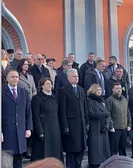
On 25 January 2026, at Vilnius’ Rossa Cemetery in Lithuania, four figures stood in quiet alignment: Lithuania’s President Gitanas Nausėda, Poland’s President Andrzej Duda, Ukraine’s President Volodymyr Zelenskyy, and Belarusian opposition leader Sviatlana Tsikhanouskaya. They came to honour the fighters of the 1863 January Uprising, being those who resisted the Russian Empire and paid for it in blood. In the cold stillness of a cemetery, surrounded by stone and silence, they performed an act that was neither mere diplomacy nor empty symbolism. They affirmed something dangerous to empire: a shared remembrance, and thus a shared future. This is exactly the kind of symbol Moscow has hated for centuries.
Empires do not fear armies alone. They fear the collapse of the story that justifies their rule. They fear peoples who remember that they were once free even if that concept is relative to their times, and who remember that imperial domination was never inevitable. The January Uprising was not just a Polish revolt. It was a regional defiance. It was a refusal by a group of nations in the borderland of the Russian Empire (past and present) to be reduced to a colony of history. And yes, it is proper for the opposition leader of Belarus to represent that nation. Standing at Rossa, the four of them drew a line of continuity from that nineteenth-century struggle to the present war in Ukraine, and the still unfinished liberation of Belarus. This line is not just a historical matter, it is also a moral one.
For Russia’s imperial narrative, the borderland region must be a sphere of influence or in other words a place without agency, without sovereignty, without voice. A zone that is mapped and administered for the purposes of empire. But the image from Vilnius offers something else entirely: an alternative vision of the region as a community of nations, each with its own memory and dignity, standing together not as satellites of an empire but as equals in a community. The geography remains the same, but there is an added meaning.
What is that addition in meaning? It is that, today, as in Ukraine, we are not merely talking about a battleground for territory. The four political figures standing at Rossa are talking about belonging. That is, the right of nations to choose their alliances without coercion and to interpret their past on their own terms but in a truthful way of remembrance that is unshackled from intimidation. In this case, as a struggle against imperialism, old and new, which all understand as a struggle against Russian imperialism. This is also a struggle for cultural sovereignty, because local culture is about identity and meaning. It shapes how a people remembers its past, defines its reality, and defends its dignity against imposed narratives and domination.
But a deeper principle also comes into view: it is that human society functions best when organised around coordinated cooperation rather than subordinated domination. Where cooperation and collaboration are at work, people willingly share their culture and heritage for the benefit of all participates and allow it to adapt and be positively influenced accordingly. Empire, however, treats neighbours as instruments of domination, as hegemonic subjects, not as willing and equal participants (as in the case of cooperation). A healthier order is not one nation ruling others, but nations standing in a network of solidarity. The reason for solidarity is to be strong enough together to resist coercion. Solidarity is a unity and can exist amidst diversity of nations. It does not require uniformity, rather it is based on harmony.
Empire understands that severing a society from its patterns of continuity makes it governable for hegemonic purposes. However, a society of people who remember their heritage cannot easily have their memories rewritten or forgotten. This is even the case after they share their heritage with others and recognise that their present culture will change as a consequence — but this is done freely. Free expansion of culture will not readily erase past memories. Indeed, those memories will find expression in other areas. Still, authoritarian empires will attack memory — history, language, culture, monuments, education, archives, and so on.
Standing together at Rossa though has declared that this region, represented by the four political figures, is not a projection of someone else’s power, but a lived inheritance of struggle and self-respect of its own people. It also indicates welcoming of new people who wish to integrate their socio-economic interests with those currently living in the region. There is an irony of empires in that the harder they press to erase the memory of a people — which is also an expression of sovereignty — the more they create the conditions for sovereign unity. Nations do not only endure through strength. They endure through meaning.
Truely, a community of memory is not merely remembrance. It is a community of power that is made legitimate by truth, and therefore difficult to crush. The modern world is full of alliances that are transactional and temporary. But what stood in Vilnius was something rarer that cannot easily be crushed: an alliance rooted in shared historical consciousness. Sadly, that has also arisen from wounds inflicted by the Russian Empire that are still remembered. Though that in itself is highly instructive as it reveals that solidarity is often forged not by convenience, but by the hard-earned recognition that freedom requires vigilance, mutual protection against recurring imperial ambitions, and that collective memory is worth protecting.
https://substack.com/@macropsychic/note/c-205306844