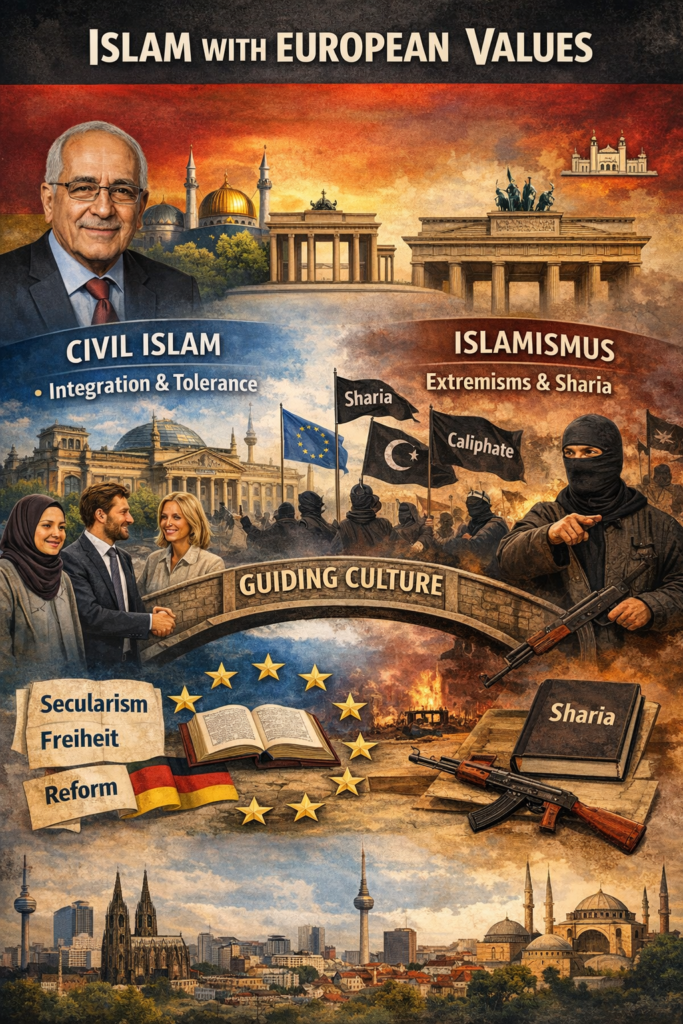
Islam Aligned with European Values
The phrase ‘Islam with German values’ refers to the broader idea of ‘Euro-Islam’ (or ‘Europäisierter Islam’), a concept promoted primarily by the Syrian-born German political scientist and Muslim intellectual Bassam Tibi. It was introduced in the early 1990s, and gained traction in Germany during the late 1990s and 2000s amid debates on immigration, integration and multiculturalism. Tibi, who immigrated to Germany in 1962 and became a citizen in 1976, framed Euro-Islam as a reformed, secularized version of the faith that reconciles Islamic principles with core European values, such as democracy, human rights, secularism and gender equality. The idea is to make Islam compatible with life in Germany — and today the EU.
This was positioned as an alternative to parallel societies or Islamist interpretations that Tibi saw as barriers to integration. Recently, the idea gained some more traction in Germany, and probably remains the policy position but does not achieve media recognition. While not always phrased exactly as ‘Islam with German values’ (more commonly ‘Islam mit deutschen Werten’ in German discourse), the idea ties into the related Leitkultur (i.e. Germany leading or guiding culture) debate, which Tibi also coined in 1998. Leitkultur emphasizes that immigrants, including Muslims (who number about 5.5 million in Germany or ~6.5% of the population), must actively adopt Germany’s constitutional values for successful coexistence. Euro-Islam has been promoted as the pathway for Muslims to achieve this, especially after waves of Turkish guest workers in the 1960s–70s and refugees from the Middle East in the mid-2010s.
Core Elements of Euro-Islam
Tibi’s vision, detailed in books like Euro-Islam: Die Lösung eines Zivilisationskonflikts (2009, expanded 2020), calls for the following:
- Secularization and reform. This practically means Muslims in Europe should prioritize the separation of religion and state (no Sharia law), reject jihadism, and interpret the Quran in light of modern pluralism.
- Integration over assimilation. This means to retain Islamic identity but ‘Europeanize’ it, e.g. by embracing individual freedoms, tolerance and civic participation while abandoning patriarchal or supremacist elements.
- Civil Islam: This means a ‘faith of testimony’ (Dar al-Shahada) where Muslims live under secular laws with religious freedom, countering the traditional Islamic dichotomy of Dar al-Islam (house of Islam) versus Dar al-Harb (house of war).
- Critique of extremism: Here, Tibi warned against Islamist groups (e.g. those backed by Turkey’s AKP* or Salafists**) hijacking communities, estimating they represent 3–5% of European Muslims but pose risks if unchecked.* Justice and Development Party (Turkish: Adalet ve Kalkınma Partisi), a conservative political party that has dominated Turkish politics since the early 2000s.** Muslims who advocate a strict, literalist return to the beliefs and practices of the salaf—the first generations of early Muslims—seeking to model contemporary life and governance on what they view as Islam’s original form.
Euro-Islam was not in Tibi’s time, a top-down government policy but an intellectual and policy proposal. It was amplified in media (e.g., Der Spiegel interviews) and forums like the German Islam Conference (Deutsche Islam Konferenz, launched in 2006), which promotes shared values between Muslims and non-Muslims. As mentioned, the basic idea is to reconcile Islamic faith with pluralism, secular law and human rights by encouraging civic integration and cultural adaptation from within Muslim communities, rather than through coercive assimilation or legal compulsion by the state.
Historical Context and Promotion in Germany
Going into more detail, Tibi first used ‘Euro-Islam’ in a 1992 paper, publishing it in 1995 amid post-Cold War migration debates. By 1998, he linked it to Leitkultur in Europa ohne Identität?, arguing Europe needed a shared civic culture to avoid cultural clashes, but Europe guides. This resonated during the 2000 Bundestag debate sparked by CDU leader Friedrich Merz, who invoked Leitkultur to demand immigrants respect German norms like equality and secularism. So, Euro-Islam had its first impact back then.
The peak promotion period was in the 2000s–2010s. This was from post-9/11 and during the 2005 London bombings both of which had Islamist connections and both incidents heightened fears of Islamism, so this boosted Tibi’s calls for reform. He urged Germany to support liberal Muslims over traditional associations like DITIB (Turkish-Islamic Union for Religious Affairs or in German Diyanet İşleri Türk-İslam Birliği, the largest Islamic organization in Germany with around 130,000 members and seen as AKP-influenced). The main political party’s (Christian Democrat Union or CDU) 2010 resolution affirmed Germany’s Christian-Jewish Leitkultur (guiding culture) but welcomed immigrants who adopt it, though the CDU also said ‘Islam was part of Germany’.
Germany’s migrant crisis, with over 1 million arrivals, mostly Muslim from Syria, effectively beginning in 2014 but escalating rapidly in 2015, revived Euro-Islam thinking. However, Angela Merkel’s Wir schaffen das (We can do this) at a press conference on 31 Augusts 2015 faced backlash, with surveys showing only 22% of Germans agreeing with ‘Islam belongs to Germany’. Still, Euro-Islam was pushed as a pragmatic solution. This had to be done along with integration laws, such as a 2016 Act mandating 600+ hours of civics/language courses and women’s Islamic centres, but this was seen by many as tokenistic and still favouring conservative mosques. Emphasis on rejection of honour violence and political Islam was also stressed.
Mention should also be made of broader debates. Figures like Thilo Sarrazin (in his 2010 book Deutschland schafft sich ab) criticized unintegrated Islam, which actually fueled populist calls. For example, by 2017 the AfD had risen to 12.6% in public opinion polls and there was a larger view that ‘Islam was not part of Germany’. Liberals like Tariq Ramadan offered a semi-competing view, seeing Euro-Islam as possible without fully rejecting Sharia. As well, critics accused Tibi of essentializing Islam, but he positioned it as pro-integration while not anti-Muslim.
Tibi’s disillusionment
After the mid-2010s, Tibi declared Euro-Islam a failure — not in the sense of its substance but in the sense that practical implementation was not achieved. In a 2016 Cicero article and 2020 Deutschlandfunk interview, he said ‘headscarf Islam’ (symbolizing conservative practices) had triumphed, blaming Islamist influence via state-backed mosques and migration and European weakness in defending values. He mentioned the cancelling of the Idomeneo opera in Berlin earlier in 2006 after police warned of a possible risk of violent reaction from Islamist extremists because of a scene in which severed heads of religious figures, including Muhammad, Jesus, Buddha and Neptune, were displayed on stage. He felt a lack of support for reformers like himself.
The idea of Euro-Islam still has support. In 2024, the CDU’s Carsten Linnemann reiterated ‘Sharia does not belong to Germany’ tying this approach to Leitkultur. He did this amid Islamist protests/marches, such as that in Hamburg in 2024, supporting caliphates. Interestingly, the German Islam Conference continues promoting shared values. However, Euro-Islam has sometimes been accused of promoting cultural supremacism and ignoring hybrid identities.
Conclusion
In essence, ‘Islam with German values’ was a call for mutual adaptation: Muslims reforming faith to fit democratic German values and wider European values. Europe had begun to support this shift, but practical implementation was weak. It still remains influential in integration policy but there are some ongoing tensions between pluralism going too far and cultural cohesion in Germany. For a deeper reading see Tibi’s Euro-Islam statt Islamismus (2020) as a key text.
That book presents a comprehensive approach to Islam in Europe, emphasizing the need for a European Islam that embraces European ideas of civil society, secular democracy and individual human rights. So, Tibi (a knowledgeable reader of the Quran) has not given up. He has indeed developed an integrative concept to counteract the politicization of Islam and critically addressed Sharia law and jihadisation. His work remains a secular response to the challenge of Islamic fundamentalism, offering a convincing European answer.
https://open.substack.com/pub/macropsychic/p/concept-of-euro-islam