Victorian-era standards imposed onto a diverse population
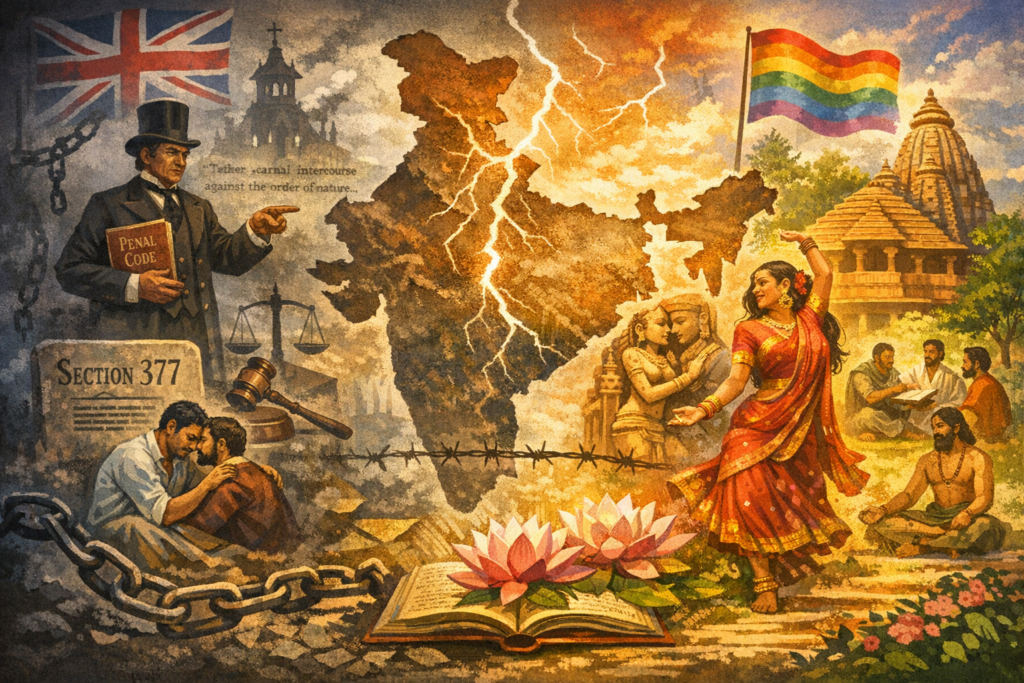
British colonialism influenced morality in India by imposing Victorian-era Christian values, which emphasized strict sexual propriety, heteronormativity, and the condemnation of ‘unnatural’ acts as sinful. This was part of a broader effort to ‘civilize’ and reform colonized societies according to European standards, often overriding indigenous cultural norms that were more fluid and tolerant. The most prominent example is the criminalization of homosexuality through section 377 of the Indian Penal Code (IPC), introduced in 1860 under British rule. The section reads as follows:
377. Unnatural offences.—Whoever voluntarily has carnal intercourse against the order of nature with any man, woman or animal, shall be punished with transportation for life [imprisonment for life], or with imprisonment of either description for a term which may extend to ten years, and shall also be liable to fine.
Explanation.— Penetration is sufficient to constitute the carnal intercourse necessary to the offence described in this section.
This law, rooted in Judeo-Christian prohibitions against sodomy, labeled consensual same-sex acts as “carnal intercourse against the order of nature” (Government of India, 1860). Up to 1955, the penalty was “transportation for life” which was then changed to “imprisonment for life”. Transportation for life meant permanent exile to a penal colony, most notably the Andaman Islands (Cellular Jail), forced labour under harsh prison conditions, or severance from family, community and civil life. These were forms of ostracism. In practice, the punishment often amounted to a life sentence under extreme conditions, with little realistic prospect of return. This law not only legally suppressed non-heteronormative behaviours but also instilled a lasting societal stigma, reshaping moral discourse in India for over 150 years.
Before the British
Before British arrival, Indian society exhibited a relatively tolerant stance toward diverse sexualities, influenced by ancient Hindu, Buddhist and Jain texts that portrayed homosexuality, bisexuality and gender fluidity without outright condemnation. Ethical concern focused less on the gender of one’s partner than on attachment, desire and karmic consequences of action, with sexual diversity understood as part of conditioned embodied existence rather than as moral transgression. Temple carvings at sites like Khajuraho also depict homoerotic scenes (Chakraborty & Thakurata, 2013), reflecting cultural acceptance in medieval India. The Khajuraho temples belong primarily to Hinduism, with a minority Jain presence as well.
Works like the Kama Sutra, composed between approximately 400 BCE and 200 CE within the classical Hindu worldview, and traditionally attributed to Vātsyāyana, includes discussions of same-sex relations and sexual practices, and recognises categories of third-gender individuals (tritiya prakriti), which are preserved in later English translations (Vātsyāyana, trans. Burton & Arbuthnot, 1883). These were treated as part of human expression and experience rather than moral aberrations. Importantly, such discussions were embedded within a broader normative framework concerned with social roles, mutual consent, and the cultivation of pleasure (kāma) as one of the legitimate aims of human life, rather than framed in terms of sin or criminality. In this respect, the Kama Sutra is part of the Hindu intellectual and cultural tradition, but it is not a religious scripture.
Classical Buddhist texts generally focus on conduct, harm and intention, not sexual orientation. They address same-sex acts mainly in monastic disciplinary contexts, not in relation to the broader society. They also acknowledge gender variance (e.g. paṇḍaka, ubhatobyañjanaka) without framing people as morally depraved (Cabezón, 1992). Cabezón shows that Buddhist canonical and commentarial sources do not contain a general moral condemnation of homosexuality, treat same-sex relations as largely disciplinary matters for monks, and in terms of societal ethics emphasise non-harm and intention over categorical prohibition.
Jain literature recognises sexual and gender diversity as part of karmic embodiment, so classifies sexual behaviours descriptively rather than morally absolutist. The literature tends to treat desire, not orientation, as an ethical concern. Also, it acknowledges third-gender categories without demonisation. (Jaini, 1991) Jain ethical texts emphasise self-discipline equally for all desires and treat sexual diversity as part of worldly existence rather than moral deviance (Dundas, 2002).
While some regions (mainly north-western) of pre-British India, influenced by Zoroastrianism or early Islamic invasions, showed pockets of homophobia (Vanita & Kidwai, 2000), there were no widespread legal bans on homosexuality for the general population. Punishments, if any, were mild fines rather than severe penalties, and queer identities, like hijras (transgender or intersex communities), held social roles in rituals and folklore. This inclusivity stemmed from indigenous philosophies emphasizing contextual ethics over rigid moral binaries. Contextual ethics refers to an approach that holds that ethical judgements must be evaluated within their social, cultural, historical and situational contexts, but does not deny universal values (e.g. human dignity), though their implementation and prioritisation can vary across contexts.
Colonial mentality
British colonizers, driven by 19th-century Victorian-era puritanism and Christian doctrine, viewed Indian sexual pluralism as uncivilized and in need of reform. Drawing from English anti-sodomy laws dating back to the 1533 Buggery Act (English Heritage, n.d.), they standardized morality across the British Empire to enforce behavioural control and cultural superiority. Section 377 of the IPC, drafted by Thomas Macaulay (a colonial administrator), explicitly targeted “unnatural” acts, including homosexuality, as offences against Christian notions of natural law and procreation. This law was replicated in over 80 British colonies, creating a global anti-LGBTQ+ legacy.
Beyond homosexuality, colonial morality suppressed practices like polygamy, and hijra communities, framing them as immoral to justify imperial intervention. Missionaries and administrators promoted monogamous, heterosexual marriage as the moral ideal, eroding indigenous inclusivity and fostering internalized homophobia. Accordingly, in India, Victorian-era British imported norms were institutionalised through colonial law and education. This reshaped social attitudes long after Indian independence (on 15 August 1947) and embedded Victorian-era moral assumptions within postcolonial legal and cultural frameworks.
No doubt it was the introduction of section 377 of the IPC that transformed homosexuality from a tolerated or neutral aspect of life in India into a criminal and moral taboo, aligning Indian ethics with Christian puritanism. It enabled police harassment, blackmail and social ostracism, embedding shame in cultural systems and narratives. This colonial imprint persisted post-independence (1947), as India retained much of the IPC, including section 377, until 2018.
Supreme Court ruling
In 2018, the Supreme Court of India (its apex court) in Navtej Singh Johar v. Union of India (2018) partially struck down section 377 of the IPC in relation to criminalization of consensual same-sex acts, deeming it unconstitutional and a colonial relic violating privacy, equality and dignity. This means section 377 excludes consensual sexual relationships between adults, whether between same-sex individuals or otherwise. In this respect, the Court decided that section 377 was contrary to Article 21 (right to dignity, privacy and sexual autonomy), Article 19 (freedom of expression), Article 14 (right to equality) and Article 15 (nondiscrimination) of the Constitution of India. However, section 377 continues to apply to non-consensual sexual activity against adults, sexual acts against minors, and bestiality.
Importantly, the ruling acknowledged the pre-colonial nature of section 377 and framed decriminalization as reclaiming indigenous morality. However, challenges remain: societal stigma persists, same-sex marriage does not have legal recognition, and LGBTQ+ individuals face discrimination in healthcare, employment and family law. This reflects the enduring shadow of colonial Christian morality (or rather what was then seen as Christian morality), even as activism pushes for fuller decolonization.
Conclusion
In summary, British rule exported a rigid, homophobic moral framework into India that supplanted India’s more permissive traditions, with homosexuality as a stark example. While legal reforms signal progress, the Victorian-era cultural residue continues to influence ethical norms, highlighting the complex interplay between colonialism and identity in modern India. Confronting this legacy requires not only legal change but a critical re-engagement with precolonial ethical traditions to reclaim pluralism as an original indigenous value.
References
Cabezón, J. I. (1992). Buddhism, Sexuality, and Gender. State University of New York Press. https://sunypress.edu/Books/B/Buddhism-Sexuality-and-Gender
Chakraborty, K., & Thakurata, R. G. (2013). Indian concepts on sexuality. Indian Journal of Psychiatry, 55(Suppl 2), S250–S255. https://journals.lww.com/indianjpsychiatry/fulltext/2013/55002/indian_concepts_on_sexuality.22.aspx, https://www.ncbi.nlm.nih.gov/pmc/articles/PMC3705691/
Dundas, P. (2002). The Jains (2nd ed.). Routledge. https://www.routledge.com/The-Jains/Dundas/p/book/9780415266055
English Heritage. (n.d.). Walter Hungerford and the ‘Buggery Act’. https://www.english-heritage.org.uk/learn/histories/lgbtq-history/walter-hungerford-and-the-buggery-act/
Government of India. (1860). Indian Penal Code, 1860: Section 377 (Unnatural offences). India Code, Ministry of Law and Justice. https://indiankanoon.org/doc/137539806/, https://www.indiacode.nic.in/bitstream/123456789/15289/1/ipc_act.pdf
Jaini, P. S. (1991). Gender and salvation: Jaina debates on the spiritual liberation of women. University of California Press. http://ark.cdlib.org/ark:/13030/ft138nb0wk/
Navtej Singh Johar and Ors vs. Union of India thr. Secretary of Ministry of Law and Justice. (2018). https://privacylibrary.ccgnlud.org/case/navtej-singh-johar-and-ors-vs-union-of-india-uoi-and-ors, https://indiankanoon.org/doc/168671544/
Vanita, R., & Kidwai, S. (2000). Same-sex love in India: Readings from literature and history. Palgrave Macmillan. https://doi.org/10.1007/978-1-349-62183-5
Vātsyāyana. (n.d./1883). The Kama Sutra (R. F. Burton & F. F. Arbuthnot, Trans.). Project Gutenberg. https://www.gutenberg.org/ebooks/27827
https://open.substack.com/pub/macropsychic/p/how-british-colonialism-influenced
