Radiofrequency spectrum, telephone numbers, backbone networks
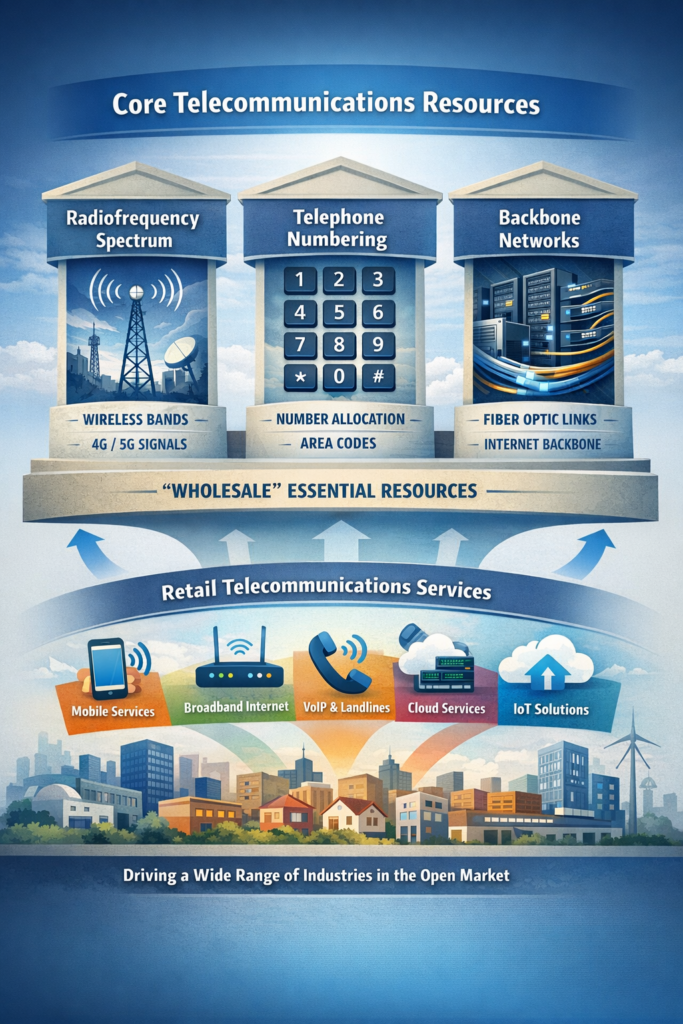
Radiofrequency spectrum, telephone numbering, backbone network infrastructure (non-retail) are 3 fundamental, non-substitutable resources in telecommunications. They are essential for entire industries to function, and in open market economies access to them is heavily regulated to promote competition and efficiency. Effectively, they are the key resources or key industries. Together they enormously benefit the economy. Everything else that end-users buy — mobile broadband and/or fixed broadband, TV bundles combining television services with high-speed internet and even home phone or mobile plans, cloud services, etc — is basically a retail product built on top of access to those 3 primary resources. The 3, form the “natural resource layer” of telecommunications.
The matter can be broken down as follows. What is the resource, why is it fundamental and scarce, who controls it initially, and what retail layers can be built on top of it. These distinctions clarify where natural monopoly characteristics arise compared to where genuine markets can function that best serve consumers, and are to be encouraged. This breakdown helps separate utility-style regulation of the foundational layer (key resources and industries) from competitive dynamics at the service and application layers involving retailers (non-key industries).
Initial and ongoing allocations allowing use of the 3 resource components can:
- Be managed on a no-profit no-loss basis. That is, the government through a regulator recovers its costs for allocating spectrum and numbers, and for ongoing management, by imposing service charges for work done in the allocation and management. This is basically cost recovery. Likewise, a backbone network, such as a national broadband network, through a government owned enterprise, charges for access to the network that is required by commercial (or other) enterprises who provide telecommunications services to the public or need the resources for their own use. This would include a fixed line broadband supplier for the former, and a mining company needing wireless communications on a site for the latter.
- Demand and impose factor or first stage production taxes on acquirers of radiofrequency spectrum licences and telephone numbers, and also on an ongoing basis (where required). They are usually called fees, though economically function as factor taxes. The amount of tax being based on the value of the spectrum or numbers (should they have value that is relevant to the commercial economy). Such taxes are common for natural resource extractions. The amount determined can also be via an auction process. Effectively, there is a tax on a key input before service delivery by a provider of commercial services. Likewise, when a retail service provider acquires access (an input of production) to a national broadband network, the government owned enterprise charges a wholesale price and on top of that a consumption tax, such as value-added tax (VAT) or goods and services tax (GST).
3 key essential assets
Take radiofrequency spectrum. It is electromagnetic waves, which are a finite physical resource. Only certain frequency bands are usable for mobile telephony, Wi-Fi, satellite communications, etc. Within a topographical area, the state is the controller (usually via a national regulator, e.g. FCC in the USA, BNetzA in Germany, Ofcom in the UK). From acquisition and use of this resource, spring mobile network operators (MNOs), wireless internet service providers (WISPs), satellite operators, and many others. They acquire spectrum for a fee/tax, and have it licenced to them, though some spectrum can be generally authorized or shared without a charge. From use of the spectrum, they can sell 4G/5G plans, fixed-wireless access, satellite TV services, etc. These are retail services.
Now consider public telephone numbering. This means the E.164 numbers (2010) standardized by the International Telecommunication Union (Telecommunication Standardization Sector), usually referred to as ITU-T. These numbers are globally unique identifiers needed for interconnection and routing. Number blocks are finite and coordinated internationally by the ITU-T. The next layer is the state/country regulation, which is effectively done by a national regulator (or supranational). Then telecommunications carriers receive large number ranges in bulk from the regulator, on payment of a fee (a tax in a broad economic sense). This should be based on demonstrated need and efficient use rules. These numbers are used in selling mobile phone plans which need a telephone number, VoIP numbers, toll-free numbers, etc. to enterprises and end-consumers. There are lots of possibilities and variations.
What about a backbone transport network for telecommunications? Generally, this is non-retail. Backbone networks primarily provide high-capacity, long-haul connectivity between regions in a country, or between countries or continents, as well as last-mile and middle-mile fixed telecommunications cables, and relevant non-retail infrastructure. They are sold on a wholesale basis to other telecommunications carriers, internet service providers (ISPs), and others.
In relation to backbone telecommunications networks how they are structured as a key industry can vary per country or region. Some countries have a national broadband network. In Australia this is operated by NBN Co Limited which is a dedicated national/federal government enterprise that sells access to retailers (e.g. telecommunications carriers providing broadband services). Other countries have different models, such as a small number of wholesale-only carriers. For example, New Zealand has an Ultra-Fast Broadband (UFB) programme under which Crown Infrastructure Partners (CIPs) oversee funding and rollout by Local Fibre Companies (LFCs) to build and operate fibre infrastructure. In New Zealand, Chorus Limited is the largest at about 70% of the UFB coverage area. But whatever the case, mobile network operators, retail ISPs, hyper-scalers (cloud companies), CDNs (content delivery networks), and others, buy capacity from a wholesaler. From there, they can sell consumer broadband products, enterprise VPNs (virtual private networks), cloud interconnects, etc.
Diverse services – retail sector
So, in relation to all these 3 resources: radiofrequency spectrum, telephone numbers, telecommunications backbone networks, these are key resources, regulatory resources, or part of the wholesale stack, respectively. The retail stack is a layer that consumers (individuals and enterprises) deal with. Businesses operating in the retail stack or sector are not key industries (ordinarily they should not be treated as such). Once you have access to those 3 primary resources, everything else derived from them is retail or value-added. Commonly the retailers are:
- Mobile Network Operators (MNOs), who sell broadband services (fixed or wireless or both), and
- Mobile Virtual Network Operators (MVNOs), who buy radio access and numbering and other related accesses from an MNO (another retailer) as a package of inputs for the MVNO’s own business (as a reseller) and sell services to consumers.
For the above two, there is a wide variety of consumer and business broadband plans, among many other services. These plans are retail in nature, as they are marketed and sold directly to households, small businesses and enterprises, so providing the final (or sometimes intermediate) connectivity layer for everyday internet access, streaming of video and audio, remote work, e-commerce, and much more. High-quality, affordable retail broadband services are vital to the modern economy, driving productivity, economic growth, and digital inclusion by enabling participation in online education, healthcare, commerce, and much more.
Then there are also:
- OTT (Over The Top) services, such as WhatsApp, Netflix, Zoom, who use capacity available from retail ISPs.
- Cloud providers who buy huge amounts of backbone transit and data-centre space.
- Fixed-wireless access (FWA) providers who deliver broadband using wireless radio links instead of physical cables (fibre or copper), which is important in rural areas.
- ISPs who market, sell and bill broadband and related services directly to consumers, while offering a wide variety of plans with customer support and pricing tailored to retail needs.
- WISPs who operate independent networks, often community-based, to serve rural or remote areas as local or regional operators.
- Satellite ISPs who use radiofrequency spectrum and infrastructure such as ground stations (earth stations) and satellite stations (space stations) to provide communications services.
There are many more examples, including for communications at mining sites, and so on. Essentially, at the retail level, telecommunications services underpin everyday economic and social activity that involve access to voice, messaging, and fixed or mobile broadband. Furthermore, competition, pricing structures, service quality, and universal access obligations in retail telecommunications have direct implications for inclusion and removing digital divides, access to diverse socio-economic opportunities, and numerous forms of productivity. This diversity requires multiple commercial approaches to suit end-users, which is best done through retail markets, even if regulated by governments to ensure equity in society.
Conclusions
The 3 key resources mentioned are to telecommunications what land and water rights are to agriculture, and what mineral rights are to mining. You can’t grow anything without land and water. In most countries, you can’t legally extract minerals without a licence. You can’t operate any telecommunications service without spectrum, telephone numbers, and/or backbone connectivity.
Everything else, is the equivalent of tractors, seeds, fertilisers, supermarkets, restaurants, etc. They are important services and need to be price competitive in retail markets. This is where there is differentiation, various competitive approaches that tend to suit different needs, and value for consumers. Whereas wholesale infrastructure is a shared utility best kept neutral.
Telecommunications, say in the last 50 years, is an example of what fits into the premise that “… industries which cannot be readily decentralized today may be decentralized in the future due to changing circumstances. At that time the decentralization of key industries must be implemented.” (Sarkar, 1988) The huge changes in telecommunications over this time, in particular its evolution into digital communications rather than simply analog, has resulted in numerous retail services springing up. The reality is that these cannot possibly be run as government owned key industries, like the old simple analog fixed line public telecommunications system was in many countries. We are way past that era.
References
International Telecommunication Union. (2010). The international public telecommunication numbering plan (ITU-T Recommendation E.164). ITU Telecommunication Standardization Sector. https://www.itu.int/rec/t-rec-e.164/en
Sarkar, P. R. (1988, November 6). Decentralized Economy – 2 [Speech]. Calcutta, India.
https://macropsychic.substack.com/p/key-industries-in-telecommunications
